 Brands
The Mitsubishi Pajero Is Coming Back — And in North America It Will Be Called the Montero

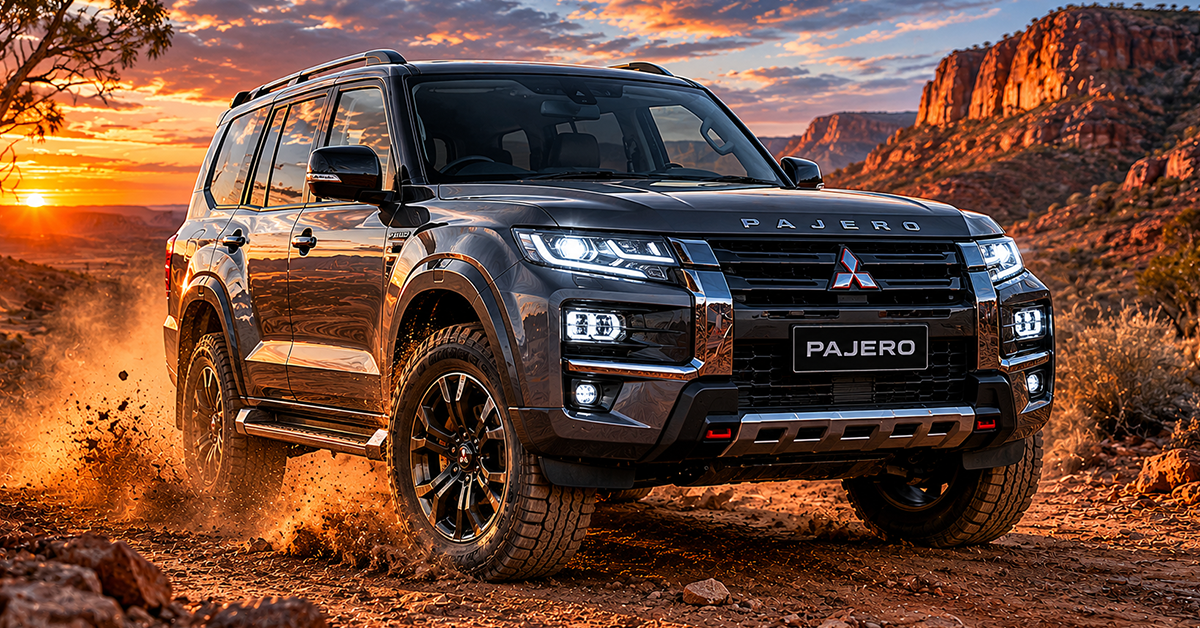
AI-generated concept illustration of the 2027 Mitsubishi Pajero — not an official Mitsubishi image. | Rev N Rise
The Mitsubishi Pajero has been absent from Australian showrooms since 2021. It disappeared quietly — the Pajero Sport axed early last year, the full-sized Pajero gone before that. Five years of silence. That silence ended on May 29 2026. Mitsubishi confirmed today that the Pajero nameplate is coming back — as a full body-on-frame SUV based on the Triton, with a reveal scheduled between September and November 2026 and Australian sales beginning before the end of the year. The icon returns.
Mitsubishi's official media release issued on May 29 2026 confirmed three things with absolute clarity. First, the new SUV will be called the Pajero — not the Pajero Sport, not a different name. The full Pajero nameplate returns for the first time since the fourth-generation model launched in 2006. Second, it will be built on the Triton ladder-frame chassis — a body-on-frame architecture that takes the new Pajero back to its original 1982 roots as a rugged off-road machine rather than a monocoque crossover. Third, it will feature model-specific development of the cabin and front and rear suspension — meaning this is not simply a Triton with a different body, but a properly engineered SUV that uses the truck's foundation and then builds its own character on top of it.
The reveal timing has been confirmed as the second half of 2026 — with the September to November window identified as the most likely period. Australian deliveries are expected before the end of 2026. Mitsubishi has also released an official teaser image of a camouflaged prototype, confirming the car exists in physical form and is ready to be shown.
The decision to go body-on-frame is the most significant engineering choice Mitsubishi has made in years — and it is a deliberate statement of intent. In an era where most SUVs — including many that call themselves off-roaders — use monocoque unibody construction, returning to a ladder frame puts the new Pajero in a different class entirely. Body-on-frame construction is stronger under torsional stress on rough terrain, easier to repair after off-road damage, more capable of handling heavy towing loads and fundamentally more suited to the kind of serious four-wheel driving the Pajero was always built for.
The previous Pajero Sport used Mitsubishi's monocoque platform. The new Pajero drops the Sport suffix and drops the monocoque architecture with it — signalling that this is a more serious, more capable product. It directly competes with the Toyota LandCruiser Prado and full-size 300 Series, the Nissan Patrol, the Land Rover Defender and the growing field of Chinese body-on-frame challengers including the GWM Tank 500. All of those cars are body-on-frame. The new Pajero belongs in that company.
The engine is expected to be carried directly from the Triton — the 2.4-litre four-cylinder twin-turbocharged diesel producing 150kW of power and 470Nm of torque. It is a proven, well-regarded unit that has been progressively refined across several generations of Triton and already powers the Mitsubishi Outlander Sport in some markets. For a large body-on-frame SUV targeting buyers who use their vehicles for genuine off-road work and long-distance touring — exactly the Pajero's traditional customer — a capable turbodiesel is the correct powertrain choice.
Mitsubishi has also confirmed that a plug-in hybrid variant is under development — with PHEV technology being worked on for the Triton pickup that would naturally flow into the Pajero when ready. The PHEV Pajero would combine the diesel engine with an electric motor for improved efficiency and added torque — particularly useful for low-speed off-road crawling where electric motors deliver peak torque instantly. No timeline for the PHEV variant has been confirmed. The diesel arrives first.
The Pajero is expected to use Mitsubishi's Super Select II four-wheel drive system — the same sophisticated setup that made the original Pajero so capable and so trusted by serious off-road drivers globally. Super Select II allows the driver to operate in two-wheel drive on sealed roads for fuel efficiency, switch to full-time four-wheel drive on loose or mixed surfaces, and select low-range four-wheel drive for serious off-road terrain — all while moving. It is one of the most flexible and capable 4WD systems available in a production vehicle and its return in the new Pajero confirms that this car is built for buyers who will actually use it off-road, not just for buyers who want the look of an off-roader.
The suspension development is also significant. Mitsubishi confirmed the Pajero will have model-specific front and rear suspension — with the rear expected to use coil springs rather than the Triton's leaf springs. Coil rear suspension transforms the on-road and off-road ride quality compared to leaf springs — giving significantly better wheel articulation off-road and a more comfortable on-road experience. It is exactly what the previous Pajero Sport was criticised for lacking.
Render images and spy shots of test vehicles confirm a design direction that is deliberately boxy and purposeful — a slab-sided silhouette with significant vertical surfaces, a large front grille with cascading LED headlights, bonnet bulges that signal the presence of a serious engine underneath and a nearly vertical rear tailgate. Character lines on the C-pillar break up the slab sides without softening the overall impression of solidity. Notably, the renders and test vehicles do not show a tailgate-mounted spare wheel — indicating that Mitsubishi is not planning to fit one, which simplifies the rear design considerably.
The overall design shares significant DNA with the Mitsubishi Destinator — a Prado-sized SUV developed for Southeast Asian and African markets — which gives it a production-ready appearance rather than a concept-influenced one. Three rows of seats are confirmed for the Australian-specification model.
Reports from Australian automotive media indicate that Mitsubishi is planning to price the new Pajero aggressively — positioning it as one of the most affordable large body-on-frame 4WDs on the Australian market. The Toyota LandCruiser Prado starts at $73,200 before on-roads. The full-size LandCruiser 300 Series starts considerably higher. The Nissan Patrol GU is priced comparably to the Prado. If Mitsubishi can undercut those figures meaningfully — early reports suggest it will — the new Pajero will attract buyers who want genuine off-road capability at a price that the LandCruiser and Patrol do not offer.
In North America and several Spanish-speaking markets, the new SUV will not be called the Pajero. Mitsubishi has confirmed it will use the Montero nameplate — the name under which the same vehicle was sold in the United States and Latin America during the original model's production run. The reason is straightforward: the word "pajero" carries a derogatory meaning in Spanish slang, making it commercially unworkable in those markets. The Montero name was retired alongside the Pajero in those regions in the early 2000s. Its return is a significant moment for North American buyers who grew up with the nameplate — and confirms that Mitsubishi is targeting the US market seriously with this vehicle, not just Australia and the Middle East.
| Name (global) | 2027 Mitsubishi Pajero |
| Name (North America) | 2027 Mitsubishi Montero |
| Confirmed today | May 29 2026 — official Mitsubishi media release |
| Platform | Triton ladder-frame — body-on-frame construction |
| Engine (expected) | 2.4L twin-turbo diesel — 150kW / 470Nm |
| 4WD system | Super Select II — full-time and part-time 4WD + low range |
| Suspension | Model-specific — coil rear expected — NOT Triton leaf springs |
| PHEV variant | Under development — no confirmed timeline |
| Rows | 3 rows — confirmed |
| Design | Boxy — slab-sided — no tailgate spare wheel |
| Design relation | Mitsubishi Destinator — Southeast Asia / Africa |
| Global reveal | September to November 2026 |
| Australia launch | Before end of 2026 |
| Last Pajero in Australia | 2021 — full-size discontinued |
| Last Pajero Sport in Aus | 2025 — axed due to AEB compliance |
| Rivals | Toyota LandCruiser Prado, Nissan Patrol, Land Rover Defender, Ford Everest |
| Est. pricing | Below Toyota LandCruiser Prado — one of cheapest large 4WDs |
| Confirmed by | Mitsubishi — official media release, May 29 2026 |
"The all-new Pajero is based on the highly robust ladder frame of the Triton pickup truck, with model-specific development of the cabin and front and rear suspension."
— Mitsubishi Motors — Official Media Release, May 29 2026Mitsubishi needed this. The brand has been without a serious halo product since the Lancer Evolution was discontinued in 2016 and the full-size Pajero left showrooms in 2021. A body-on-frame Pajero with Super Select II four-wheel drive, a twin-turbo diesel engine, coil rear suspension and aggressive pricing against the LandCruiser Prado is exactly the right product for exactly the right moment. The large 4WD segment is growing. The Pajero name carries enormous recognition and loyalty in Australia, the Middle East and globally. September to November 2026 cannot come soon enough.