 Brands
Hyundai — History, Models and Everything You Need to Know
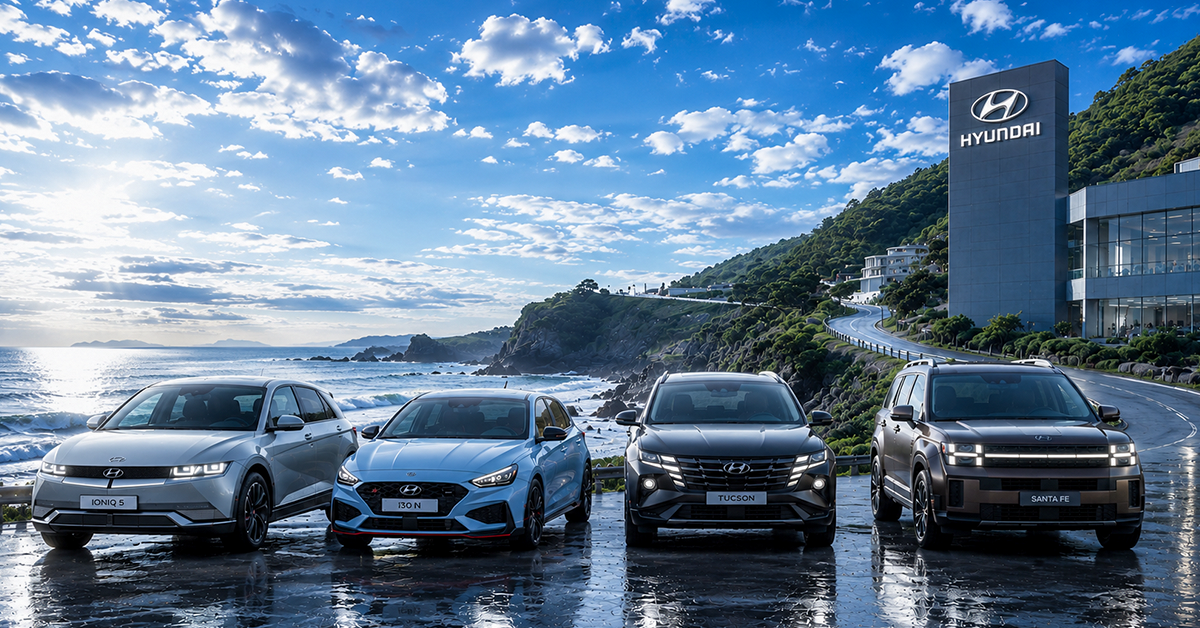
AI-generated concept illustration — Hyundai brand overview. | Rev N Rise
Hyundai is South Korea's largest automaker and one of the automotive world's most dramatic success stories. A brand once associated primarily with affordable, no-frills transportation has transformed into a design and technology leader — producing the Ioniq 5, Ioniq 6 and the N performance range to widespread critical acclaim. In less than 60 years Hyundai went from building cars under foreign licence to winning the World Car of the Year award multiple times.
Hyundai Motor Company was founded in 1967 by Chung Ju-yung — a construction magnate who had already built one of South Korea's largest industrial conglomerates. The company's first car, the Cortina, was assembled under a licensing agreement with Ford. In 1975 Hyundai launched the Pony — the first car designed entirely in South Korea, with styling by Italian designer Giorgetto Giugiaro. It was the first Korean car to be exported internationally, reaching markets in Ecuador, Benelux and Canada.
Through the 1980s and 1990s, Hyundai expanded rapidly into North America and Europe, initially competing primarily on price. The Excel was America's best-selling import in 1986 — a remarkable achievement for a brand barely a decade old. But quality problems in the early years damaged the brand's reputation, and Hyundai spent the 2000s rebuilding it — investing heavily in R&D, design and manufacturing quality. The famous America's Best Warranty programme — ten years or 100,000 miles powertrain coverage — launched in 1998 and sent a clear message: Hyundai was confident enough in its quality to back it with the longest warranty in the segment.
The results of that investment were transformative. By the 2010s Hyundai was consistently winning design and quality awards. The appointment of Peter Schreyer as Chief Design Officer for the group in 2012 — the man who had already transformed Kia's design — elevated both brands visually. The arrival of the Ioniq 5 in 2021 on the company's 800V E-GMP electric platform completed the transformation and positioned Hyundai as a genuine technology leader. The Ioniq 5 won the World Car of the Year, World Electric Vehicle of the Year and World Car Design of the Year at the 2022 awards — a clean sweep that no car had achieved before.
The Electric Global Modular Platform — E-GMP — is Hyundai's most significant engineering achievement. Launched in 2021 and shared with Kia, it introduced 800V electrical architecture to mainstream electric vehicles for the first time. The 800V system enables ultra-fast charging — up to 350kW — allowing the Ioniq 5 to add 100km of range in approximately five minutes at a compatible charger. It also enables vehicle-to-load power delivery, turning the car into a mobile power station capable of running appliances and even other electric vehicles. The platform underpins the Ioniq 5, Ioniq 6, Kia EV6, Kia EV9 and Genesis GV60 — giving the Hyundai Motor Group a technology advantage that competitors are still working to match.
Hyundai N is the brand's performance division — named after Namyang, Hyundai's R&D centre in South Korea, and the Nürburgring Nordschleife where many N models are developed and tested. Founded under the leadership of Albert Biermann — former head of BMW M — the N division has produced a string of acclaimed performance cars in a remarkably short time. The i30 N was immediately praised as one of the best hot hatches ever made. The i20 N brought rally-inspired performance to the supermini segment. And the Ioniq 5 N — launched in 2023 — proved that an electric performance car could deliver genuine driver engagement, with simulated gear shifts, N Grin Boost overboost function and a 0-100km/h time of 3.4 seconds.
Hyundai's transformation from a budget brand to a genuine premium and performance competitor is one of the most remarkable stories in modern automotive history. The E-GMP 800V platform is genuinely class-leading technology. The N performance division produces cars like the Ioniq 5 N and i30 N that outperform rivals costing significantly more. The brand's design language — led by SangYup Lee — is consistently among the most striking in the industry. And Hyundai's commitment to pushing electric technology forward — rather than retreating to hybrid hedging — positions it as one of the two or three most important electric vehicle manufacturers in the world alongside Tesla and BYD.