 Brands
BMW — History, Models and Everything You Need to Know
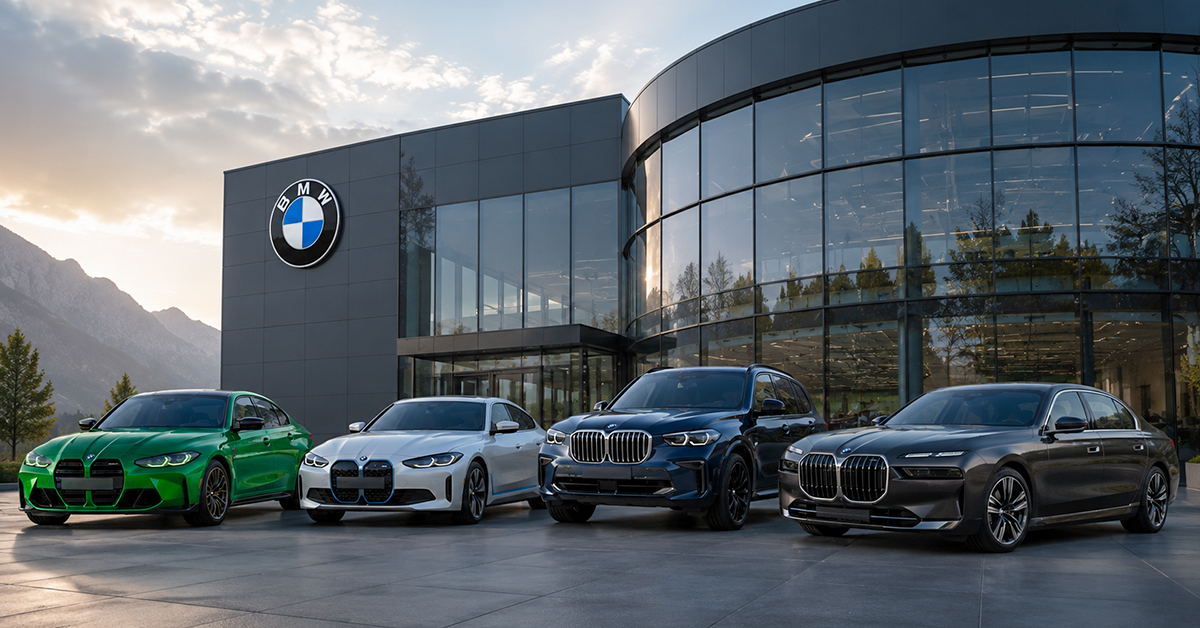
AI-generated concept illustration — BMW brand overview. | Rev N Rise
BMW is Germany's most successful premium car brand and one of the world's most profitable luxury automakers. Founded in Munich in 1916, BMW has built its reputation on a single, unwavering principle — that a car should feel alive in the driver's hands, should reward engagement and should make even ordinary journeys feel special. From the 2002 turbo to the M3 to the i4, that principle has never changed.
Bayerische Motoren Werke was founded on March 7 1916 in Munich as an aircraft engine manufacturer. The circular blue and white logo reflects the Bavarian state flag's colours — not, as popularly believed, a spinning propeller, though the propeller association has served BMW's aviation heritage story well for over a century. After World War I, the Treaty of Versailles prohibited Germany from producing aircraft engines, forcing BMW to pivot to motorcycle production. The R32 motorcycle of 1923 — with its horizontally opposed twin-cylinder engine — established the boxer engine configuration that BMW motorcycles still use today.
BMW entered car production in 1928 by acquiring the Dixi company — which produced a licensed version of the Austin Seven. Through the 1930s BMW produced some of the most beautiful sports cars in Europe — the 328 roadster of 1936 is considered by many to be among the most elegant pre-war cars ever built. Post-World War II reconstruction was painfully slow — the company briefly produced the Isetta bubble car to survive financially — but the New Class 1500 of 1962 established the modern BMW formula: a compact, rear-wheel-drive saloon with a high-revving engine and precise handling.
The 2002 of 1968 crystallised what BMW stood for. Small, light, rear-drive, with a turbocharged engine option from 1973 that made it the world's first turbocharged production saloon — it was genuinely thrilling to drive in a way that German saloons had never been before. The BMW M division was established in 1972 and the M1 supercar of 1978 established M's credentials. The E30 M3 of 1986 became the definitive driver's car of its generation, winning the European Touring Car Championship four consecutive times. The 3 Series has been the benchmark premium compact saloon for five decades.
BMW M GmbH — originally BMW Motorsport GmbH — was established in 1972 to manage BMW's motorsport activities and develop high-performance road cars. The M division's philosophy has never changed: take a standard BMW, give it more power, sharpen its chassis, add wider bodywork to accommodate larger wheels and brakes, and create a car that can be driven to a race circuit, lapped enthusiastically and driven home again in comfort.
The E30 M3 won 1,500 races worldwide and redefined what a production saloon could achieve on track. The E46 M3 — with its naturally aspirated 3.2-litre inline-six producing 343 horsepower — is still considered by many the finest M3 ever made. The F80 M3 introduced turbocharged power and AWD options for the first time. The current G80 M3 produces up to 530 horsepower in Competition xDrive form. And the upcoming fully electric ZA0 M3 — due in 2027 with up to 900 horsepower from four electric motors — will be the most powerful M3 ever built. The first fully electric M car in BMW's history arrives in an era when the brand must prove that electrification can preserve, not destroy, the driving engagement that defines M.
BMW's Neue Klasse — New Class — is the most important BMW development programme since the original New Class of 1962 that established the modern brand. The new platform, launching from 2026, is designed entirely around electric powertrains — with a new generation of cylindrical battery cells, a new electrical architecture and a new driver interface that debuts on the next-generation iX3 and i3 saloon. The Neue Klasse will underpin every BMW from 2026 onwards and represents a fundamental reinvention of how BMW designs and builds cars. The critical question — whether it can preserve the driver engagement that has defined BMW for 60 years — will be answered progressively as the platform rolls out across the range. Early indications from BMW M's development of the ZA0 M3 suggest the answer is a cautious yes.
BMW's commitment to driver engagement — even as the industry moves toward autonomy and electrification — is its defining characteristic. The 3 Series has been the benchmark compact premium saloon for 50 years not because it is the most comfortable or the most spacious but because it is the most rewarding to drive. The M division produces cars that prioritise driver involvement above all else — the M3 CS Handschalter, offered with a manual gearbox in an era when nearly every competitor has abandoned the third pedal, is the clearest possible statement of values. And BMW's ownership of MINI and Rolls-Royce gives the group a range that spans from a £25,000 city car to a £500,000 ultra-luxury saloon — with a driver's car at the heart of every brand decision.