 Brands
Volvo — History, Models and Everything You Need to Know
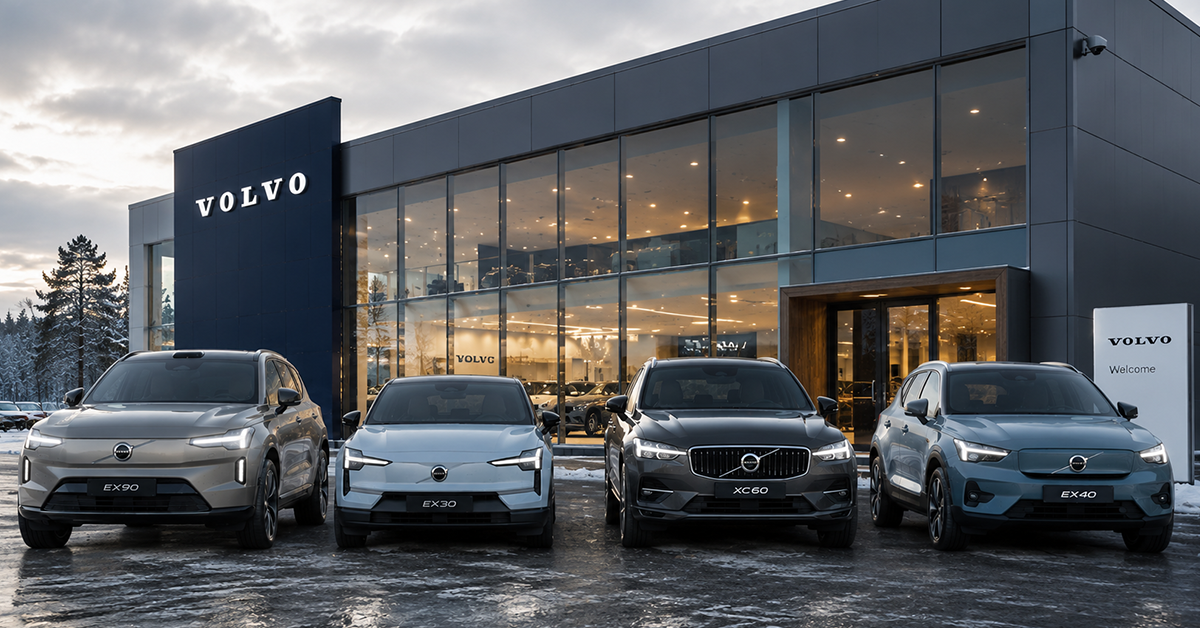
AI-generated concept illustration — Volvo brand overview. | Rev N Rise
Volvo is the world's most trusted name in automotive safety — the Swedish brand that invented the three-point seatbelt, gave that invention freely to the world and has spent nearly 100 years making cars that protect their occupants better than any competitor. Today Volvo is also one of the most committed brands to full electrification — with the EX30, EX40, EX60 and EX90 forming an expanding electric lineup built on Scandinavian design values and a genuine commitment to sustainability.
Assar Gabrielsson and Gustaf Larson founded Volvo on April 14 1927 in Gothenburg, Sweden. The name Volvo — derived from the Latin volvere, meaning to roll — was originally a subsidiary brand name used by the SKF ball bearing company. Gabrielsson and Larson licensed the name and brand from SKF to launch their car company. The first Volvo car, the ÖV 4 — nicknamed "Jakob" — rolled off the production line on April 14 1927 in temperatures of minus 15 degrees Celsius. Volvo built its cars to survive Swedish winters from the very first day.
Volvo's defining commitment to safety was established early and has never wavered. The company hired engineer Nils Bohlin in 1958 specifically to develop a better restraint system than the two-point lap belts available at the time. Bohlin's solution — the three-point seatbelt, which loops diagonally across the chest and lap simultaneously — was introduced on Volvo cars on August 13 1959. It is estimated to have saved over one million lives since its introduction. In a decision of extraordinary generosity, Volvo made the three-point belt patent freely available to every other car manufacturer — reasoning that the safety benefit of universal adoption outweighed any commercial advantage from exclusivity. Every seatbelt in every car in the world today uses Bohlin's design.
Volvo was acquired by Ford Motor Company in 1999 for $6.45 billion — Ford's most expensive acquisition. Ford invested heavily in Volvo's platform development and quality improvement. In 2010, following the global financial crisis, Ford sold Volvo Cars to Geely Holding of China for $1.8 billion — one of the most significant Chinese automotive acquisitions of the era. Under Geely, Volvo has flourished — launching its most acclaimed product range ever and committing firmly to full electrification by 2030.
The story of the three-point seatbelt is one of the most remarkable acts of corporate generosity in industrial history. When Nils Bohlin developed the diagonal shoulder-and-lap belt in 1958 and 1959, Volvo held a patent that could have been commercially exploited — licensing it to competitors for significant ongoing royalties. Instead, Volvo's management decided that the technology was too important to restrict. They opened the patent to the entire automotive industry without charge.
The consequences were world-changing. Within a decade, three-point belts were standard on cars globally. Studies estimate the belt saves approximately 15,000 lives per year in the United States alone. Globally, the cumulative total since 1959 is estimated to exceed one million lives. The German Patent Office named the three-point belt one of the eight most important patents of the 20th century. Bohlin's invention is arguably the most significant safety device in the history of transportation. And Volvo gave it away.
Volvo's safety-first culture is not a marketing position — it is a genuine engineering philosophy that has produced more life-saving innovations than any other car manufacturer. The three-point belt is the most dramatic example but not the only one: Volvo also pioneered crumple zones, side impact protection systems, whiplash protection seats and rear-facing child seats. Every Volvo is designed around the principle that no one should be killed or seriously injured in a new Volvo car — an ambitious target that drives real engineering decisions rather than simply headline-grabbing safety ratings.
Volvo's Scandinavian design aesthetic — clean, uncluttered, beautifully resolved and free of unnecessary ornamentation — gives its cars a calm, confident presence that matches the brand's safety-first values visually. And Volvo's commitment to full electrification by 2030 — confirmed by CEO Jim Rowan as a firm target rather than an aspiration — makes it one of the most decisive mainstream manufacturers in the transition away from combustion engines.