 Brands
Dacia — History, Models and Everything You Need to Know
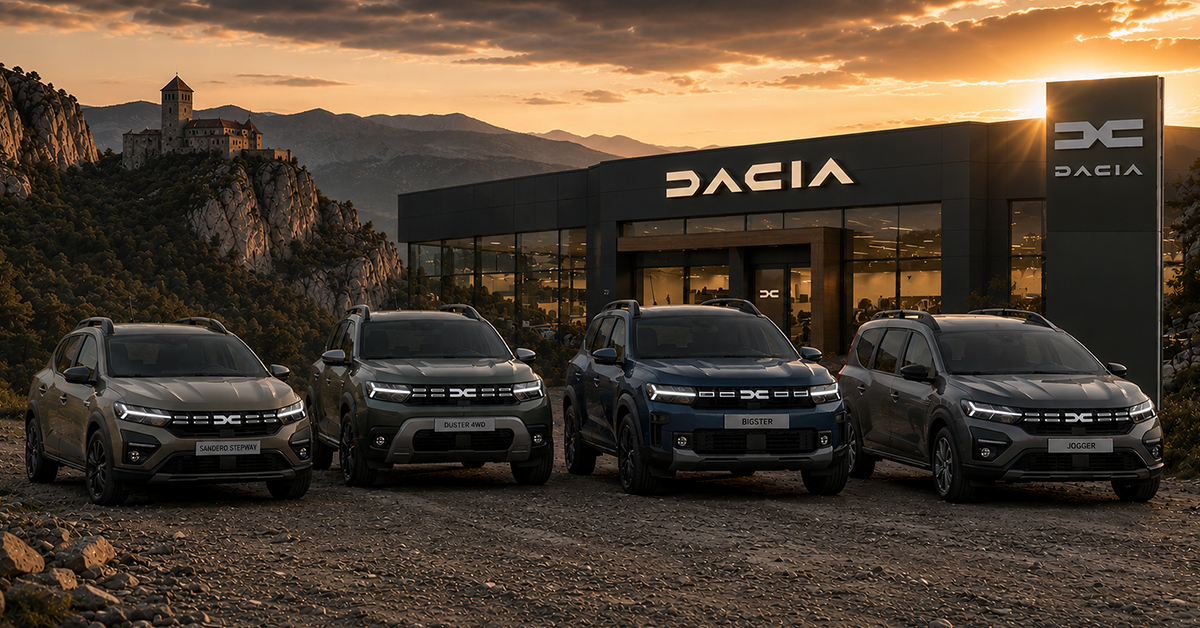
AI-generated concept illustration — Dacia brand overview. | Rev N Rise
Dacia is Europe's most disruptive car brand — a Romanian manufacturer owned by Renault that has spent 25 years proving that new cars do not have to be expensive to be good. The Sandero is consistently Europe's best-selling car by private buyers. The Duster is the best value SUV on the market. And the Bigster — launched in 2025 — threatens to do to the mid-size SUV segment what the Duster did to the compact SUV segment a decade ago.
Dacia was established in 1966 in Mioveni, Romania as a state-owned automobile manufacturer under the communist government of Nicolae Ceaușescu. The company's first car — the Dacia 1100 — was built under licence from Renault, based on the Renault 8. The relationship with Renault continued through several models including the iconic Dacia 1300 — based on the Renault 12 — which became Romania's most important car for over two decades, remaining in production from 1969 to 2004 in various forms.
After the fall of Romanian communism in 1989, Dacia struggled to compete in a newly open market. The brand's outdated models and ageing manufacturing facilities made it uncompetitive. Renault acquired Dacia in 1999 for approximately €50 million — one of the cheapest significant automotive acquisitions ever. Renault's strategy was clear: use Dacia's low-cost Romanian manufacturing base and the Logan platform it was developing to produce genuinely affordable, modern cars for emerging markets globally.
The Dacia Logan launched in 2004 at a price of €5,000 in Romania — a modern, safe, well-equipped saloon at a price no other manufacturer could approach. It was an immediate success not just in Romania but across Eastern Europe, the Middle East, North Africa and eventually Western Europe — where budget-conscious buyers recognised the extraordinary value it offered. The Sandero followed in 2008 as a hatchback variant. The Duster arrived in 2010 and changed Dacia's story permanently — an affordable compact SUV with optional 4WD that undercut every European competitor by thousands of pounds and delivered genuine capability for buyers who actually needed it.
The Dacia Sandero has been the best-selling new car to private buyers in Europe for multiple consecutive years — an extraordinary achievement for a brand that was barely known outside Romania 20 years ago. The third-generation Sandero, launched in 2021 and updated in 2024, is available from under £15,000 in the UK and equivalent prices across Europe. At that price it offers modern safety features including autonomous emergency braking, lane keep assist and a touchscreen infotainment system — equipment that competitors charge thousands more to provide. The Sandero Stepway variant adds a raised ride height and rugged styling. The Sandero ECO-G runs on LPG — offering dramatically lower running costs in markets where LPG infrastructure exists.
Dacia's philosophy is ruthless simplicity — identify what buyers actually need, remove everything they do not and price the result as low as possible. The brand's "Essential" trim strategy strips unnecessary features to deliver the lowest possible entry price while the upper trims add genuine value rather than expensive luxury. The Duster's success proved that a significant proportion of SUV buyers want capability and space at a fair price — not premium branding, expensive technology or elaborate styling. The Bigster's launch in 2025 tests whether that formula scales upward into the larger SUV segment. Early reception suggests it does — the Bigster's combination of full hybrid efficiency, genuine interior space and a price point significantly below rivals has generated waiting lists across multiple European markets. Dacia is no longer a punchline. It is the most interesting value story in the European car market.