 Brands
Citroën — History, Models and Everything You Need to Know
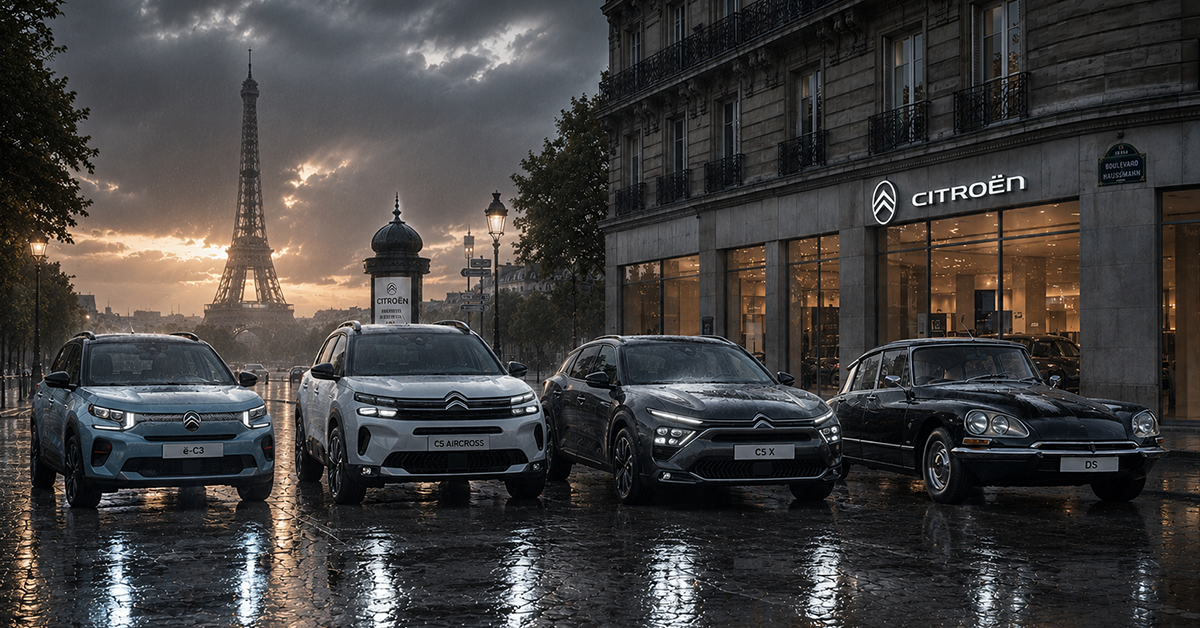
AI-generated concept illustration — Citroën brand overview. | Rev N Rise
Citroën is the most technically adventurous car manufacturer in history — the French brand that gave the world hydropneumatic suspension, the DS, the 2CV and some of the most radical automotive engineering ever attempted. No mainstream manufacturer has taken more creative risks or produced more genuinely extraordinary cars than Citroën at its peak. Today Citroën is refocusing on accessible, comfortable and affordable motoring — but the DNA of radical thinking runs through everything it builds.
André Citroën founded his car company on June 4 1919 in Paris — and immediately did something no European manufacturer had done before. He introduced moving assembly line production to Europe, having studied Henry Ford's methods in America. The first Citroën car — the Type A — was the first European car to be mass-produced using assembly line techniques. André Citroën was as much a marketing genius as an engineer — he illuminated the Eiffel Tower with the Citroën name in lights from 1925 to 1936, making it the world's largest advertising sign.
Citroën's history of radical engineering began immediately. The Traction Avant of 1934 was the world's first mass-produced front-wheel-drive car with a unibody construction — a decade ahead of any competitor. The 2CV — Deux Chevaux — launched in 1948 as the most minimalist practical car ever conceived: a canvas roof, corrugated steel body and a 375cc twin-cylinder engine producing 9 horsepower. It was designed to put rural France on wheels at the lowest possible cost. Over 3.8 million were built before production ended in 1990.
The Citroën DS of 1955 is the most technically extraordinary production car of the 20th century. Its hydropneumatic suspension — using hydraulic fluid and nitrogen spheres instead of conventional springs — delivered a ride quality so supple that no car has fully equalled it since. The DS also featured power-assisted brakes and steering, a semi-automatic gearbox and — from 1967 — swivelling headlights that turned with the steering. When it was unveiled at the 1955 Paris Motor Show, 12,000 orders were placed in the first 15 minutes. The name DS sounds like the French word "déesse" — goddess. The car earned it.
Citroën merged with Peugeot in 1976 to form PSA Group following financial difficulties. PSA later acquired Opel and Vauxhall before merging with Fiat Chrysler in 2021 to form Stellantis.
The Citroën DS deserves its own chapter in any automotive history. When it launched in 1955 it was not merely ahead of its time — it was ahead of time itself. The hydropneumatic suspension adjusted automatically to road conditions, maintained a constant ride height regardless of load and could raise the car to facilitate wheel changes. The braking system used a single touch-sensitive disc rather than a conventional pedal — so sensitive that new DS owners were advised to use only the ball of their foot. The steering was power-assisted at a time when power steering was a luxury feature on American cars twice its size.
The DS remained in production for 20 years — from 1955 to 1975 — and was continuously developed throughout. The SM of 1970 paired the hydropneumatic system with a Maserati V6 engine for a grand touring car of extraordinary capability. The DS's influence on automotive engineering — its approach to ride comfort, its hydraulic systems, its aerodynamic body — rippled through the industry for decades. The DS Automobiles brand — Citroën's luxury sub-brand launched in 2015 — takes its name directly from this legacy.
Citroën's brand identity is built on two pillars — comfort and creativity. The brand's current Advanced Comfort programme — which brings progressive hydraulic cushions to suspension systems across the lineup — is a direct descendant of the hydropneumatic philosophy the DS established in 1955. No mainstream manufacturer prioritises ride comfort as deliberately as Citroën. The new C3 and ë-C3 — built on the Stellantis Smart Car platform — represent Citroën's most important product of the current decade: an affordable, accessible city car and electric car that brings genuine Citroën character to the most price-sensitive buyers in the market. If the ë-C3 achieves the same cultural significance as the 2CV did in 1948 — putting ordinary French and European families into electric cars for the first time — it will be the most important Citroën since the DS itself.