 Brands
SEAT — History, Models and Everything You Need to Know
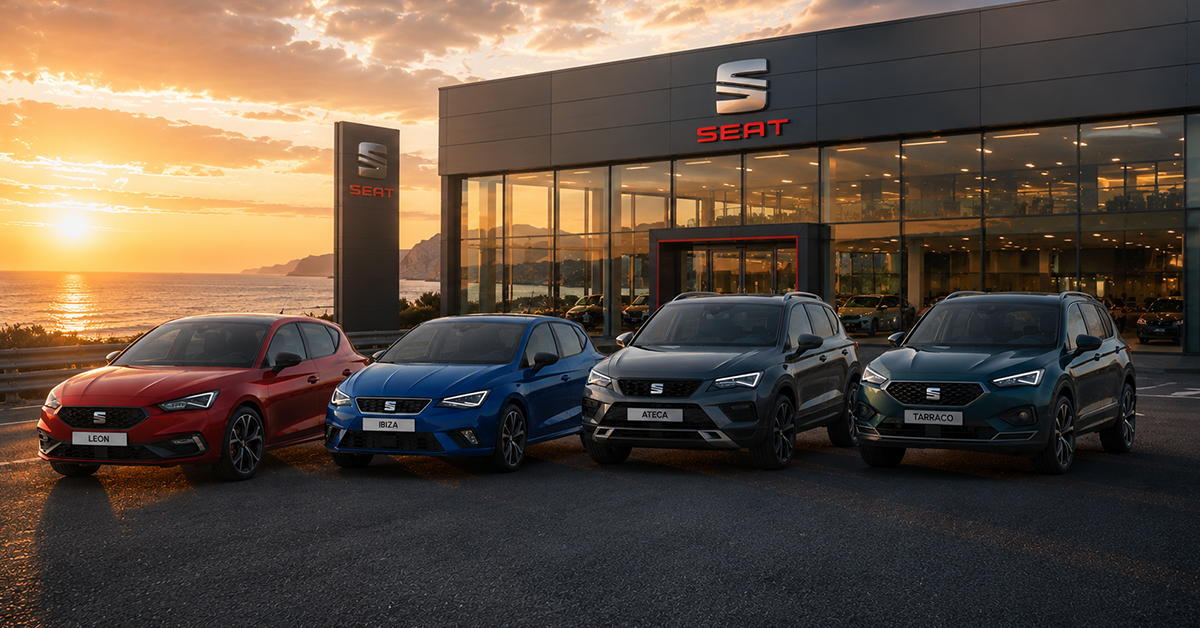
AI-generated concept illustration — SEAT brand overview. | Rev N Rise
SEAT is Spain's only mass-market car manufacturer and one of the most important automotive brands in Southern Europe. Founded in Barcelona in 1950, SEAT has grown from a Fiat licence producer into a globally sold VW Group brand with a distinctly Mediterranean character — cars that combine sharp styling, sporty dynamics and strong value in a way that reflects the culture of the country that built them. SEAT is also the parent of Cupra, one of the most exciting new performance brands of the current decade.
SEAT — Sociedad Española de Automóviles de Turismo — was founded on May 9 1950 in Barcelona under the direction of the Spanish government's Instituto Nacional de Industria. The founding partnership with Fiat gave SEAT access to Italian engineering and designs — the first SEAT car, the SEAT 1400, was a direct licence-built version of the Fiat 1400. Through the 1950s and 1960s, SEAT models were essentially Spanish-built Fiats — the SEAT 600 of 1957 was based on the Fiat 600 and became the car that motorised Spain in the postwar economic recovery, just as the Fiat 500 had done in Italy.
SEAT gradually developed its own engineering identity through the 1970s, and the relationship with Fiat ended in 1981. The brand struggled briefly as an independent manufacturer before Volkswagen acquired it in 1986 — giving SEAT access to VW Group platforms, engineering and manufacturing expertise. Under VW, SEAT developed its Spanish character more explicitly — designing cars with Mediterranean flair that complemented the more conservative German aesthetic of Volkswagen and Skoda.
The SEAT Ibiza — launched in 1984 — became the brand's most successful model globally. The SEAT Leon arrived in 1999 as a Golf-based compact hatchback with sharper styling and a more driver-focused character. The SEAT Cupra performance variants — hotter versions of the Ibiza, Leon and Ateca — became so popular and so distinct that SEAT spun them off as a standalone premium performance brand in 2018.
The separation of Cupra from SEAT in 2018 was one of the most strategically significant decisions in the VW Group's recent history. Rather than simply badging performance variants of SEAT models, VW Group created Cupra as a standalone premium performance brand with its own design language, its own dealerships and its own product strategy. The decision freed SEAT to focus on its core mainstream audience — practical, stylish, value-conscious buyers — while Cupra addressed the growing appetite for premium performance at accessible prices.
SEAT and Cupra share platforms, manufacturing and much of their engineering at the Martorell factory near Barcelona. But their products are meaningfully differentiated — the Cupra Formentor, Leon and Born offer genuinely distinct styling, performance calibration and interior specification rather than simply carrying different badges. The strategy has been commercially successful: Cupra has become one of the fastest-growing automotive brands in Europe and has significantly raised the profile of the entire SEAT Group.
SEAT's brand identity is built on Mediterranean character — cars with more visual drama, more sporting intent and more youthful energy than the equivalent VW or Skoda models they share platforms with. The Ibiza has been one of Europe's most stylish small cars for four decades. The Leon consistently wins comparisons against the Golf for driver appeal. And SEAT's Spanish manufacturing — all passenger cars are built at the Martorell plant near Barcelona, one of the most productive automotive factories in Europe — gives the brand a genuine industrial heritage that resonates with buyers across Southern Europe. The brand's future focus is shifting toward supporting Cupra's growth while maintaining its core lineup for buyers who want VW Group quality and technology with Spanish personality at accessible prices.