 Brands
Jaguar — History, Models and Everything You Need to Know
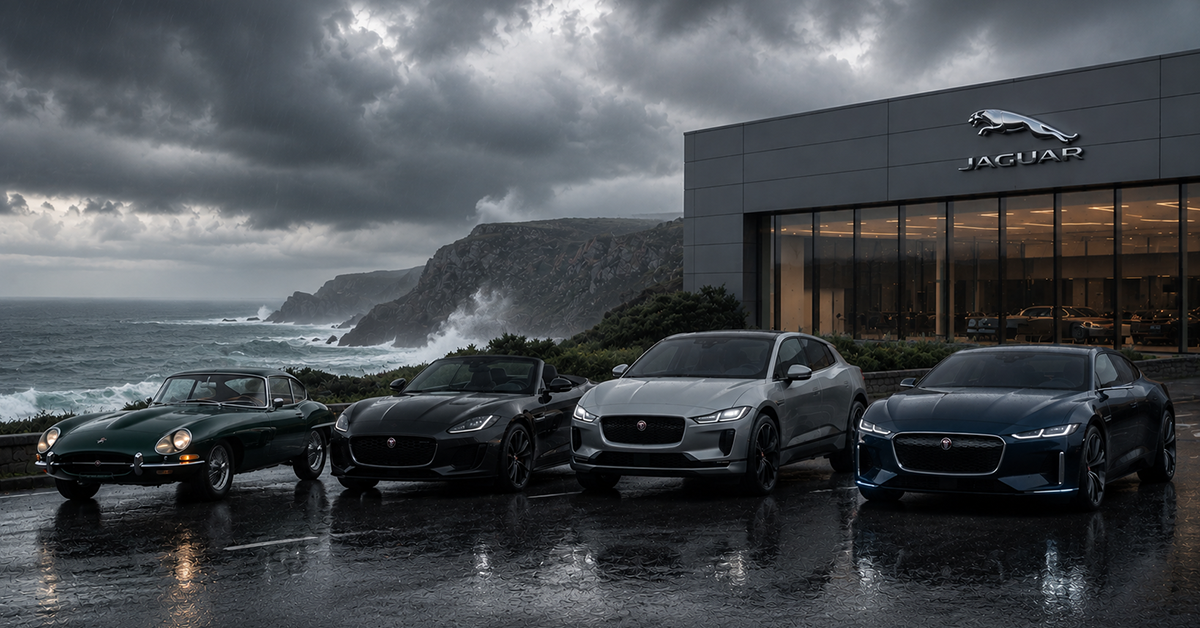
AI-generated concept illustration — Jaguar brand overview. | Rev N Rise
Jaguar is one of the most storied names in automotive history — a British brand that gave the world the E-Type, won Le Mans seven times and built some of the most beautiful cars ever made. Now undergoing the most radical transformation in its 100-year history, Jaguar is relaunching as a fully electric ultra-luxury brand — abandoning its entire existing lineup and emerging as something entirely new, with prices starting above £100,000.
William Lyons and William Walmsley founded the Swallow Sidecar Company in Blackpool in 1922 — producing motorcycle sidecars before moving into coachbuilt car bodies in the late 1920s. The company became SS Cars Limited in 1934. The SS Jaguar 100 of 1935 — a beautiful open two-seater sports car that combined striking looks with genuine performance at a price that undercut European rivals — established the formula that Jaguar would follow for the next 80 years: exceptional style and performance at prices that seemed almost impossibly good value.
The SS name was quietly dropped after World War II due to its uncomfortable associations, and the company was renamed Jaguar Cars Limited in 1945. The XK120 of 1948 — with a twin-cam inline-six engine and a claimed top speed of 120mph — was the fastest production car in the world at launch and one of the most beautiful. The C-Type won Le Mans in 1951 and 1953. The D-Type won in 1955, 1956 and 1957. Jaguar had become one of the most successful racing car manufacturers in the world.
The E-Type of 1961 is widely considered the most beautiful production car ever made. Enzo Ferrari — not a man given to complimenting competitors — reportedly called it the most beautiful car in the world when he saw it at Geneva. With a top speed of 150mph and 0-60 in under 7 seconds at a price of £2,097 — less than half the cost of a Ferrari — it was as revolutionary in value as it was in beauty. Over 72,000 were produced between 1961 and 1975.
Jaguar passed through British Leyland, then independence, then Ford's ownership before being sold to Tata Motors alongside Land Rover in 2008. Under Tata, Jaguar launched the F-Type sports car, the XE saloon and the I-PACE — the world's first premium electric SUV, which won the World Car of the Year award in 2019. In late 2024 Jaguar announced the most dramatic rebrand in automotive history — discontinuing its entire existing lineup and relaunching as a fully electric ultra-luxury brand targeting Bentley and Ferrari rather than BMW and Mercedes.
The Jaguar E-Type deserves its own chapter in automotive history. Designed by Malcolm Sayer — an aerodynamicist who applied aircraft design principles to car bodies — the E-Type's curvaceous long bonnet, tapered tail and minimal chrome detailing created a visual harmony that has never been equalled in a mass-production car. The Series 1 E-Type of 1961 is regularly voted the most beautiful car ever made in polls of automotive designers, engineers and enthusiasts. The Museum of Modern Art in New York acquired an E-Type for its permanent collection in 1996 — one of only three cars ever designated an object of permanent artistic significance by MoMA. The other two are a Cisitalia 202 and a Willys Jeep.
In November 2024 Jaguar unveiled its new brand identity — and nothing prepared the automotive world for what it saw. The new Jaguar visual identity, revealed at Miami Art Week, featured no cars. No engines. No reference to the brand's racing heritage or its British identity. Instead it presented a series of abstract art images and a new brand philosophy: Copy Nothing. The response from the automotive press and public was polarised — some dismissed it as marketing that had lost its way, others recognised it as the most decisive act of brand repositioning in automotive history.
The first new electric Jaguar — a four-door GT grand tourer — was revealed as a concept in December 2024. With a starting price expected above £100,000, Jaguar is positioning itself above its previous price point and targeting the ultra-luxury segment occupied by Bentley, Aston Martin and high-specification Porsche. The production GT arrives in 2025. Whether the relaunch succeeds will depend entirely on whether the cars justify the ambition. Jaguar's history of producing extraordinary vehicles suggests the potential is real. The execution will determine everything.
Jaguar's defining quality has always been its ability to produce cars of exceptional beauty and performance at prices that undercut European rivals — the E-Type cheaper than a Ferrari, the XJ more refined than an equivalent Mercedes, the F-Type more dramatic than a Porsche 911 at a lower price. The relaunch changes that positioning fundamentally — the new Jaguar will not be cheaper than its European rivals. It will aim to be better. Whether a brand that spent most of its history competing on value can reinvent itself as an ultra-luxury manufacturer is the defining question of Jaguar's next chapter. The answer will determine whether one of automotive history's greatest names survives the electric revolution or becomes a casualty of it.