 Brands
Porsche — History, Models and Everything You Need to Know
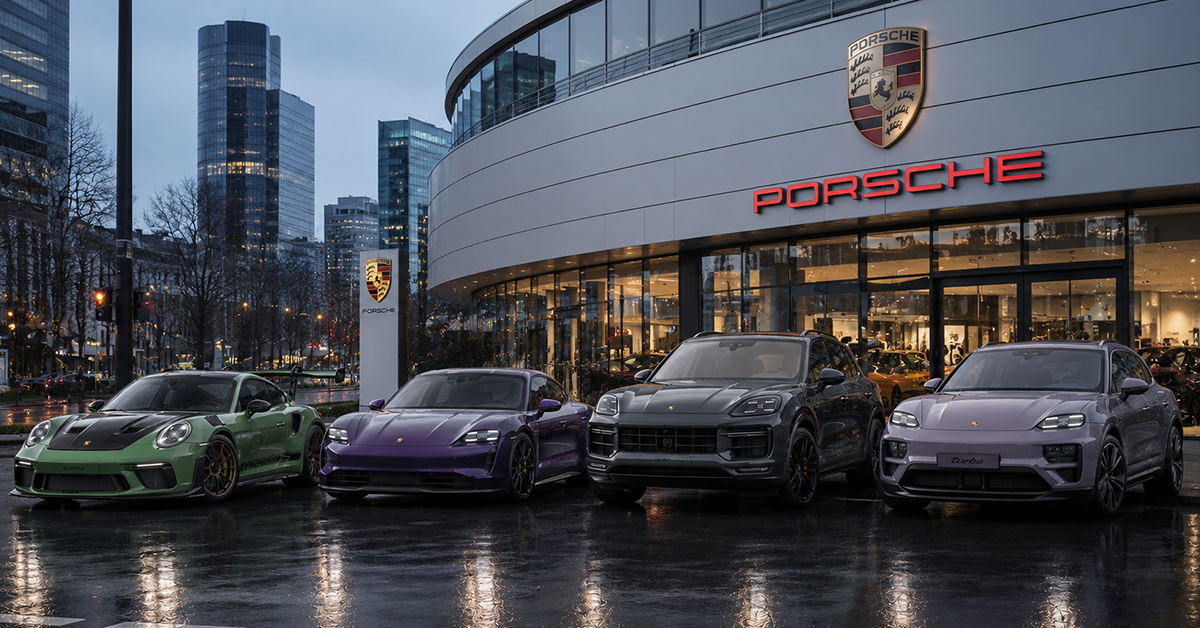
AI-generated concept illustration — Porsche brand overview. | Rev N Rise
Porsche is the most successful motorsport manufacturer in history and one of the world's most profitable luxury car brands. Founded in Stuttgart in 1931, Porsche has spent nearly a century proving that engineering excellence and driving passion are the same thing — from the 356 to the 911 to the Taycan. With 20 Le Mans victories, a Nürburgring lap record and the world's most capable electric sports car, Porsche has never stopped being the benchmark.
Ferdinand Porsche founded his design consultancy — Dr. Ing. h.c. F. Porsche GmbH — on April 25 1931 in Stuttgart. Ferdinand was already one of the most accomplished automotive engineers in Europe, having designed the Mercedes-Benz SSK and the Volkswagen Beetle before establishing his own company. The first product to bear the Porsche name as a car — the 356 — was produced in a small workshop in Gmünd, Austria in 1948, built by Ferdinand's son Ferry Porsche using Volkswagen components. It was a lightweight, rear-engined sports car of exceptional handling ability and it sold immediately to enthusiastic buyers across Europe and America.
The 911 arrived in 1963 — designed by Ferdinand Porsche's grandson Butzi Porsche — and became the most successful sports car in motorsport history. The 911's rear-engine layout, which every engineering textbook said was fundamentally wrong, turned out to be fundamentally right when driven with skill and commitment. The combination of rear-engine traction, perfect steering feel and a flat-six engine note that remains one of the most distinctive sounds in all of motoring has kept the 911 in continuous production for over 60 years. No other sports car has been continuously developed and sold for as long.
Porsche won Le Mans for the first time in 1970 with the 917 — a car so powerful that it terrified its own drivers. The 956 and 962 dominated Le Mans through the 1980s, winning six consecutive overall victories from 1982 to 1987. Porsche has won Le Mans 20 times in total — more than any other manufacturer. The brand returned to top-level prototype racing in 2023 with the 963 LMDh and won the World Endurance Championship Manufacturers' title in 2024.
The Porsche 911 is the most continuously developed and refined sports car in automotive history. Every generation has retained the core characteristics established in 1963 — rear-engine flat-six, rear-wheel drive in base form, that silhouette — while dramatically improving performance, safety and daily usability. The current 992 generation, launched in 2019 and updated in 2024, produces up to 650 horsepower in Turbo S form, accelerates to 100km/h in 2.7 seconds, has a top speed of 330km/h and can lap the Nürburgring in under 7 minutes — all while being comfortable enough to drive daily and practical enough for a weekend away with luggage in the front boot.
The 911 GT3 RS — with its massive rear wing, naturally aspirated 4.0-litre flat-six revving to 9,000rpm and motorsport-derived aerodynamics — holds the production car lap record at the Nürburgring Nordschleife. It is considered by many automotive engineers and journalists to be the greatest driver's car available at any price. The GT3 RS costs approximately £230,000. A Bugatti Chiron costs €3 million and is slower around the Nürburgring.
The Porsche Taycan, launched in 2019, was the most significant new car Porsche had launched since the 911 itself. It was the first production car to use an 800V electrical architecture — enabling charging speeds of up to 270kW and dramatically reducing charge times compared to 400V systems. It proved that an electric car could deliver a driving experience worthy of the Porsche name — precise, communicative, driver-focused and genuinely fast. The Taycan Turbo GT, launched in 2024, produces 1,093 horsepower using an overboost function and accelerates to 100km/h in 2.2 seconds — making it the fastest accelerating Porsche ever produced.
Porsche's defining characteristic is the seamless connection between its motorsport engineering and its road cars. The PDK dual-clutch gearbox came from racing. The rear-axle steering on the 911 came from racing. The 800V architecture in the Taycan — now used by Hyundai, Kia, Audi and others — came from Porsche's engineering ambition applied to production cars. Porsche is the only manufacturer in the world that consistently wins at Le Mans and simultaneously sells SUVs that top customer satisfaction surveys. The Cayenne funds the 911 GT3 RS. The Macan funds the Taycan. The commercial success of the SUVs and saloons enables the engineering excellence of the sports cars. That virtuous cycle has made Porsche the most profitable luxury car manufacturer per vehicle in the world — and the most desirable brand in automotive history by most measures of desire research.