 Brands
Lamborghini — History, Models and Everything You Need to Know
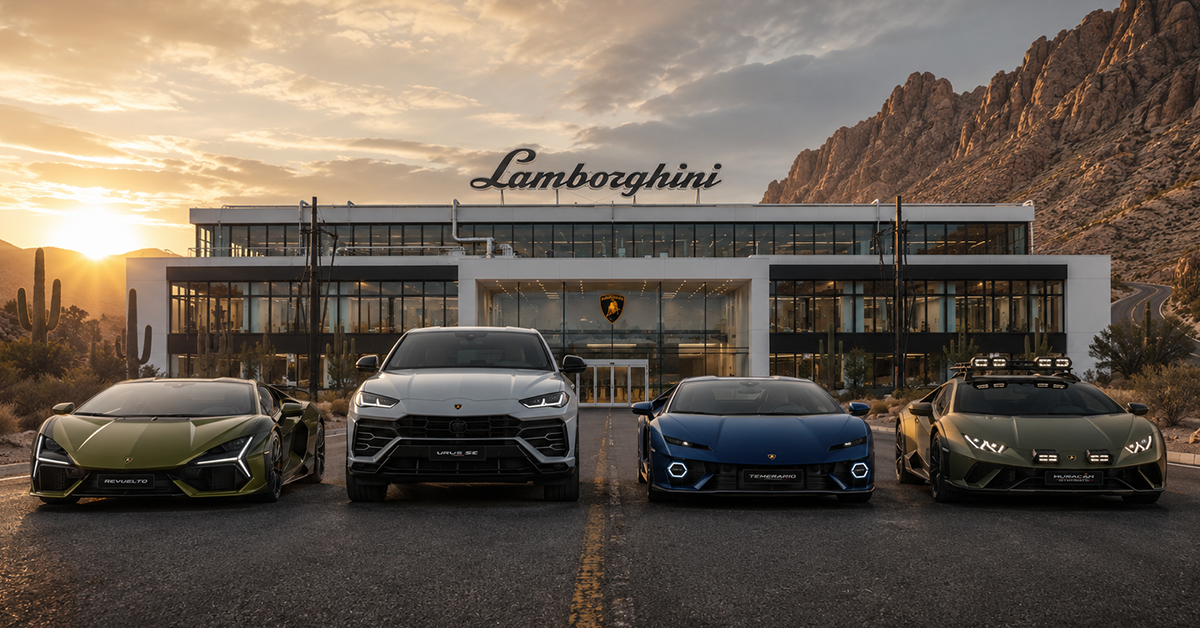
AI-generated concept illustration — Lamborghini brand overview. | Rev N Rise
Lamborghini is the world's most theatrical supercar brand — the Italian manufacturer born from a tractor maker's argument with Enzo Ferrari that has spent 60 years building the most dramatic, most visually outrageous and most viscerally exciting supercars money can buy. From the Miura — the world's first supercar — to the Countach, the Diablo, the Murciélago, the Aventador and now the 1,001-horsepower hybrid Revuelto, Lamborghini has never built a car that anyone could ignore.
Ferruccio Lamborghini was a highly successful manufacturer of agricultural tractors — his company Lamborghini Trattori was one of Italy's leading tractor producers — when he bought a Ferrari 250 GT in the early 1960s. Dissatisfied with the clutch, Ferruccio approached Enzo Ferrari directly with his complaint. According to the story — disputed in some details but essentially true in spirit — Enzo dismissed him: a tractor maker had no business telling him how to build a sports car. Ferruccio's response was to build a better one himself. Automobili Lamborghini was founded on May 7 1963 in Sant'Agata Bolognese, just 28 kilometres from Maranello.
The first Lamborghini — the 350 GT of 1964 — was a refined, elegant grand tourer that demonstrated serious engineering quality. But it was the Miura of 1966 that made the world pay attention. Designed by Marcello Gandini at Bertone with a transverse mid-mounted V12, the Miura was the first true supercar — a word that barely existed before it arrived. Its 170mph top speed, its impossibly beautiful body and its innovative engineering established Lamborghini as Ferrari's most credible rival in a single product launch.
The Countach of 1974 — also designed by Gandini — redefined what a supercar could look like with its angular wedge shape, scissor doors and dramatic rear wing. It remained in production until 1990 and became the definitive poster car of a generation. The Diablo, Murciélago and Aventador continued the V12 flagship tradition through changing ownerships — Chrysler, then the Malaysian Mycom Setdco group, then Audi AG in 1998, which gave Lamborghini the engineering resources and financial stability it had always lacked. Under Audi and VW Group ownership, Lamborghini's quality and reliability transformed completely while its visual drama remained entirely intact.
The Lamborghini Countach is arguably the most important automotive design of the 20th century in terms of cultural impact. Unveiled in 1971 as the LP 500 concept and entering production in 1974, the Countach's extreme wedge proportions, scissor doors and aggressive stance defined what a supercar looked like for two decades. It was on the bedroom walls of an entire generation — the car that made children decide they wanted to be engineers or designers or racing drivers. The name Countach is Piedmontese dialect, reportedly the exclamation of a Bertone employee when he first saw the car: roughly translating as an expression of astonishment. The reaction was appropriate. Nothing had looked like it before and very little has looked as dramatic since.
Lamborghini's defining characteristic is theatre — the brand builds cars that are engineered to create an experience, not just to achieve performance numbers. The Aventador's naturally aspirated V12 revving to 8,500rpm produced a sound that no turbocharged or hybrid engine has yet replicated. The Urus SUV — dismissed by purists when announced in 2017 — became Lamborghini's best-selling model immediately and funded the engineering investment that created the Revuelto. The Huracán Sterrato — a supercar with off-road suspension and all-terrain tyres — proved that Lamborghini's engineers retain the creative audacity of Ferruccio's original challenge to Ferrari. The Temerario's new twin-turbo V8 hybrid replaces the naturally aspirated V10 that defined the Huracán — and the question of whether a turbocharged Lamborghini can deliver the same raw emotional engagement as a naturally aspirated one is the most interesting question in the supercar world right now.