 Brands
Lotus — History, Models and Everything You Need to Know
AI-generated concept illustration — Lotus brand overview. | Rev N Rise
Lotus is the British engineering brand built on a single, transformative idea — that lightness, not horsepower, is the truest path to genuine driving performance. Founded by the brilliant and obsessive Colin Chapman in 1952, Lotus won seven Formula 1 Constructors' Championships and built some of the purest, most communicative sports cars ever made. Now under Chinese ownership and pivoting toward electric vehicles, Lotus faces its most significant identity transition since Chapman's death in 1982.
Colin Chapman founded Lotus Engineering in 1952 in London, building his first cars from a workshop behind a pub. Chapman was a uniquely gifted structural engineer whose central philosophy — "simplify, then add lightness" — became one of the most influential ideas in automotive history. Rather than chasing more powerful engines, Chapman obsessively pursued weight reduction, recognising that a lighter car requires less power to achieve the same performance and handles with far greater agility regardless of engine output.
Lotus entered Formula 1 in 1958 and, under Chapman's relentless engineering innovation, became one of the most dominant teams of the 1960s and 1970s. Chapman introduced the monocoque chassis to Formula 1 with the Lotus 25 in 1962 — replacing the heavier tubular space-frame designs used by every other team and fundamentally changing how racing cars were constructed. He pioneered the use of the engine as a structural, load-bearing chassis member. He introduced ground-effect aerodynamics with the Lotus 78 and 79, which dominated the 1978 season. Lotus won 7 Constructors' Championships between 1963 and 1978 with drivers including Jim Clark, Graham Hill, Jochen Rindt, Emerson Fittipaldi and Mario Andretti.
Lotus's road car business followed the same philosophy — the Lotus Elise of 1996 became one of the most influential lightweight sports cars of the modern era, using a bonded aluminium chassis that weighed barely 68kg and a total car weight under 725kg. Chapman died suddenly in 1982, and Lotus passed through several owners — including General Motors and Proton — before Geely Holding Group of China acquired a 51 percent controlling stake in 2017, beginning the most significant investment period in the company's history.
Colin Chapman's engineering philosophy remains one of the most quoted and most influential ideas in automotive history, even outside Lotus itself. The principle was simple but radical for its time: rather than pursuing more power as the primary route to better performance, an engineer should first eliminate unnecessary weight and complexity, because a lighter car improves every dynamic quality simultaneously — acceleration, braking, cornering and fuel efficiency — without the compromises that adding power alone creates. This philosophy directly informed the development of the Elan, Elise, Exige and Evora — cars that consistently punched far above their power figures in terms of driving engagement because their exceptional lightness amplified every input. The principle has been cited by engineers at Mazda, Porsche and McLaren as a formative influence on their own design philosophies.
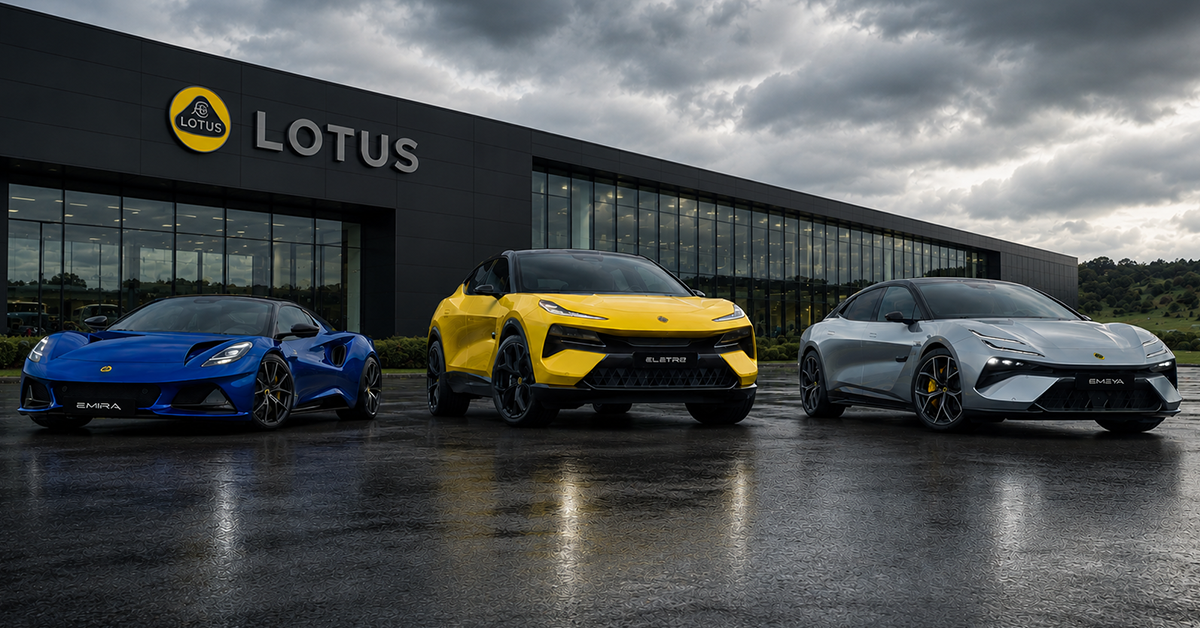
Lotus's transition under Geely ownership represents one of the most dramatic strategic pivots of any heritage car brand in recent memory — a company built entirely on the principle of lightness now produces a 2.5-tonne electric SUV as its primary growth vehicle. The Emira, Lotus's final combustion sports car, represents a genuine culmination of Chapman's lightweight philosophy refined over seven decades — it is widely regarded as the most complete, best-built Lotus sports car ever made. The Eletre and Emeya represent a fundamentally different proposition: substantial weight is an unavoidable consequence of large battery packs, so Lotus's engineers have instead focused on sophisticated active suspension, advanced aerodynamics and torque-vectoring software to deliver dynamic engagement despite the mass. Whether that engineering approach can preserve the emotional connection that made Lotus's lightweight sports cars so beloved by enthusiasts is the central question facing the brand's next decade — and the answer will determine whether Lotus's identity survives its most necessary transformation.