 Brands
Lancia — History, Models and Everything You Need to Know
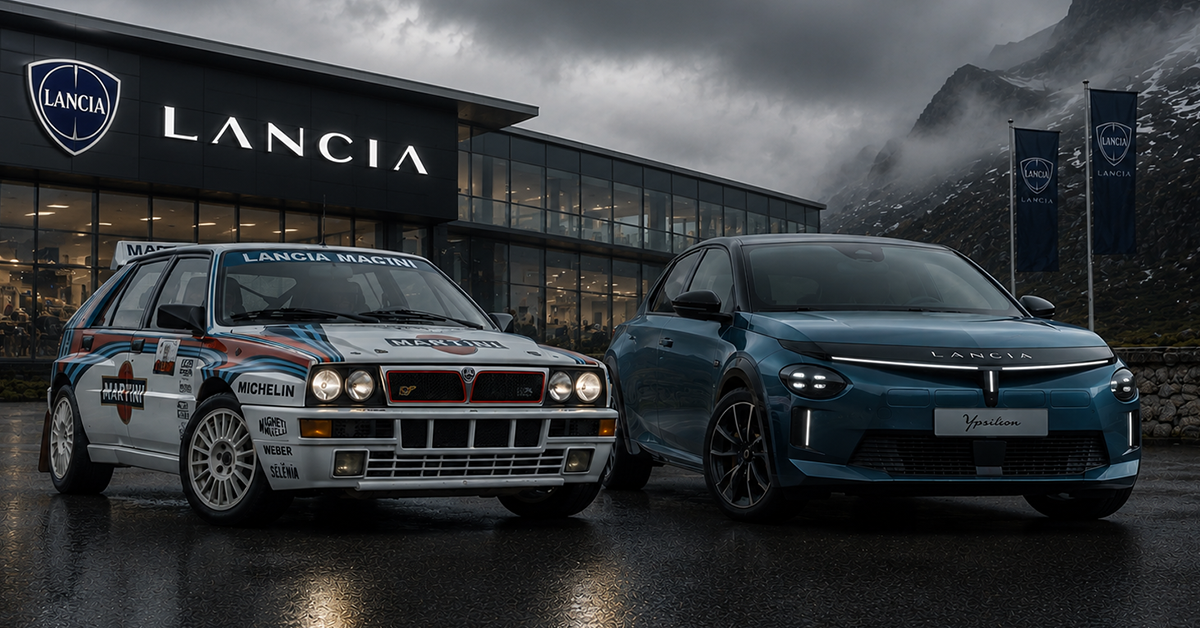
AI-generated concept illustration — Lancia brand overview. | Rev N Rise
Lancia is one of Italy's most technically innovative car brands and one of the most successful rally manufacturers in history — a company that pioneered the unibody production car, invented the production V6 engine and won 10 World Rally Championship manufacturers' titles. Founded in 1906 and reduced to a single ageing model by the 2020s, Lancia is now in the early stages of a genuine Stellantis-backed revival that aims to restore one of Italy's most storied automotive names.
Vincenzo Lancia — a former racing driver for Fiat — founded his own automobile company in Turin in 1906. From its earliest years, Lancia distinguished itself through serious technical innovation rather than simply competing on price or volume. The Lancia Lambda of 1922 was the world's first production car to use a unitary (unibody) body-chassis construction — eliminating the separate chassis frame that every other manufacturer used at the time and establishing a fundamental construction principle that virtually every modern passenger car now uses.
The Lancia Aurelia of 1950 introduced the world's first production V6 engine — another genuinely original engineering contribution that predated Ferrari, Buick and every other manufacturer's V6 efforts by years. Lancia consistently demonstrated this pattern of arriving at important engineering solutions before larger, better-resourced competitors, a remarkable achievement for a relatively small manufacturer. The brand became part of Fiat in 1969, beginning the corporate relationship that has continued through to Stellantis today.
Lancia's most celebrated era came through rallying. The Lancia Stratos — a purpose-built rally weapon launched in 1973 — won three consecutive World Rally Championships. The Lancia Delta Integrale then achieved something even more remarkable: six consecutive World Rally Championship manufacturers' titles from 1987 to 1992, an unmatched dynasty in the sport's history. Lancia's total of 10 WRC manufacturers' titles remains one of the most dominant runs by any manufacturer in any major motorsport discipline.
The Lancia Delta Integrale is the most successful rally car in World Rally Championship history. Based on a humble Fiat-platform hatchback, the Integrale's turbocharged all-wheel-drive engineering transformed it into an unstoppable rallying force through the late 1980s and early 1990s. Miki Biasion, Juha Kankkunen and Didier Auriol drove the Integrale to championship after championship, building a winning streak that has never been matched by any other manufacturer in WRC history. The road-going Integrale Evoluzione versions, sold to homologate the rally car for competition, are now among the most collectible Italian performance hatchbacks ever made, with values that have risen dramatically as enthusiasts recognise the car's unique place in motorsport history.
Lancia's road car business declined dramatically through the 2000s and 2010s under Fiat ownership, which prioritised investment in other group brands. By the early 2020s, Lancia's entire global lineup had shrunk to a single model — the Ypsilon, an ageing city car sold only in Italy. The brand appeared on the verge of disappearing entirely, a remarkable fall for a manufacturer with such significant engineering and motorsport heritage. Stellantis committed to a genuine revival plan in 2024, launching an entirely new Ypsilon built on shared group platform technology, available in hybrid and fully electric versions — Lancia's first new model in over a decade and the first concrete step in what Stellantis describes as a multi-year plan to restore Lancia to relevance across European markets.
Lancia's history of genuine engineering originality — the unibody chassis, the production V6 — distinguishes it from brands whose heritage is built primarily on styling or marketing rather than fundamental technical contribution. The Delta Integrale's rallying dynasty gives Lancia a motorsport credibility that few mainstream manufacturers can claim, even decades after the team's withdrawal from top-level competition. Stellantis's 2024 revival plan represents a genuine test of whether a heritage brand reduced to a single ageing model in a single market can be rebuilt into a relevant, competitive proposition once again. The new Ypsilon's positioning — sharing technical underpinnings with other Stellantis group products while attempting to recapture some of Lancia's distinctive Italian design character — will determine whether Lancia's next chapter honours its remarkable engineering legacy or simply becomes another badge on a shared platform.