 Brands
Polestar Banned From Selling Cars in the US From 2027

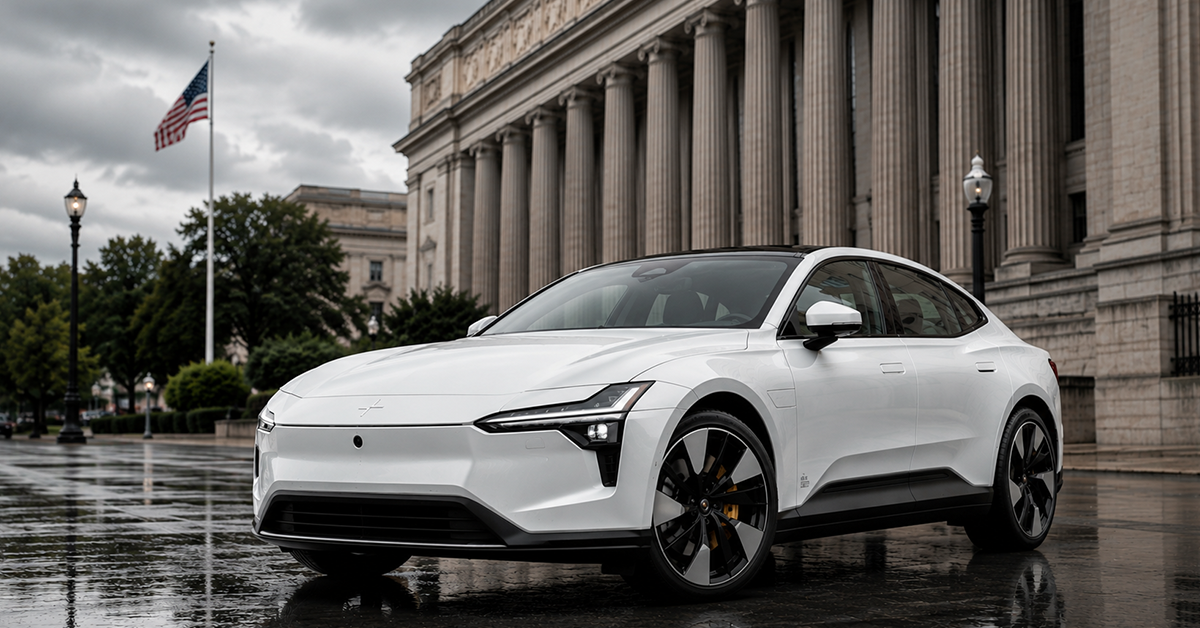
AI-generated concept illustration of a Polestar electric vehicle — not an official Polestar image. | Rev N Rise
Polestar says the US Department of Commerce has effectively pushed it out of the American market — confirming it will be unable to market or sell any 2027-model-year vehicles in the United States after federal regulators denied the Swedish-based, Chinese-owned brand's request for an exemption under new connected-vehicle rules. The decision triggered a double-digit drop in Polestar's share price, but the company itself says it's barely flinching, since the US has never been where most of its customers actually are.
Polestar confirmed on Thursday that the Commerce Department's Bureau of Industry and Security (BIS) declined to grant it authorization under the Connected Vehicle Rule — a regulation that restricts the importation and sale of cars whose connected technology, including Bluetooth, Wi-Fi, cellular connectivity and certain satellite communication systems, is linked to China or Russia. The rule was originally adopted in January 2025, in the final days of the Biden administration, and the Trump administration has chosen to maintain and enforce it rather than reverse course.
The practical effect is straightforward: starting with the 2027 model year, Polestar will be unable to market or sell any new vehicles in the United States. The company says it will continue selling its existing US inventory of the Polestar 3 and Polestar 4, and will keep supporting current American owners and lease customers through its existing service network, with all warranties remaining fully in effect according to their original terms.
Polestar is a Swedish brand, and neither of its two current US models is actually built in China. The Polestar 3 is assembled at a Volvo-shared plant in Charleston, South Carolina, while the Polestar 4 is built in Busan, South Korea. None of that mattered to regulators. The rule's restriction is based on corporate ownership and control, not assembly location — and Polestar is majority-owned by Geely Holding, the Chinese automotive conglomerate that also controls Volvo, Lotus, Zeekr and more than a dozen other global brands.
That ownership-based standard is what makes this case unusual. It means a Polestar 3 built on American soil, on the very same production line as a Volvo EX90 that has been authorized to keep selling, can still be blocked purely because of who ultimately owns the company that makes it. Volvo — also majority-owned by Geely — secured its own separate authorization from US officials in May after discussions specifically addressing its technology and data-security arrangements. Polestar sought a similar outcome but, despite CEO Michael Lohscheller telling the Wall Street Journal the company was in "good dialogue with authorities," that approval never arrived.
| Rule Name | Connected Vehicle Rule (Commerce Dept. / BIS) |
| Originally Adopted | January 2025 (Biden administration) |
| Enforced By | Trump administration |
| Software Restriction Effective | Model Year 2027 |
| Hardware Restriction Effective | 2030 |
| Polestar 3 Build Location | Charleston, South Carolina, USA |
| Polestar 4 Build Location | Busan, South Korea |
| Polestar Ownership | Majority-owned by Geely Holding (China) |
| Sister Brand Outcome | Volvo authorized in May 2026 |
| 2025 Global Sales | 60,119 vehicles (record) |
| Q1 2026 Deliveries | 13,126 (+7% year-over-year) |
| Share of Sales Outside US (Q1 2026) | 94% |
| Share Price Reaction | -5.7% to -13% (sources vary) |
The automotive industry is entering a new phase, based on regional dynamics. Our strategy reflects that, with Europe being our largest growth engine and our plan to manufacture Polestar 7 in Europe.
— Michael Lohscheller, CEO, PolestarPolestar's public response has leaned heavily into the fact that America was never its primary market. The company says 94 percent of its retail sales volume in the first quarter of 2026 came from markets outside the US, with Europe alone accounting for close to 80 percent of global retail sales. CEO Michael Lohscheller framed the decision as a catalyst for a regional restructuring the company says it was already pursuing, naming Southeast Asia, Eastern Europe, Latin America and Canada as continued growth priorities alongside Europe.
The timing context matters too. Polestar posted record global sales of more than 60,000 vehicles in 2025, and Q1 2026 deliveries of 13,126 units were up 7 percent year-over-year — genuine momentum heading into this decision. The upcoming Polestar 5 four-door grand tourer is set to begin customer deliveries this summer, a new Polestar 4 variant is planned for the second half of the year, and a redesigned Polestar 2 is due in 2027 — all of which will simply never be sold new in the United States under current rules. The company has confirmed plans to build its next model, the Polestar 7 compact SUV, in Europe rather than pursuing any further American manufacturing investment.
Polestar's case is being closely watched well beyond its own showrooms. It's reportedly the first high-profile instance of a non-Chinese-headquartered brand, with a model partly assembled on US soil, being pushed out of the American market specifically because of its corporate ownership structure rather than where its parts or factories are located. Other automakers with Chinese-linked ownership, supply chains or software face similar exposure: Ford is reportedly seeking its own authorization for the China-built Lincoln Nautilus, while General Motors has been restructuring Buick Envision production specifically to move it out of China by 2028, in apparent anticipation of exactly this kind of regulatory risk.
Polestar had actually flagged this exact risk years in advance — as early as 2024, the company explicitly warned that the looming Connected Vehicle Rule could eventually shut down its entire American retail operation, including vehicles assembled domestically. That warning has now fully materialized. Whether other Geely-linked or China-connected brands manage to secure the kind of exemption Volvo received, or face the same fate as Polestar, remains an open question that will likely shape how foreign automakers structure their US manufacturing and ownership going forward.
What makes this case genuinely significant isn't really about Polestar itself — the company's own numbers make clear the US was always a relatively minor part of its global business, and its public response reflects that reality rather than genuine alarm. The real story is the precedent: a vehicle built in South Carolina, sharing a factory line with an already-approved sister brand, blocked purely on the basis of who owns the parent company. That ownership-based standard, rather than a factory-location standard, is the detail every other automaker with any Chinese capital or supply-chain connection now has to take seriously. Ford and GM are already restructuring specific models in apparent anticipation of facing the same question Polestar just lost. This is unlikely to be the last brand caught by this rule — it's simply the first one we've seen the answer for.