 Brands
McMurtry's 1,000HP Fan Car Goes Into Production This Week

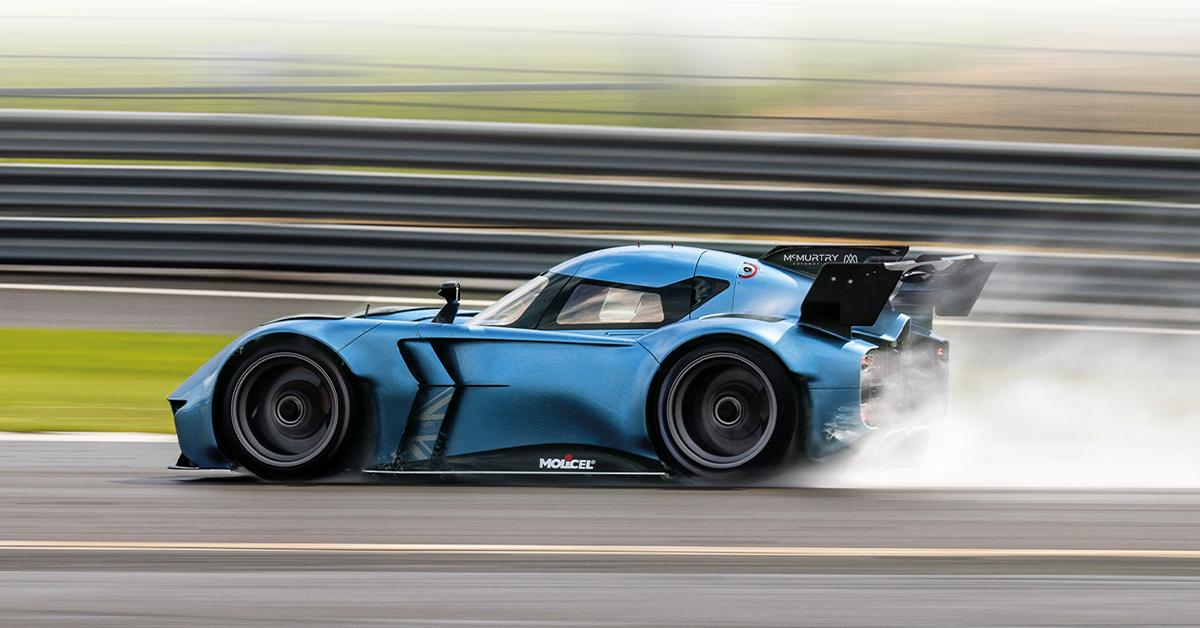
Official image of the McMurtry Spéirling Pure. | © McMurtry Automotive
A tiny British manufacturer is about to do something genuinely rare in the car industry: put a banned Formula 1 technology back on track, legally, as a customer-owned production car. McMurtry Automotive is unveiling the production-ready Spéirling Pure this week, the single-seat electric "fan car" that has spent the last several years quietly demolishing lap records once held by actual F1 machinery. Only 100 will ever be built, and the company says it has already taken two dozen deposits.
The Spéirling's defining trick is something Formula 1 actually outlawed nearly five decades ago. Rather than relying on wings and bodywork shaped to create downforce as speed increases, the car uses twin underfloor fans — reportedly spinning at roughly 23,000rpm — to physically suck air out from underneath the chassis, generating a low-pressure zone that pins the car to the ground. McMurtry calls this "Downforce-on-Demand," and crucially, it works even from a complete standstill, unlike every conventional aerodynamic system that needs road speed to function at all.
This isn't a new idea, exactly. Jim Hall first conceived fan-assisted downforce for the 1970 Chaparral 2J Can-Am car, and Formula 1 briefly experimented with the same principle in the 1978 Brabham BT46B — driven by Niki Lauda to victory in its only race before the sport's governing body banned moveable aerodynamic devices entirely. McMurtry's version is electrically powered rather than mechanically linked to the engine, meaning the fans can be controlled independently of road speed, motor torque, or anything else happening in the drivetrain — a software problem the company says took years to solve properly.
McMurtry has not yet published completely finalized specifications ahead of this week's full reveal, but the figures shared so far are genuinely startling. The car is expected to produce more than 1,000 horsepower sent through two electric motors in a rear-mounted "e-axle," in a car weighing under 1,000 kilograms — reported variously as roughly 2,860 to 2,870 pounds depending on the source. That combination is said to deliver a 0-60mph time of approximately 1.5 to 1.55 seconds, a top speed north of 190mph, and sustained cornering forces of up to 3.5G.
The fan system itself is rated to generate up to 2,000 kilograms (4,400 pounds) of downforce — more than the car's own weight — entirely independent of speed. A 100kWh battery pack, said to be roughly 15 percent lighter than the version used in earlier prototypes, is expected to allow around 20 to 25 minutes of sustained GT3-pace track driving before needing a recharge, with a 350kW charger able to top the car back up in about 25 minutes.
| Body Type | Single-seat, track-only electric hypercar |
| Power Output | 1,000+ hp (estimated, pre-reveal) |
| Curb Weight | ~2,860–2,870 lbs (estimated) |
| 0-60 mph | ~1.5–1.55 sec (estimated) |
| Top Speed | 190+ mph |
| Cornering Force | Up to 3.5G |
| Active Downforce | 2,000 kg (4,400 lbs), available from standstill |
| Battery | 100 kWh (~15% lighter than prototype pack) |
| Track Endurance | ~20–25 minutes at GT3 pace per charge |
| Fast Charging | 350 kW — full charge in ~25 minutes |
| Drive | Rear-wheel drive, twin-motor e-axle |
| Production Cap | 100 units total |
| Starting Price | £995,000 (~$1.3–1.36 million), excl. taxes/options |
| Reported Deposits (March 2026) | 24 confirmed, ~half from US buyers |
| Reveal Window | Week of June 29, 2026 |
| First Deliveries | Later in 2026 |
Building upon the extraordinary performance of its prototype predecessors, the new Spéirling PURE features 95 percent new components, marking a significant evolution toward series production.
— McMurtry Automotive, official teaser statementThe credibility behind these numbers comes from real, independently verified track records, not just marketing claims. Prototype versions of the Spéirling set the outright hillclimb record at the Goodwood Festival of Speed in 2022, and in 2025 a prototype reportedly lapped the Top Gear Test Track in 55.9 seconds, beating the 20-year-old record set by the V10-powered Renault R24 Formula 1 car by more than three seconds. During a tour of Denmark earlier this year, a McMurtry prototype driven by a private, non-professional customer broke the outright lap record at the Jyllandsringen circuit — a record previously held by a professionally driven Formula 4 race car — by more than two seconds.
What makes the production Spéirling Pure different from those record-setting prototypes is the sheer scale of re-engineering involved. McMurtry says the customer car shares only about 5 percent of its components with the prototypes, reflecting the genuine difficulty of turning a one-off record-chasing machine into something 100 private owners can take to track days and reliably drive home afterward, weekend after weekend.
The Spéirling Pure is designed and assembled at McMurtry's own headquarters in Wotton-under-Edge, Gloucestershire, with production reportedly running at a deliberately slow pace of around two cars per month. McMurtry confirmed in March 2026 that it had already taken 24 deposits toward the 100-car run, with roughly half of those reservations coming from customers in the United States — notable given the car's steep £995,000 (roughly $1.3 to $1.36 million) starting price before local taxes, delivery, and any options.
It's worth being clear about what this car is, and isn't. The Spéirling Pure being revealed this week is strictly track-only — it is not road legal in any market. McMurtry has said it is separately developing a road-going variant, but co-founder Thomas Yates has acknowledged that the central challenge isn't really the engineering itself, but rather navigating a regulatory environment that has historically treated moveable, active aerodynamic devices as prohibited equipment on public roads. No timeline has been given for when, or if, that road car might actually arrive.
What makes the Spéirling Pure genuinely exciting isn't just the spec sheet — plenty of track-only electric cars claim huge horsepower figures — it's that McMurtry is putting a piece of banned Formula 1 history directly into private hands, with independently verified lap times to back up the claim that this isn't just clever marketing. The decision to rebuild 95 percent of the car for production, rather than simply badge-engineering the record-setting prototype, suggests a level of seriousness about long-term ownership that a lot of low-volume hypercar startups never bother with. Whether the final reveal this week confirms every pre-release number exactly as reported remains to be seen, but even allowing for some adjustment at the margins, this looks like one of the most genuinely original performance cars to reach production in years.