 Brands
Bugatti’s Last W16 Roadster Gets a One-of-One Porcelain Finish

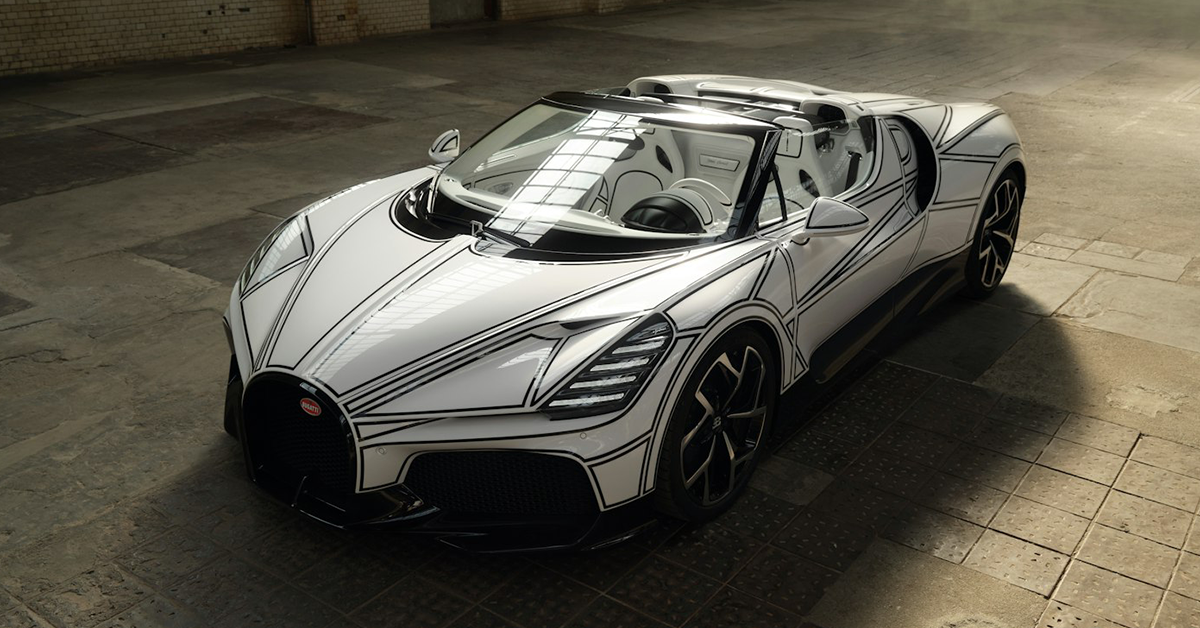
Official press image of the Bugatti W16 Mistral ‘Blanc Éternel’. | © Bugatti Automobiles S.A.S.
The W16 Mistral is already the final open-top expression of Bugatti’s legendary W16 engine — 99 roadsters built to close out the most extraordinary powertrain chapter in the brand’s modern history. Bugatti has now revealed a single car within that run that stands apart from every other: the ‘Blanc Éternel’, a one-of-one commission created in partnership with Königliche Porzellan-Manufaktur Berlin that maps the Mistral’s own digital design geometry directly onto its bodywork in hand-applied black lines, and fits genuine hand-fired porcelain into the cockpit where drivers actually touch it.
The ‘Blanc Éternel’ has a direct ancestor. Fifteen years ago, Bugatti and Königliche Porzellan-Manufaktur Berlin — KPM, Berlin’s royal porcelain manufactory founded in 1763 — collaborated on ‘L’Or Blanc’, a one-of-one Veyron Grand Sport finished in white porcelain-inspired paint and decorated with flowing blue brushstroke lines. The starting point for that design was a white porcelain vase by the Italian designer Enzo Mari, finished with fluid royal-blue brushwork of apparent simplicity. Bugatti’s designers translated that confidence of line onto the complex sculptural volumes of the Veyron by converting the lines of light used by quality specialists to check a car’s surface reflections into an expressive painted composition, applied by hand directly onto the body.
Frank Heyl, who was personally involved in developing ‘L’Or Blanc’ and is today Bugatti’s Design Director, led the ‘Blanc Éternel’ project. Rather than recreate the original’s aesthetic, he and his team chose to move the idea forward — reflecting not just how the brand’s relationship with KPM has evolved, but how the process of designing a Bugatti has changed entirely in the intervening 15 years.
The W16 Mistral was developed through a fully digital design process — no clay model was ever built. Its sculptural surfaces were constructed in software from a network of precisely controlled mathematical surfaces called NURBS (Non-Uniform Rational B-Splines), individual digital patches that together create the seamless volumes of the finished roadster. These digital boundaries are normally invisible. On the ‘Blanc Éternel’, they become the foundation of the exterior artwork.
Fine black lines map the underlying digital surface patch layout of the Mistral’s body — flowing across the pure white paintwork and revealing the geometric logic behind the car’s form. The contrast of black against white reflects the visual language of digital modelling software, while making visible something that has never been seen on a production car before: the actual mathematical structure underneath the design. The name ‘Blanc Éternel’ — eternal white — references both the perpetual beauty of pure white porcelain and the enduring place of the W16 engine within Bugatti’s history.
Despite being conceived digitally, the execution of ‘Blanc Éternel’ is entirely by hand — and the process was genuinely complex. The body is first finished in pure white and carefully sanded. Since no clay model existed on which to position and refine the graphic, every black line had to be applied directly to the actual car, translated from the digital patch layout into physical tape applied precisely to the three-dimensional surface. The surrounding areas were counter-masked, the original tape removed to expose the intended channels, and the lines then sprayed in black. The result is a composition requiring what Bugatti describes as measured patience and an instinctive understanding of how each line must travel across a compound curve in three-dimensional space.
The black line graphic traces the Mistral’s signature design features as it flows across the body — the reimagined horseshoe grille, sculpted front profile, rising C-line, dramatic air intakes and X-shaped taillight architecture. Each surface reads simultaneously as artistically expressive and technically exposed, as though the digital genesis of the car has been rendered permanently on its physical form.
| Base Vehicle | Bugatti W16 Mistral (one-of-one within the 99-unit run) |
| Commission Type | Bugatti Sur Mesure — fully bespoke, one-of-one |
| Exterior Finish | Pure white base + hand-applied black NURBS patch lines |
| Line Application | Taped, counter-masked and sprayed directly onto the car by hand |
| Design Concept | Digital NURBS surface geometry made visible on the physical car |
| Porcelain Partner | Königliche Porzellan-Manufaktur (KPM) Berlin — founded 1763 |
| Exterior Porcelain | EB emblem, fuel cap, oil cap, two engine cover inlays (KPM royal scepter logo) |
| Interior Porcelain | Speaker cover plate, knee pad inlays, gear-shifter shells, centre console armrest inlay, window lifter buttons |
| Interior Leather | White leather with hand-painted black digital linework (new Bugatti process) |
| Porcelain Shrinkage Factor | 17% — must be precisely compensated during modelling before firing |
| Partnership History | 15 years — began with Veyron Grand Sport ‘L’Or Blanc’ |
| Accompanying Collection | ‘Blanc Éternel’ porcelain series — 1,000 handmade pieces (To-Drive Cup + Aviator Cup) |
| W16 Mistral Engine | 8.0L quad-turbo W16 — 1,000 hp / 1,180 lb-ft |
| W16 Mistral Production | 99 units total — final roadgoing W16 expression |
| Announced | 1 July 2026 — Bugatti official newsroom |
‘Blanc Éternel’ respects Bugatti’s history without being constrained by it, fusing our heritage with individual taste in a way that feels wholly new.
— Frank Heyl, Design Director, BugattiThe use of porcelain inside the ‘Blanc Éternel’ goes beyond decorative inserts. KPM has produced genuine hand-fired porcelain components for the speaker cover plate, knee pad inlays, gear-shifter shells, centre console armrest inlay and window lifter buttons — every one of which a driver physically interacts with when operating the car. Bugatti describes this as a deliberate expression of the belief in real materials and purposeful artistry: rather than placing porcelain somewhere the occupant admires but never touches, it has been integrated into the functional interface of the cockpit.
The engineering challenge this creates is not trivial. Porcelain contracts by approximately 17 percent during the kiln-firing process, meaning every component must be modelled and developed at a larger size than its finished dimension so that the shrunken, fired piece fits precisely into its designated position on the vehicle. The white leather interior surfaces carry the same digital linework as the exterior, applied using an entirely new Bugatti process developed specifically for this commission: the leather sections are prepared, the pattern masked by hand, and black paint applied directly to the white leather to create the same sharp graphic contrast seen on the body.
The ‘Blanc Éternel’ arrives at a significant moment in Bugatti’s history. The W16 Mistral is the last roadgoing vehicle Bugatti will ever build around the 8.0-litre quad-turbocharged W16 engine that defined the brand for more than two decades — from the Veyron’s debut in 2005 through to the Chiron and its derivatives, and now the 99-unit Mistral. The Tourbillon, already unveiled as the next chapter, uses a hybrid V16 rather than the W16. ‘Blanc Éternel’ therefore carries the weight of being one of the final individual expressions of an engineering era that began with ‘L’Or Blanc’ and ends with a car that uses the same collaborative relationship and the same porcelain house to write a genuinely new chapter rather than simply repeat the original.
To mark the renewed partnership, KPM and Bugatti have separately released a limited ‘Blanc Éternel’ porcelain collection — the To-Drive Cup and KPM’s Aviator Cup in two sizes — limited to 1,000 handmade pieces, each carrying the same visual language as the car.
The ‘Blanc Éternel’ is one of the more intellectually interesting one-of-one commissions to come out of the hypercar world in some time — not because of what it adds in terms of precious materials, but because of the idea at its centre. Mapping a car’s own digital construction geometry onto its physical surface as a design element is genuinely original: it takes something invisible by definition and makes it the entire visual identity of the car. The decision to put porcelain on the gear-shifter shells and window buttons rather than just in decorative panels is the kind of detail that separates a thoughtfully conceived bespoke commission from a cosmetic exercise. As a bookend to the W16 era, it works: the same partnership, the same craft house, the same commitment to applying lines by hand to a Bugatti body — but expressing an entirely different version of what Bugatti now is. That is exactly what a closing chapter should do.