 Brands
VW ID. Cross Revealed — €27,990, Physical Buttons Back, Orders Open

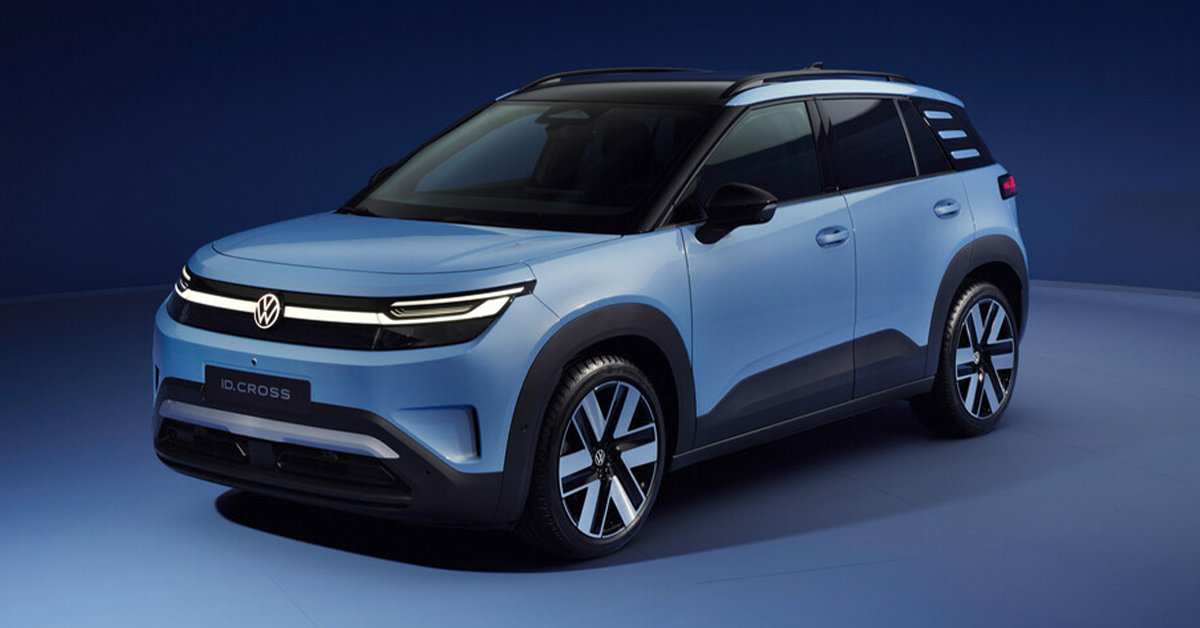
Official press image of the all-new Volkswagen ID. Cross. | © Volkswagen AG
Volkswagen has revealed the production ID. Cross today — a fully electric compact SUV priced from €27,990 in Germany, with German advance orders opening right alongside the reveal. It sits above the ID. Polo in VW’s electric lineup, takes on the Ford Puma Gen-E and Renault 4 in the most fiercely contested segment in European car sales, and comes with something the earlier ID. models notably lacked: physical buttons for the basics, back where they belong.
The ID. Cross is Volkswagen’s electric alternative to the T-Cross — the brand’s popular combustion-powered compact crossover that sells in most global markets except the United States. Think of it as a crossover companion to the ID. Polo, sitting in the same small-SUV territory but with a raised ride height, chunky wheel-arch cladding and a more rugged appearance that VW describes as combining urban-friendly practicality with what it calls “a sense of off-road toughness.” It sits on the same MEB+ platform as the ID. Polo, the Cupra Raval and the upcoming Skoda Epiq, sharing motors, batteries and control systems across the group’s expanded compact EV family.
The car measures 4,153mm long, 1,794mm wide and 1,581mm tall — comfortably within the compact crossover class and fractionally more spacious than the combustion T-Cross it parallels. Despite its small footprint the ID. Cross is designed as a genuine five-seat car rather than a 4+1, and VW has confirmed that cargo space is meaningfully larger than the T-Cross. The boot access is wide and practical rather than shaped around aerodynamic priorities, a deliberate choice for a car VW expects to appeal to families and daily-use urban buyers rather than performance enthusiasts.
The ID. Cross is offered with three electric motor outputs and two battery sizes, giving buyers more genuine choice than most competitors in this segment currently offer. The entry-level motor produces 85 kW (116 hp), the mid-spec unit delivers 99 kW (135 hp), and the range-topping unit produces 155 kW (211 hp). All three are front-wheel drive — there is no AWD option in the ID. Cross at launch.
Battery options are 37 kWh (paired with the lower power outputs) and 52 kWh (available with the 211 hp motor). The smaller battery delivers a WLTP range of approximately 316 km (196 miles) on VW’s own projections; the larger delivers up to 427 km (265 miles). DC fast charging is standard across the entire range — the 37 kWh battery supports up to 90 kW DC charging, while the 52 kWh unit supports higher rates. With the 52 kWh battery the ID. Cross can tow up to 1,200 kg — an unusual capability for a car this size that will matter to buyers with caravans or trailers.
The single detail generating more attention in Germany today than any specification is not the power output or the range. It is the control interface. Volkswagen has explicitly reversed its earlier ID. model approach with the ID. Cross: touch-sensitive haptic control surfaces and multi-tasked capacitive switches have been replaced with physical buttons and conventional switches throughout the cabin. Window controls, climate settings, volume, basic navigation inputs — all are now operated through physical controls rather than screen menus or haptic surfaces.
VW has been unambiguous about why. The earlier ID.3 and ID.4’s touch-only interface drew consistent and significant criticism from buyers and reviewers. The brand took that feedback on board and spent development time specifically reversing the decision for this generation. The ID. Cross still has two screens — a 10.25-inch digital instrument cluster and a 12.9-inch central infotainment touchscreen — but the fundamental controls that drivers reach for at speed, in the dark, or without looking are once again buttons you can feel. This matters because the Renault 4, one of the ID. Cross’s primary rivals, retained physical controls from the outset and was praised for doing exactly that. VW is catching up to a decision its competitor made correctly two years ago.
The ID. Cross introduces VW’s Pure Positive design language — characterised by an elongated “flying roof” roofline, a pronounced C-pillar and distinct light signatures front and rear. The thick plastic cladding to the doors and wheel arches gives the car its crossover character without requiring genuine off-road capability to justify it. Optional IQ.LIGHT LED matrix headlamps and 3D LED tail lights with illuminated VW logos are available on the Style trim. The C-pillar carries three vertical stripes that reference the ventilation slats on the classic VW Type 2 Transporter van from the 1950s — the kind of deliberate heritage reference that VW’s designers have used successfully on the ID. Buzz and now apply here.
Interior materials have been upgraded versus the earlier ID. models. A fabric-covered dash panel replaces the hard plastics that drew criticism in the ID.3, and metallic-edged audio controls on the centre console add a tactile quality that brings the cabin closer to premium-feel territory. A retro display mode on the instrument cluster switches the graphics to an analogue-style speedometer inspired by the first-generation Golf — a deliberate nod to the ID. Cross’s heritage as an electric replacement for a combustion institution.
| Full Name | Volkswagen ID. Cross |
| Segment | Compact electric SUV / crossover |
| Platform | MEB+ (Volkswagen Group) |
| Platform siblings | ID. Polo, Cupra Raval, Skoda Epiq |
| Length | 4,153mm |
| Width | 1,794mm |
| Height | 1,581mm |
| Seating | 5 passengers |
| Drive | Front-wheel drive — all variants |
| Motor outputs | 85 kW (116 hp) / 99 kW (135 hp) / 155 kW (211 hp) |
| Battery options | 37 kWh (LFP) / 52 kWh (NMC) |
| WLTP range (37 kWh) | ~316 km (196 miles) |
| WLTP range (52 kWh) | ~427 km (265 miles) |
| DC Fast Charging | Standard — all trims (up to 90 kW on 37 kWh battery) |
| Towing (52 kWh) | Up to 1,200 kg |
| Controls | Physical buttons — no haptic touch surfaces |
| Infotainment | 12.9-inch touchscreen + 10.25-inch digital cluster |
| Trim levels | Trend / Life / Style |
| Starting price (Germany) | €27,990 (Trend — 85 kW / 37 kWh) |
| Life trim price | ~€33,930 |
| Style trim price | ~€35,930 |
| German orders | Open today, July 15, 2026 |
| European launch | Autumn 2026 |
| Production start | October 2026 |
| UK availability | Estimated early 2027 |
| US availability | Not confirmed |
| Key rivals | Ford Puma Gen-E, Renault 4, Kia EV2, Skoda Epiq |
The ID. Cross brings together technological expertise, clean design, impressive, intricate solutions and genuine all-rounder qualities — all for excellent value for money. These are ideal conditions for a new success story from Volkswagen.
— Thomas Schäfer, CEO, Volkswagen Brand — official ID. Cross reveal, July 15, 2026The ID. Cross’s arrival is directly tied to Volkswagen Group’s ongoing effort to arrest declining profits and falling EV sales in Europe. The company made significant restructuring announcements in 2025, including potential factory closures and a 20 percent cost disadvantage versus Chinese rivals. The ID. Cross at €27,990 is a direct response to the competitive pressure from Chinese brands — at that price it sits below the entry price of most Chinese EV crossovers when duties, shipping and local taxes are factored in, while offering the VW dealer network, the familiar badge and the confidence of an established European brand that buyers in Germany, France, Spain and the UK still demonstrably prefer.
The €27,990 starting price is approximately €2,800 more than the ID. Polo it sits above — a premium the larger body, raised ride height and additional cargo space justifies without difficulty. The Skoda Epiq, which shares the same MEB+ platform, is expected to be priced from around €25,000 when it launches, which will create an interesting intra-group comparison for buyers who prioritise value over badge. The ID. Cross answers that with the VW three-letter guarantee: warranty support, dealer network depth, resale values and the strongest EV subsidy eligibility in most European markets.
The ID. Cross is exactly the car Volkswagen needs right now. Not because it is dramatic — it is not — but because it is priced correctly, sized correctly, controls correctly and arrives in the segment where European families actually spend their money. The return of physical buttons is not a trivial detail: it is an admission that VW got it wrong with the ID.3 and ID.4, and it will convert buyers who walked away from those cars specifically because of the interface. The 427 km range on the 52 kWh battery is competitive without being class-leading; the towing capability is a genuine differentiator at this price point; and the three motor options give a level of buyer choice that the Renault 4 and Ford Puma Gen-E do not currently match. Whether VW can produce it in sufficient volume by autumn 2026 to make a meaningful dent in its financial position is the real question. The product is right. The execution has to follow.