 Brands
Toyota Prado — The Land Cruiser America Doesn't Call Prado
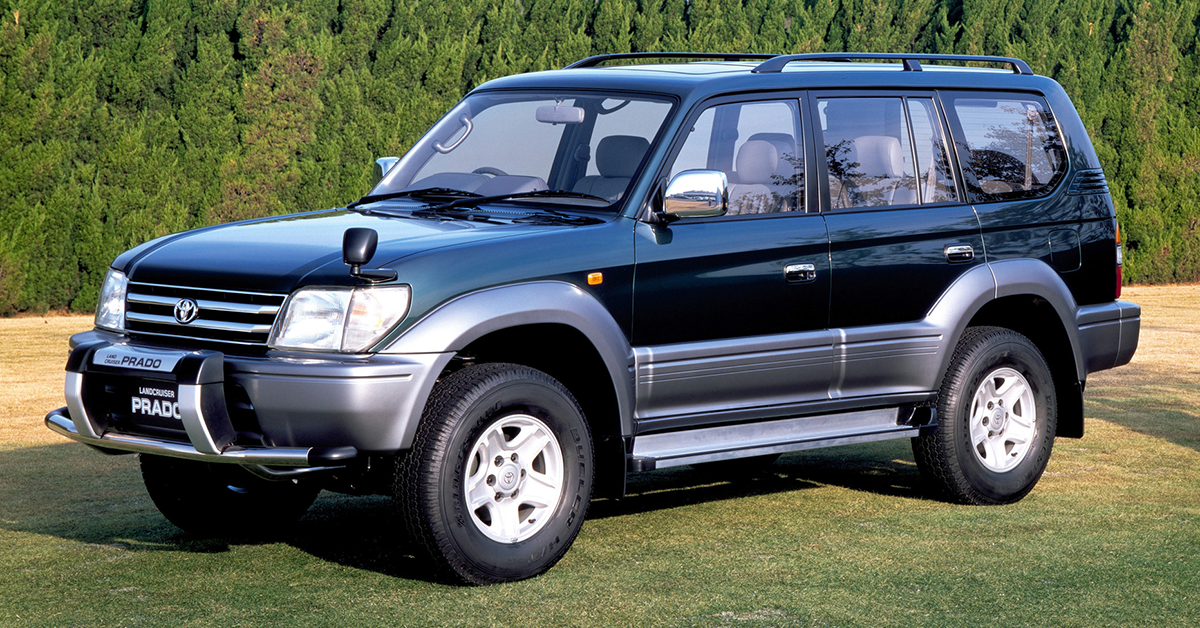
Official press image of the Toyota Land Cruiser Prado. | © Toyota Motor Corporation
Here is a fact that genuinely confuses a lot of buyers: the Toyota Land Cruiser you can currently walk into an American dealership and purchase is, mechanically, the same vehicle that Australia, the Middle East and most of the rest of the world know as the Land Cruiser Prado. America simply doesn’t use the Prado name. Understanding why requires understanding a genuinely deliberate 1990 decision Toyota made to split its most famous off-roader into two distinct vehicles — one heavy-duty, one considerably more liveable — and the Prado has spent the 35 years since building a reputation every bit as strong as its bigger sibling’s.
In 1990, Toyota made a genuinely deliberate strategic decision about its Land Cruiser lineup: rather than continue offering a single, purely utilitarian off-roader to every buyer, the company split the range into two distinct directions. The heavy-duty 70 Series continued serving military, agricultural and genuinely extreme off-road use, prioritising raw durability above all else. A new, lighter and considerably more liveable variant was created alongside it — shorter, narrower and lighter than the 70 Series, while retaining the same body-on-frame construction, low-range transfer case and diesel-first reputation that had made the Land Cruiser name what it was. This new variant became the Land Cruiser Prado.
The J90 generation, launched in 1996, is widely considered the point where the Prado genuinely established its own identity separate from being “the smaller Land Cruiser.” It introduced the 1KZ-TE diesel engine that built much of the model’s early reputation for reliability, and began attracting buyers who specifically wanted Land Cruiser durability without the 70 Series’s uncompromising ride quality and utilitarian cabin.
Nowhere has the Prado’s identity been more significant than in Australia, where 2026 marks the model’s 30th anniversary as a standalone nameplate. When the Prado first launched there, it was priced almost 26 percent cheaper than the base Land Cruiser 80 Series — with the range-topping Sahara Land Cruiser costing nearly three times the Prado’s starting price. That value gap, combined with genuine off-road credibility, made the Prado the best-selling SUV in its class in Australia for more than two decades, a dominance that barely wavered even as competition intensified from both established rivals and newer entrants.
The current J150 generation (2009–2023) and its predecessor the J120 (2002–2009) remain the generations most commonly sought by buyers today, fitted with the 1KD-FTV and later 1GD-FTV diesel engines respectively — both genuinely well-regarded for long-term durability. The Japanese-market TZ-G grade from this era adds a factory rear differential lock and Multi-Terrain Select as standard, details that have made grey-market imports of these generations genuinely desirable in markets where direct new-Prado sales aren’t available.
The current J250 generation launched in 2023, and reception has been genuinely strong — more than 17,000 Australian orders were placed before the vehicle had even physically launched in local showrooms. In Australia, this generation sits as the 250 Series, positioned as the slightly smaller sibling to the flagship LandCruiser 300 Series, with the Lexus GX serving as the platform’s luxury-badged equivalent in markets including the United States.
The 2026 Australian Prado lineup spans five variants, from the entry-level GX starting at approximately AU$72,500 to AU$73,200 before on-road costs, through to the range-topping Kakadu trim starting around AU$99,990 to AU$101,365 — the final rung on Toyota’s ladder before stepping up to the Lexus GX proper. Power comes from a 2.8-litre four-cylinder turbo-diesel engine paired with an eight-speed automatic transmission, with fuel economy rated at approximately 7.6 litres per 100km. Interior configurations offer five or seven-seat layouts across a range of variants, and the model carries a full 5-star ANCAP safety rating.
Here is the honest clarification worth stating plainly: what Toyota badges as the Land Cruiser in the United States today — the vehicle that returned to American showrooms in 2024 after the previous full-size 200 Series left in 2021 — is, underneath, the J250 Prado. Toyota simply chose not to use the Prado name in the American market, instead applying the more historically recognisable Land Cruiser badge to what is genuinely the Prado platform. This is not a coincidence or a marketing sleight of hand exclusive to America — it reflects how Toyota has always managed the Land Cruiser family differently by region, sometimes using the Prado name, sometimes not, depending on what resonates locally and what each market’s existing model lineup already includes.
For buyers trying to understand exactly what they are looking at, the honest simplification is this: the true full-size, flagship 300 Series Land Cruiser remains a considerably larger, more expensive and more luxurious vehicle, sold internationally but not in the United States. The Prado, badged as the “Land Cruiser” in America and by that name almost everywhere else, is the mid-size, more accessible sibling — genuinely capable, genuinely durable, and considerably more attainable than its bigger brother.