 Brands
Are Toyotas Safe? Ratings, Safety Sense & Top Models
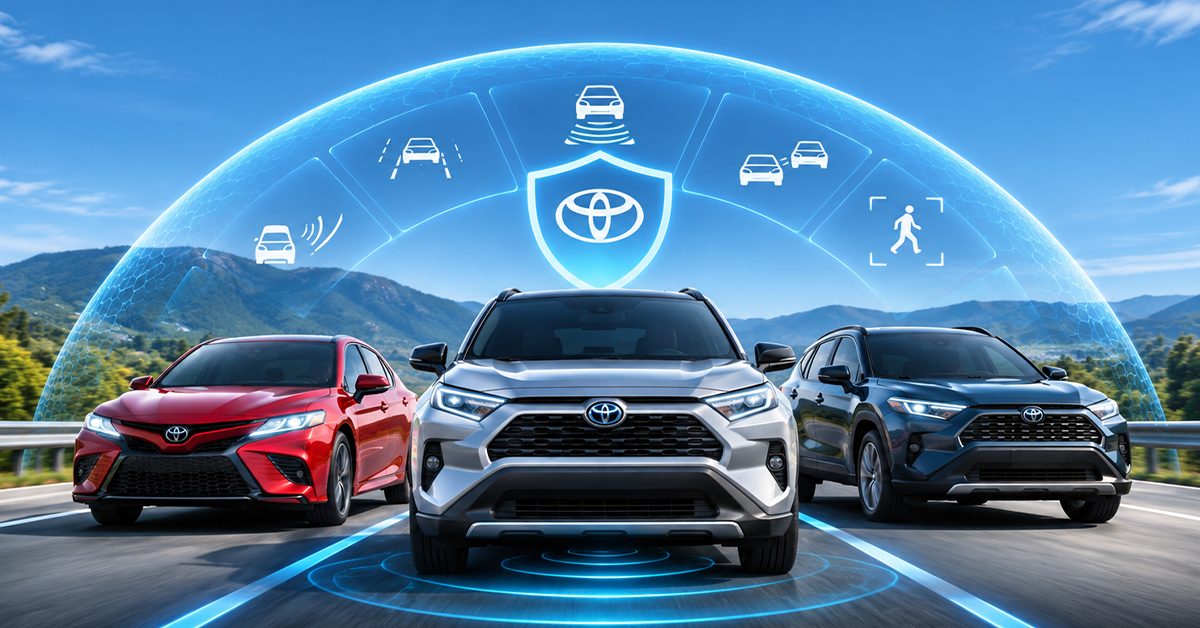
AI-generated concept illustration — Toyota safety technology. | Rev N Rise
Toyota fits its Safety Sense driver assistance suite as standard across nearly its entire lineup, and in 2026 the Camry, Prius and Tundra earned top honours from the Insurance Institute for Highway Safety. But what does Toyota Safety Sense actually do, which models are genuinely the safest, and what should every buyer check before trusting the badge? Here is the full picture.
When people ask whether a Toyota is safe, they are really asking two separate questions. The first is how well the car protects its occupants in a crash, which is a matter of structure, airbags and restraints. The second is how well it helps the driver avoid the crash in the first place, which is where Toyota Safety Sense, usually shortened to TSS, comes in. TSS is Toyota's umbrella name for its suite of camera- and radar-based driver assistance features. Rather than selling these systems as expensive options, Toyota has made them standard equipment across nearly all of its American lineup, which is a significant part of why the brand scores so well in modern safety assessments.
Toyota introduced the Toyota Safety Sense name in 2015 and has refined the package in generations since. The earliest versions focused on a core set of features: forward collision warning with automatic braking, lane departure warning and automatic high beams, with radar cruise control in the more capable package. Later versions, usually referred to as TSS 2.0 and TSS 2.5, expanded the range of what the system could detect, added pedestrian and cyclist recognition, and improved the adaptive cruise control. The latest generation, Toyota Safety Sense 3.0, began arriving on 2023 model-year vehicles such as the redesigned Prius and the Crown, and it is now spreading across the rest of the range as models are updated.
Physically, the system relies on two main sensors. A forward-facing camera mounted behind the windscreen reads lane markings, recognises vehicles, pedestrians, cyclists and road signs, and judges the position of other objects. A millimetre-wave radar, usually hidden behind the Toyota badge in the grille, measures distance and relative speed to whatever is ahead. A control computer fuses the two streams of data and decides when to warn the driver, when to apply the brakes and when to nudge the steering. Using two different kinds of sensor is deliberate, because a camera and a radar fail in different conditions and each covers for the other's weaknesses.
It is worth being clear about what TSS is and is not. It is a set of assistance and warning systems designed to reduce the likelihood and severity of crashes, particularly the common and avoidable ones such as rear-end collisions and unintended lane drift. It is not a self-driving system, and Toyota itself is explicit that the driver remains responsible for safe driving at all times. The systems have limits that depend on speed, the size and position of the object, and weather, light and road conditions, and they can be fooled by faded lane markings, heavy rain, glare or a dirty sensor.
The reason standard fitment matters so much is that safety systems only save lives if they are actually on the car. When automatic emergency braking is an optional extra, many buyers decline it, and the cars that most need it end up without it. By building TSS into nearly every new Toyota, the company ensures that the base-model Corolla a first-time buyer picks and the top-trim Grand Highlander a family chooses carry the same fundamental protection. Insurance-industry testing also rewards this approach, since the IIHS requires front crash prevention to be standard equipment, not optional, before a model can qualify for either of its top awards.
Over the following sections we look at exactly what each TSS 3.0 feature does, how Toyota's models perform in independent crash testing, which Toyotas stand out, and how to get the most out of the technology as an owner. The short version is that Toyota has built a genuine safety story on two foundations: a strong crash structure and a comprehensive, standard-fit suite of driver assistance that keeps improving with each generation.
Toyota Safety Sense 3.0 is the most capable version of the system so far, built around an upgraded forward camera with a higher resolution and wider field of view, together with an improved radar that sees further and wider than before. Those hardware upgrades make the software features below more effective, particularly in tricky situations such as intersections. Some features appear on every vehicle with the package, while others are limited to certain models, so it is always worth checking the specification of the exact vehicle you are considering.
The headline feature is the Pre-Collision System, which warns the driver of a possible frontal collision with a vehicle, pedestrian or cyclist and can assist with braking. In the 3.0 generation it gains better intersection support, including detection of oncoming vehicles while you are turning and vehicles approaching from the side, and in certain situations it can now detect motorcyclists. Intersections are where many serious crashes happen, so this expansion is a meaningful step beyond the straight-line braking protection of earlier versions. As with all of these systems, its effectiveness depends on speed, the object involved and the conditions.
Dynamic Radar Cruise Control is Toyota's adaptive cruise control, holding a set following distance from the vehicle ahead at speeds above 20 mph. The 3.0 version offers four following-distance settings instead of three and makes smoother, more natural speed adjustments, which makes long highway drives less tiring. Paired with it is Lane Tracing Assist, a new feature in this generation that gives steering input to help keep the car centred in its lane and can even shift the vehicle slightly within the lane to create more space from an object in an adjacent lane. Lane Tracing Assist works only when the cruise control is active, and it is not available with manual transmissions.
Lane Departure Alert warns the driver with sound and visual signals if the car begins to drift out of its lane at speeds above 30 mph, and it can apply gentle steering correction if the driver does not respond. In the 3.0 generation it is better at recognising some three-dimensional lane boundaries such as certain guardrails. Toyota is careful to note that it relies on visible lane markings and is not a collision-avoidance system. Road Sign Assist reads certain road signs and displays them on the driver's information screen, alerting the driver if they exceed the speed limit, and it now recognises a wider range of signs, including some warning signs such as pedestrian crossings.
Automatic High Beams switch between main and dipped beam depending on traffic, improving night visibility while reducing glare for other road users, and they operate above 25 mph. Two newer features are limited to certain vehicles. Proactive Driving Assist provides gentle braking and steering support in several situations, including anticipating parked vehicles or pedestrians near the road, easing off for slower traffic or upcoming curves, and adjusting steering assistance to help the driver stay in lane. Emergency Driving Stop System, available on vehicles equipped with a driver monitor camera, can bring the car to a stop under certain conditions if the driver appears inattentive and does not respond to prompts.
One more practical point: certain vehicles with TSS 3.0 support over-the-air software updates, which means the system can be improved after the car leaves the factory. That is a change from earlier generations, where a car's safety software was effectively fixed at the time of purchase. Whatever the version, every one of these features is a driver aid, not a replacement for an attentive driver, and Toyota states plainly that the driver remains responsible for safe operation of the vehicle at all times.
For independent evidence of how safe Toyotas actually are, the most widely cited source is the Insurance Institute for Highway Safety, or IIHS, a US organisation funded by auto insurers that crash-tests new vehicles and publishes annual awards. Its top honours are Top Safety Pick and Top Safety Pick+, and the requirements have become noticeably tougher. For 2026, both awards require good ratings in the moderate overlap front, small overlap front and side crash tests, acceptable or good headlights across all trim levels, and standard front crash prevention. Top Safety Pick also requires an acceptable or good pedestrian front crash prevention rating.
The higher Top Safety Pick+ award is more demanding still. It requires a good pedestrian rating and an acceptable or good rating in IIHS's updated vehicle-to-vehicle front crash prevention evaluation, which was introduced in 2024 and tests how well a car's automatic braking performs at higher speeds. Because of those stricter standards, the number of winners across the whole industry is limited, and a model has to be strong in crashworthiness, crash avoidance and headlight performance at the same time. That is why a model that does very well in crash tests can still miss out on an award because of a single weaker area.
Toyota's 2026 winners are the Camry and the Prius, both of which earned Top Safety Pick+, and the Tundra crew cab, which earned Top Safety Pick. The Prius is an interesting story: it originally held the lower Top Safety Pick award and was upgraded to Top Safety Pick+ in May 2026 after IIHS evaluated it in the updated vehicle-to-vehicle front crash prevention test. The Camry, one of America's best-known family sedans, achieving the top award confirms that the brand's volume models are not being left behind by its more specialised products. On the Lexus side, the NX also earned a Top Safety Pick+ when the 2026 awards were announced.
The Tundra's result carries particular weight. Large pickups are heavy, complex vehicles, and winning an IIHS award in that class is a genuine achievement, and it shows that Toyota's truck engineering is as capable in crash testing as its cars. It is worth noting that the award applies to the crew cab body style that IIHS tested, so buyers choosing other cab configurations should check the specific rating for that body. This is a general rule with IIHS results: awards attach to specific body styles, model years and sometimes build dates, so the exact vehicle matters.
It is just as important to read the absence of an award correctly. Several Toyota models, including the RAV4, Grand Highlander and Corolla, did not appear among the 2026 award winners, and some newer models such as the redesigned 4Runner have not yet completed IIHS's full set of tests. That does not mean those vehicles are unsafe. An award requires a clean sweep across every test and criterion, and a vehicle can perform well and still fall short on one measure, such as a headlight rating on a lower trim level, or simply not have been fully tested yet. The sensible response is to look at the individual test results for the model and year you are considering.
IIHS results also change as the institute updates its tests and as manufacturers update their vehicles, so an award held today is not guaranteed for the next model year. Awards are listed by model year, and a mid-year update such as the Prius upgrade shows that ratings can improve during a model's life. For the most current picture, check the IIHS website directly for the exact year and body style you plan to buy, and treat awards as one important input alongside the government crash ratings and your own priorities.
Based on the independent evidence, the clearest answer to which Toyotas are safest comes from the 2026 IIHS awards: the Camry, the Prius and the Tundra crew cab. Two of those hold the higher Top Safety Pick+ honour, and all three satisfied the institute's requirements for crash protection, crash prevention and headlights. If you want the models with the strongest third-party validation today, those are the three to start with, and each represents a different type of buyer: a family sedan, an efficient hatchback and a full-size truck.
The Camry is a particularly compelling choice for safety-focused shoppers. It combines a Top Safety Pick+ award with standard Toyota Safety Sense, a hybrid-only powertrain and a strong reliability record, as covered in our Toyota reliability guide. For many families, the midsize sedan remains the sweet spot: low enough to have a safer centre of gravity than most SUVs, spacious enough for child seats and cargo, and now backed by an award that confirms its crash performance. It is easy to overlook sedans in an era of SUV dominance, but this is a case where the traditional choice remains an excellent one.
The Prius deserves credit for how far it has come. Once seen as an efficiency-first car with modest crash credentials, the current generation has earned Top Safety Pick+ and is among the safest small cars on sale. Its upgrade from Top Safety Pick to Top Safety Pick+ in 2026 shows that Toyota's engineers continue to refine the car, and its low, sleek body and TSS 3.0 suite make it a strong option for drivers who want fuel economy without compromising on protection. Buyers who previously ruled out small cars on safety grounds should take a fresh look at the current Prius.
Among larger vehicles, the Tundra crew cab is the standout. Full-size pickups can be intimidating in urban and suburban settings, but the Tundra's Top Safety Pick award indicates strong protection for its occupants and that it met the pedestrian front crash prevention requirement the institute now weighs heavily. Anyone considering a Tundra should also read our reliability guide, which covers the engine recall campaign that affects some model years, because safety and reliability are separate questions and both deserve attention before a purchase.
For three-row family transport, Toyota's Sienna, Highlander and Grand Highlander all carry the standard TSS suite and are widely chosen by families, though the Grand Highlander did not earn a 2026 IIHS award. That is a reminder to examine the specific ratings rather than assuming that every vehicle from a strong brand is equally strong. Toyota's range also includes newer models, such as the redesigned 4Runner, that had not completed IIHS's full set of tests at the time of writing, so buyers of those should watch for results as they are published.
A useful approach when shortlisting is to look at three layers. First, check IIHS for the specific model year and body style. Second, check the US government's NHTSA five-star ratings at nhtsa.gov, which use a different testing methodology and are a valuable cross-check. Third, check which version of Toyota Safety Sense the car carries and which optional features, such as blind spot monitoring or rear cross-traffic alert, are included on the trim you are considering. Combining those three layers gives a much more reliable picture than relying on a brand reputation alone.
Toyota Safety Sense gets most of the attention, but it sits on top of a foundation of passive safety engineering that determines what happens if a crash cannot be avoided. Modern Toyotas are built on the Toyota New Global Architecture, known as TNGA, which was designed from the start to offer a stiffer, stronger body structure than previous platforms. A rigid passenger cell, deliberately engineered crumple zones and energy-absorbing structures work together to channel crash forces around the occupants rather than through them, and this is the physical basis for the strong crash-test results described earlier.
Restraint systems are the second layer. Toyota fits multiple airbags across its range, typically including front, side, curtain and knee airbags, alongside seatbelts with pretensioners and force limiters that tighten at the start of a crash and then release load gradually to reduce chest injuries. Airbag counts and configurations vary by model and market, so the specification of a given vehicle is the place to confirm precisely what is fitted. Child-seat anchorage points are also part of the structure, and families should check that the rear seats on any prospective vehicle accommodate their specific child seats securely.
Underneath all of this sits the long-established vehicle stability technology that Toyota calls the Star Safety System. It combines anti-lock brakes, electronic brake-force distribution, brake assist, vehicle stability control, traction control and smart stop technology, which reduces engine power when the brake and accelerator are pressed together. These systems have been standard on Toyotas for many years, and they are so well established that buyers rarely think about them, even though they prevent a great many loss-of-control accidents. They are also a reminder that a safe car is the product of many layers, not one headline feature.
Many Toyotas also offer connected safety services. On vehicles equipped with Toyota's connected platform, an automatic collision notification feature can alert emergency responders and relay the car's location if the airbags deploy, and an SOS button allows the occupants to speak to an agent. Availability, subscription terms and features differ by model year and by market, so these services should be checked individually rather than assumed. Where they are available they provide a safety net that does not depend on the driver being conscious or able to use a phone.
Features aimed at the rest of the cabin are worth looking for too. Many Toyotas offer a rear seat reminder that prompts the driver to check the back seat when leaving the vehicle, which is designed to help prevent children or pets from being left behind, and blind spot monitoring with rear cross-traffic alert is common on higher trims and is standard on some models. Parking sensors and a surround-view camera, where fitted, reduce low-speed accidents, which are common and expensive even when they are rarely dangerous. When comparing trim levels, these items can make a larger practical difference to everyday safety than headline crash-test numbers.
Finally, hybrids and plug-in hybrids add one more dimension. Their high-voltage systems are designed with dedicated safety measures, including automatic shut-off of the high-voltage circuit in a serious collision and clear markings and procedures for emergency responders. Toyota has been building hybrids since the first Prius in 1997, and that experience extends to how rescue crews are trained to handle them. For buyers worried about electrified vehicles in a crash, the evidence from the Prius and other hybrids is reassuring, and the 2026 Top Safety Pick+ award for the Prius is a pointed example.
Having a safe car is not the same as using it safely, and the most important point about Toyota Safety Sense is that it works best when the driver understands it. The systems are designed to assist, not to take over, and Toyota's own documentation is clear that they have limits. Spend time with the owner's manual and the vehicle's settings menu when you first get the car, learn which alerts you have enabled, and adjust the sensitivity and warning style to suit your driving. A driver who understands what each beep or vibration means will react quickly, while one who finds the alerts confusing may be tempted to switch them off.
Resist the temptation to disable features because they seem annoying. Lane departure alerts that trigger on a narrow road or in roadworks can be irritating, but they are working as designed, and switching off the entire system removes protection when you most need it. If a particular feature is unsuitable for a specific situation, such as lane assistance on a winding rural road, adjust the setting for that journey rather than permanently disabling it. Where the car allows it, choose the warning-only option over a complete shutdown, and check that the system is set to its default state after any service visit.
Keep the sensors clean and clear. The forward camera behind the windscreen and the radar behind the grille badge can be blocked by dirt, ice, snow, mud or even a decorative film or sticker, and a blocked sensor will disable some or all of the features with a warning message. Clean the windscreen thoroughly, keep the area in front of the camera free of obstructions, and avoid fitting accessories such as bull bars or aftermarket badges that can interfere with the radar. In winter, clearing frost and snow from the sensor area is as important as clearing the glass you look through.
Calibration matters after certain repairs. If you replace the windscreen, repair front-end damage or alter the vehicle's ride height, the camera or radar may need to be recalibrated so that it continues to measure distances and lane positions correctly. A system that is misaligned by even a small amount can misjudge the road ahead, and a car that has had a windscreen replaced without recalibration may appear to work normally while being less accurate. Use a repairer that follows Toyota's procedures, and ask specifically whether calibration was completed, especially after a collision repair or a glass replacement.
Keep up with recalls and software updates. Run your vehicle identification number through the National Highway Traffic Safety Administration's recall lookup at nhtsa.gov/recalls, or use Toyota's owner website, to confirm that no safety recalls are outstanding. Where a vehicle supports over-the-air updates or dealer software updates for its safety systems, apply them, since they can improve how the features behave. Maintain tyres, brakes and lights in good condition too, because driver assistance can only brake as well as the tyres and brakes allow, and no electronic system can overcome worn or underinflated tyres.
If you are buying used, note that not every Toyota carries the latest generation of Toyota Safety Sense, so a car from a few years ago may have an earlier and less capable version. Check which version it has, whether features such as pedestrian detection and adaptive cruise control are included, and look up the IIHS and NHTSA ratings for that exact model year. Above all, remember that the best safety feature in any car is a focused driver who keeps a safe distance, adapts speed to conditions and treats the technology as a backup, not a substitute.