 Brands
Honda Fit — Japan Prices, US History and the Fit EV
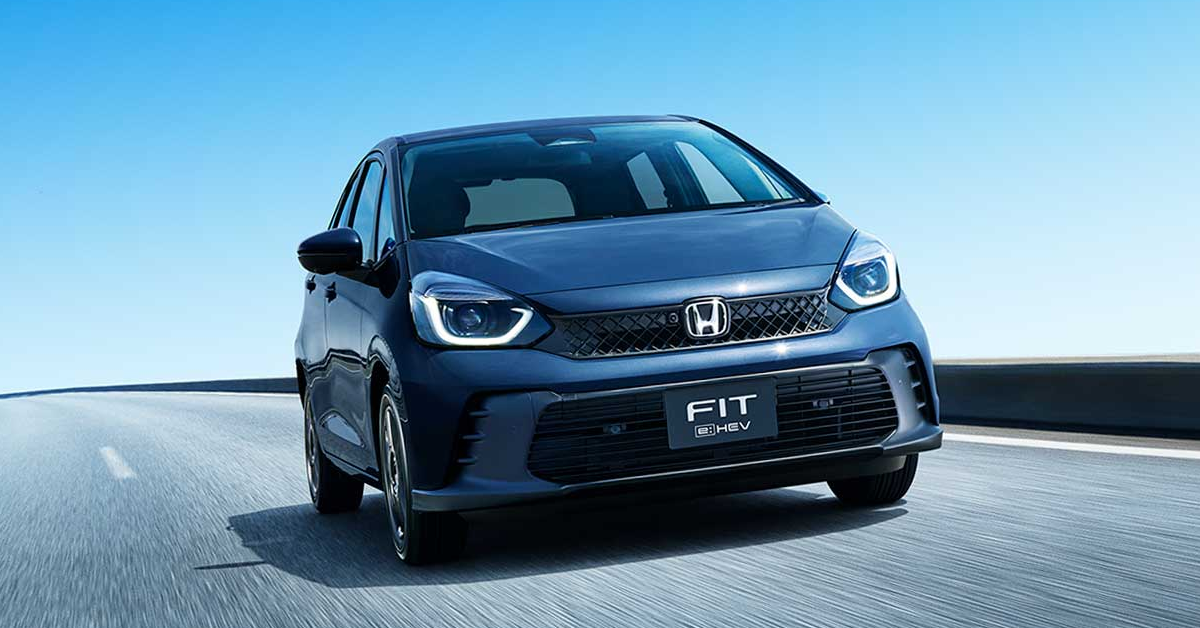
Official press image of the Honda Fit (Japan). | © Honda Motor Co., Ltd.
The Fit is Honda's small hatchback, still sold in Japan and gone from the US since 2020. Here are Honda's own 2026 Japanese types and prices, engines, equipment and colors, the US Fit from 2007 to 2020 and the electric Fit EV.
The Honda Fit is a small five-door hatchback that Honda still sells in Japan, where Honda’s own site lists the 2026 range at ¥1,806,200 to ¥2,955,700 including consumption tax (Honda). Honda’s news release says it made a minor model change to the Fit with sales starting on 10 July 2026 (Honda). The same car is sold as the Jazz in Europe and other markets, and our Honda Jazz article covers the UK car, its grades and its prices. This article focuses on the Japanese Fit and the American Fit.
| Japan price range | ¥1,806,200 to ¥2,955,700 (Honda) |
| Japan update on sale | 10 July 2026 (Honda) |
| Japan types | X, Z, RS, Crosstar (Honda) |
| Hybrid-only type | RS (Honda) |
| Gasoline engine | 1.5L DOHC i-VTEC, CVT (Honda) |
| Hybrid | 1.5L i-VTEC with two motors, e:HEV (Honda) |
| Seats | Five (Honda) |
| US model years | 2007 to 2020 (reported) |
| 2013 Fit EV range | 82 miles (Honda) |
| Fit EV lease | $389 a month for 36 months (Honda) |
The Japanese Fit comes in four types: X, Z, RS and Crosstar (Honda). The release says the old Basic grade became the X and the Home grade became the Z, the RS is hybrid-only, and the Crosstar stays (Honda). Gasoline Fits come in X and Z, using a 1.5-liter i-VTEC engine with a CVT, while the two-motor e:HEV hybrid is offered on all four types, with the RS listed only with front-wheel drive (Honda). Front-wheel drive or 4WD is offered on most types (Honda).
The American Fit is history. Reports say Honda sold the Fit in the US from the 2007 model year until the 2020 model year, then ended sales (reported). American Honda’s 2020 release priced the final LX with a manual at $16,190 before destination, and said Honda Sensing was standard on the EX and EX-L only (Honda). A report says Honda has no active program to bring the Fit back, though an executive called a return something it could consider (reported).
There was also an electric Fit. Honda’s 2012 release said the 2013 Fit EV had a 20 kWh lithium-ion battery, a 92 kW motor, an EPA rating of 118 MPGe and an 82-mile range, and was available only on a 36-month lease at $389 a month (Honda). Honda said it expected to lease about 1,100 of them over three years (Honda). We cover it in its own section, because it is the most unusual Fit and the one with the best Honda documentation.
Where the Fit is sold has narrowed. A report says that from 2020 the Fit was phased out in most Southeast Asian and Latin American countries and replaced by the larger City Hatchback, and withdrawn entirely from North America (reported). Another report says Honda has continued selling it elsewhere because subcompact cars are far more prevalent outside the US (reported). We found no Honda page that lists the Fit’s current markets, so we do not give a country list. Our Honda Models article covers what Honda sells in the US today.
The sections that follow cover the car’s history, the 2026 Japanese grades and prices, the powertrains and dimensions, equipment and colors, the American Fit from 2007 to 2020, the final model year and why it ended, and the Fit EV. Where Honda’s pages disagree with each other or with reports, we give both figures and tag each one. Anything we could not confirm is listed at the end instead of being guessed. All prices are as listed by Honda or by reports on the dates given, and may have changed since.
Reports say the Fit launched in Japan on 21 June 2001, with sales starting the next day, and that it replaced the Logo (reported). A report says the first Fit sold far above its monthly target of 8,000 units and outsold the Toyota Corolla by December 2001 (reported). Another report says it was a last-ditch effort to prove Honda still belonged in the subcompact hatchback game (reported). We did not find a Honda page that describes the 2001 launch, so these are reports.
| First Fit launch in Japan | 21 June 2001 (reported) |
| Sales target, first generation | 8,000 units a month (reported) |
| First hybrid Fit, Japan | October 2010 (reported) |
| Fit EV world debut | November 2011, Los Angeles (Honda) |
| Fourth generation shown | 2019 Tokyo Motor Show (reported) |
| Honda release on Japan update | 9 July 2026 (Honda) |
| Fit series sales in Japan | More than 3.25 million (reported) |
| Global sales by mid-2013 | Almost 5 million (reported) |
| Facelift for Japan and Europe | 2022 (reported) |
| China run-out Fit | 3,000 units, January 2026 (reported) |
Reports describe four generations. The first ran from 2001 to 2008, the second from 2007 to 2014, the third from 2013 to 2020 and the fourth from 2019 to today (reported). A report says the second generation was unveiled in Japan in late 2007 and the third went on sale there in September 2013, and that the fourth was shown at the 2019 Tokyo Motor Show with the e:HEV hybrid system as its highlight (reported). Honda’s pages do not number the generations in the text we read, so the numbering is a report’s.
Honda’s Japanese site gives the present-day picture. Its Fit page lists a price range of ¥1,806,200 to ¥2,955,700 and a news release dated 9 July 2026 on the minor model change (Honda). A report says the Fit marks its 25th anniversary in 2026 (reported). A report says the Fit series, including related models such as the Fit Aria and Fit Shuttle, has sold more than 3.25 million units in Japan since the first generation launched in 2001 (reported).
The Fit had a hybrid early. Reports say a hybrid Fit launched in Japan in October 2010, and a report says a concept electric Fit was shown in 2010 and mass-produced as the Fit EV for 2013 to 2015 (reported). Honda’s own releases date the Fit EV’s world debut to the Los Angeles Auto Show in November 2011 (Honda). The Fit EV was built on the second-generation car, according to reports (reported). A report says earlier Fit hybrids used a different system from today’s e:HEV, and we did not find a Honda page that traces them (reported).
Names differ by region. A report says Honda uses Jazz in Europe, Oceania, the Middle East, Africa, Hong Kong, Macau, Southeast Asia and India, and Fit in Japan, Sri Lanka, China, Taiwan and the Americas (reported). The same report says sales reached almost 5 million by mid-2013 across ten plants in eight countries (reported). We did not find a Honda page that gives a lifetime global total, so we do not estimate one, and the 5 million figure is old.
The fourth generation has been updated more than once. A report says it received a modest facelift in 2022, mainly for Japan and Europe (reported), and Honda’s July 2026 release covers the latest change for Japan (Honda). A report says a run-out Fit with a new face went on sale in China in January 2026 with production capped at 3,000 units (reported). Our Honda history article covers the company’s wider timeline, and we do not repeat it here.
Honda’s release lists prices including 10 percent consumption tax. The gasoline X costs ¥1,806,200 with front-wheel drive and ¥2,026,200 with 4WD, and the gasoline Z costs ¥2,145,000 and ¥2,365,000 (Honda). The e:HEV X costs ¥2,238,500 and ¥2,458,500, the e:HEV Z ¥2,499,200 and ¥2,719,200, the e:HEV RS ¥2,899,600 in front-wheel drive only, and the e:HEV Crosstar ¥2,735,700 and ¥2,955,700 (Honda). The release says prices exclude insurance, other taxes and registration costs. Honda’s own Fit page repeats the range, listing ¥1,806,200 to ¥2,955,700, which matches the lowest and highest figures in the release (Honda, our calculation).
| Gasoline X, FF and 4WD | ¥1,806,200 and ¥2,026,200 (Honda) |
| Gasoline Z, FF and 4WD | ¥2,145,000 and ¥2,365,000 (Honda) |
| e:HEV X, FF and 4WD | ¥2,238,500 and ¥2,458,500 (Honda) |
| e:HEV Z, FF and 4WD | ¥2,499,200 and ¥2,719,200 (Honda) |
| e:HEV RS, FF only | ¥2,899,600 (Honda) |
| e:HEV Crosstar, FF and 4WD | ¥2,735,700 and ¥2,955,700 (Honda) |
| 4WD premium | ¥220,000 on every type (Honda, our calculation) |
| Hybrid premium over gasoline X, FF | ¥432,300 (Honda, our calculation) |
| Swivel seat premium on Z | ¥94,600 (Honda, our calculation) |
| Older list, e:HEV Basic FF | ¥2,138,400 (Honda) |
The pricing is regular. Four-wheel drive adds ¥220,000 on every type that offers it, gasoline or hybrid (Honda, our calculation). The e:HEV adds ¥432,300 over the gasoline X and ¥354,200 over the gasoline Z with front-wheel drive (Honda, our calculation). The RS costs ¥400,400 more than the e:HEV Z and the Crosstar ¥236,500 more (Honda, our calculation). All of those differences come from exact figures in Honda’s own table, so none is an estimate. Honda’s page lists the range as starting at the gasoline X and ending at the e:HEV Crosstar 4WD (Honda).
Swivel-seat versions are priced separately. Honda lists a power-assist swivel passenger seat on the Z, at ¥2,593,800 for the e:HEV with front-wheel drive and ¥2,813,800 with 4WD, and ¥2,239,600 and ¥2,459,600 for the gasoline Z (Honda). That is ¥94,600 above the matching Z in every case (Honda, our calculation). The release does not describe the seat’s operation in the text we read, and the seat is part of Honda’s welfare range alongside driving aids.
An older Honda price list shows how prices have moved. It lists the gasoline Basic at ¥1,720,400 and the e:HEV Basic at ¥2,138,400 with front-wheel drive, and the e:HEV Crosstar at ¥2,627,900 (Honda). Against the 2026 X and Crosstar, those are rises of ¥85,800, ¥100,100 and ¥107,800, or about 5.0, 4.7 and 4.1 percent (Honda, our calculation). The older list is undated in the text we read, and reports show earlier prices in between, so we do not call these the change at the update. Honda’s release also notes that recycling fees apply separately from the prices shown (Honda).
Types are explained by Honda. The release calls the X the entry type with simple equipment, the Z a standard type with sporty design and comfort equipment, the RS a type for people who want more refined design and driving, and the Crosstar a type for weekend active life (Honda). A report says the old range had more than six variants and Honda wanted a simpler, easier-to-remember line-up (reported). Honda’s release does not state a monthly sales target in the text we read.
A buyer’s choice is between price and equipment. The gasoline X is the cheapest Fit, and a report says the e:HEV X is the cheapest hybrid and has the best claimed economy of any type (reported). A report says the RS and Crosstar used to come as gasoline cars, at ¥2,218,700 and ¥2,363,900 before the update, and no longer do (reported). We did not find a Honda page that explains why the gasoline versions were dropped, so we give no reason.
Honda’s Japanese specification sheet lists two powertrains. The e:HEV pairs a 1.5-liter engine rated at 78 kW or 106 PS and 127 N·m with a motor rated at 90 kW or 123 PS and 253 N·m, and a lithium-ion battery (Honda). The gasoline engine, a 1.496-liter unit, is rated at 87 kW or 118 PS and 142 N·m (Honda). The UK Jazz lists 107 PS and 131 Nm for the hybrid’s engine, so the two Honda pages differ slightly, and we give both (Honda).
| Hybrid engine | 1.5L, 78 kW (106 PS), 127 N·m (Honda) |
| Hybrid motor | 90 kW (123 PS), 253 N·m (Honda) |
| Gasoline engine | 87 kW (118 PS), 142 N·m (Honda) |
| Fuel tank | 40 liters (Honda) |
| e:HEV Z length, width, height | 4,080 by 1,695 by 1,540 mm (Honda) |
| Wheelbase | 2,530 mm (Honda) |
| Ground clearance, e:HEV Z FF | 135 mm (Honda) |
| WLTC, e:HEV X | 29.1 km/L (reported) |
| WLTC, e:HEV Crosstar 4WD | 23.3 km/L (reported) |
| Claimed range, e:HEV X | About 1,164 km (Honda, our calculation) |
Fuel economy is reported by type. Reports give the WLTC figures as 29.1 km/L for the e:HEV X, 28.4 for the e:HEV Z, 27.6 for the e:HEV Crosstar with front-wheel drive, 27.0 for the e:HEV RS and 23.3 for the e:HEV Crosstar with 4WD (reported). Honda’s spec sheet carries the WLTC numbers, but the text we read does not tie them to types, and its release does not list them (Honda). We therefore tag every figure as reported and advise checking Honda’s sheet.
The update lowered the claimed figures slightly. A report says the e:HEV Z fell from 29.0 to 28.4 km/L, the e:HEV RS from 27.2 to 27.0, and the e:HEV X from 30.2 to 29.1 against the old Basic (reported). That is a drop of 0.6, 0.2 and 1.1 km/L (reported, our calculation). The report does not give a reason, and we do not guess. With the 40-liter tank listed by Honda, 29.1 km/L implies about 1,164 km on a full tank, and 23.3 km/L about 932 km (Honda, our calculation).
Dimensions are on Honda’s sheet for the e:HEV Z with front-wheel drive: 4,080 mm long, 1,695 mm wide and 1,540 mm high, on a 2,530 mm wheelbase, with 135 mm of ground clearance (Honda). The sheet also lists a set of 4,095 by 1,725 by 1,570 mm that appears to be the Crosstar’s, and a report gives those as the Crosstar’s (reported). Because the Crosstar is wider than 1,700 mm, a report says it is classed as a 3-number-size car in Japan (reported).
Other figures are less clear. Honda’s sheet lists a 40-liter fuel tank, five seats, and tire sizes of 185/60R15, 185/60R16 and 185/55R16, with a minimum turning radius of 4.9 or 5.0 meters that the text we read does not assign to types (Honda). Vehicle weights run from 1,080 to 1,290 kg across the range, and the sheet notes the maximum is for cars with certain options (Honda). We therefore give ranges and not per-type weights. Honda’s sheet also notes that mileage figures depend on test conditions, weather, traffic and driving style (Honda).
There are limits. The text we read does not tie weight, turning radius or WLTC economy to individual types, and Honda’s release has no performance figures. A report says the gasoline car is rated at 118 PS, which matches Honda’s sheet (reported). We found no 0 to 100 km/h time or top speed for the Japanese Fit. Our Honda Jazz article gives the UK car’s acceleration, so readers who want a performance figure should look there, noting that it is a different market.
Honda’s release lists what changed on each type. The X gets a black drink-holder garnish and select-lever escutcheon and a chrome-plated select knob (Honda). The Z gets the RS design for the front grille and both bumpers, a body-colored shark-fin antenna, shark-gray full wheel caps, a leather-wrapped three-spoke steering wheel, front seat heaters, and UV and IR cut glass (Honda). All types get a new clear coat to improve paint gloss (Honda). Honda does not call any color new.
| X change | Black garnish, chrome select knob (Honda) |
| Z change | RS-design grille and bumpers, heated seats (Honda) |
| RS equipment | Honda CONNECT, wireless charger, heaters (Honda) |
| Crosstar equipment | Steering and seat heaters, UV and IR cut glass (Honda) |
| Clear coat | New gloss clear coat on all types (Honda) |
| No-surcharge colors | Crystal Black Pearl, Lunar Silver Metallic (Honda) |
| ¥33,000 colors | Five pearl shades (Honda) |
| ¥55,000 colors | Premium Sunlight White, Premium Crystal Red (Honda) |
| Crosstar two-tone | ¥82,500 (Honda) |
| Honda SENSING | Standard on every type (reported) |
The RS has the longest list. Honda lists a piano-black front grille and rear license garnish, 16-inch black alloy wheels, black front pillars and roof lining, a red-stitched steering wheel, armrest and suede combination seats, a Honda CONNECT display with ETC 2.0, a wireless charger, steering and seat heaters, stainless sport pedals and UV and IR cut glass (Honda). The Crosstar gets a steering heater, front seat heaters and UV and IR cut glass (Honda). Honda’s catalog page lists Honda CONNECT as standard on the Z, RS and Crosstar (Honda).
Honda SENSING comes on every type, according to reports (reported). The reports list collision-mitigation braking, mis-start prevention, adaptive cruise control and lane-keeping assist among its functions (reported). Honda’s release does not detail the safety suite in the text we read (Honda). A report says the e:HEV X also gets full-LED headlamps with daytime running lamps and a fully automatic air conditioner, while the gasoline X has halogen headlamps and a manual air conditioner (reported).
Colors carry surcharges. Honda lists no surcharge for Crystal Black Pearl and Lunar Silver Metallic, ¥33,000 for Sea Bed Blue Pearl, Fjord Mist Pearl, Botanical Green Pearl, Platinum White Pearl and Slate Grey Pearl, and ¥55,000 for Premium Sunlight White Pearl and Premium Crystal Red Metallic (Honda). The Crosstar alone offers black two-tones in Fjord Mist Pearl, Platinum White Pearl or Slate Grey Pearl for ¥82,500 (Honda). The release does not mark any color as new (Honda).
Honda also lists welfare versions. The Tech-Matic system, a hand-operated driving aid for drivers with limited use of their hands or feet, and the Franz system, which lets drivers without arm use drive with their feet alone, are available on the Z and the Crosstar (Honda). Honda’s release says the Franz system goes on sale this autumn and gives the Honda Access customer line for inquiries (Honda). The power-assist swivel passenger seat, priced above, is a separate option on the Z (Honda).
The seats are a Fit hallmark, though Honda’s release does not discuss them in the text we read. A report names the seat arrangements Utility Mode, Long Mode and Tall Mode (reported). We did not find Honda text giving the boot capacity of the Japanese car, and the UK Jazz’s figures are in our Jazz article. A buyer who cares about cargo space should ask a Honda dealer in Japan for the specification sheet, because trim and drivetrain change the figures. Honda’s Fit page footnote describes WLTC as an international cycle that combines urban, suburban and highway driving in average proportions (Honda).
A report says Honda showed a production Fit for the US and Canada at the Detroit auto show in January 2006 and released it in April 2006 as a 2007 model (reported). Another report says it sold 27,934 units in 2006 alone, which it called good for a stop-gap after the Civic hatchback ended in 2000 (reported). Honda’s own pages do not describe the US launch in the text we read, so these are reports. They agree that the US got a car already sold overseas since 2001.
| US debut | April 2006 as a 2007 model (reported) |
| Second generation on sale | 26 August 2008 (reported) |
| Third generation on sale | June 2014 (reported) |
| US sales high mark | About 80,000 around 2009 (reported) |
| US sales in 2020 | Just under 36,000 (reported) |
| US plant | Celaya, Mexico (Honda) |
| 2018 LX manual price | $16,190 (Honda) |
| 2018 Honda Sensing | Standard on EX and above (Honda) |
| Cargo, 2015 to 2020, seat folded | 52.7 cubic feet (reported) |
| Final US model year | 2020 (reported) |
The second generation reached the US for 2009. A report says it was unveiled at the New York auto show on 19 March 2008 and went on sale in North America on 26 August 2008 (reported). A report says 2008 and 2009 were the Fit’s two best sales years in the US, and another puts the high mark at about 80,000 units around 2009 (reported). Reports say cargo space was 20.6 cubic feet behind the rear seat and 57.3 folded for 2009 to 2013 (reported).
The third generation arrived for 2015. A report says the US model debuted at the 2014 Detroit auto show and went on sale in June 2014 (reported). A report says no gasoline Fit was sold for the 2014 model year in the US (reported). Reports quote Honda’s figures for 2015 to 2020 as 16.6 cubic feet behind the rear seat and 52.7 cubic feet folded, which Honda called class-leading (reported). Those are lower than the earlier cars’ figures, as the numbers above show. Honda’s pages in the text we read do not give the third generation’s US launch date, so that date is a report’s.
The 2018 refresh added safety technology. American Honda’s 2018 release says Honda Sensing was available on all 2018 Fit models and standard on the EX and above, a first for the Fit, and that a 7-inch display audio screen with Apple CarPlay and Android Auto came on the Sport, EX and EX-L (Honda). It lists the LX at $16,190 with a six-speed manual and $16,990 with a CVT (Honda). Honda’s releases also say the US car was built in Celaya, Mexico (Honda).
US sales then declined. A report says the Fit peaked at about 80,000 units around 2009 and that Honda delivered just under 36,000 in 2020 (reported). That is a fall of about 55 percent (reported, our calculation). A report says declining sales and low profit margins ended the Fit in the US (reported). Honda’s own pages in the text we read give no reason, and we did not find a Honda statement that does, so we give the reason as a report’s.
The US Fit never had a hybrid. A report lists the final US Fit with a 1.5-liter direct-injected four-cylinder engine and a six-speed manual or a CVT (reported). We found no report of a US-market Fit hybrid, and the Fit EV was lease-only (our finding). A report says the HR-V helped fill the void left by the Fit in the US (reported). Our Honda Models article covers the HR-V and the rest of Honda’s current US line-up.
American Honda’s 2020 release says the 2020 Fit arrives in showrooms on 16 December, with prices before destination of $16,190 for the LX with a manual, $16,990 for the LX with a CVT, $17,600 for the Sport with a manual, $18,400 for the Sport with a CVT and $19,060 for the EX (Honda). Reports put the EX-L CVT at $20,620 (reported). The release says MSRP excludes tax, license, registration and a $930 destination charge, which gives $17,120 for the LX manual (Honda, our calculation). The EX with destination is $19,990 (Honda).
| 2020 LX manual | $16,190 before destination (Honda) |
| 2020 LX CVT | $16,990 before destination (Honda) |
| 2020 Sport manual | $17,600 before destination (Honda) |
| 2020 Sport CVT | $18,400 before destination (Honda) |
| 2020 EX CVT | $19,060 before destination (Honda) |
| 2020 EX-L CVT | $20,620 (reported) |
| Destination charge | $930 in Honda release (Honda); $955 in one report (reported) |
| 2020 LX manual EPA | 29/36/31 mpg (Honda) |
| 2020 LX CVT EPA | 33/40/36 mpg (Honda) |
| Honda Sensing in 2020 | Standard on EX and EX-L only (Honda) |
One report gives a different destination charge. It says the 2020 destination fee rose to $955, which would put the LX manual at $17,145 (reported). The difference from Honda’s $930 is $25, and we cannot say which applied at which dealer. We give both figures. The 2020 LX manual’s base price of $16,190 matches the 2018 LX’s base price exactly, so Honda did not change the entry price over those years (Honda, our calculation). The 2019 EX-L was $20,520 in American Honda’s release (Honda), so the reported 2020 figure of $20,620 is $100 higher (our calculation).
Safety equipment went backward on the cheaper trims. Honda’s 2020 release says Honda Sensing was standard on the EX and EX-L, and no longer available on the LX and Sport (Honda). In 2019, American Honda listed the LX with Honda Sensing at $17,990 and the Sport with it at $19,300, so buyers had paid $1,000 extra for the suite on those trims (Honda, our calculation). Reports say it was only available with the CVT (reported).
Fuel economy is Honda’s EPA rating. The 2020 release lists 29 city, 36 highway and 31 combined for the manual LX, 33, 40 and 36 for the CVT LX, and 31, 36 and 33 for the Sport CVT (Honda). Reports say the 1.5-liter engine made up to 130 horsepower, while another listing gives 128 at 6,600 rpm, so we give both (reported). Honda’s release in the text we read does not list horsepower, and we did not find a Honda page that does.
Why did it end? A report says the Fit’s declining sales and low profit margins sealed it, and that the Civic again became Honda’s cheapest car in the US (reported). Another report says Honda is putting the Civic and HR-V first and that it has no active program to bring the Fit back, though an executive called a return something it could consider (reported). We did not find a Honda statement on the discontinuation, and the explanation here is a report’s.
A new US Fit looks unlikely in the near term. We found no report of a US successor or a return date, and a report says the Fit continues in Japan and other markets (reported). Honda’s July 2026 Japanese release describes only a minor model change (Honda). A report says Honda’s focus is on hybrids and on the Civic and HR-V, which together fill the entry slot (reported). That is a report’s reading, not a Honda announcement, and we do not forecast a return.
Honda’s own releases document the Fit EV well. The Fit EV made its world debut at the Los Angeles Auto Show in November 2011 with a 20 kWh lithium-ion battery and a 92 kW coaxial electric motor, and with exterior dimensions identical to the gasoline Fit apart from a higher hip point (Honda). The 2013 Fit EV was rated by the EPA at 132 city, 105 highway and 118 combined MPGe, with a consumption of 29 kWh per 100 miles and an 82-mile combined range (Honda).
| Fit EV debut | November 2011, Los Angeles (Honda) |
| Fit EV battery | 20 kWh lithium-ion (Honda) |
| Fit EV motor | 92 kW (Honda) |
| Fit EV EPA rating | 132/105/118 MPGe (Honda) |
| Fit EV range | 82 miles combined (Honda) |
| Fit EV lease | $389 a month, 36 months (Honda) |
| Fit EV equivalent MSRP | $36,625 (Honda) |
| Fit EV planned leases | About 1,100 over three years (Honda) |
| Fit EV final model year | 2014 (reported) |
| Fit replaced in Asia and Latin America | By City Hatchback from 2020 (reported) |
It was lease-only and tiny. Honda said the Fit EV would be available for lease from 20 July 2012 in Oregon and California, at $389 a month for 36 months, a price equal to an MSRP of $36,625, and expanding to six East Coast markets in early 2013 (Honda). Honda expected to lease about 1,100 over three years (Honda). The lease price included the $7,500 federal tax credit (Honda). One report puts the base price at $37,415, which differs from Honda’s $36,625 (reported).
The Fit EV was the first Honda with a particular feature. Honda’s overview says it was the first Honda model fitted with a “B” shift position (Honda). Honda’s summary lists a three-mode drive system with Econ, Normal and Sport and a regenerative braking system (Honda). A report says the 2014 model year was the Fit EV’s last and that Honda ended it rather than carry it into the redesigned 2015 gasoline Fit (reported). Our EV article covers Honda’s later electric strategy.
Other markets are patchy. A report says the Fit was phased out in most Southeast Asian and Latin American countries from 2020 in favor of the City Hatchback, and our Honda City article covers that car in Thailand (reported). A report says a run-out Fit with a new face sold in China from January 2026 at 66,800 yuan (reported). Reports say Honda stopped selling the Jazz in India and Australia (reported). We did not find Honda pages for those withdrawals, so each is a report.
Some facts in this article differ by source. Honda’s UK Jazz page lists a 107 PS engine while Honda’s Japanese sheet lists 106 PS (Honda). The US 2020 destination charge is $930 in Honda’s release (Honda) and $955 in one report (reported). The Fit EV’s price is $36,625 in Honda’s release (Honda) and $37,415 in one report (reported). The 2020 engine output is 128 or 130 horsepower depending on the report (reported). We kept every value and its tag.
To sum up what we could not confirm: per-type WLTC economy and weight on Honda’s sheet, a monthly sales target for the Japanese Fit, Honda’s own explanation for the end of the US Fit, a successor or a return date, the cargo space of the Japanese car, Honda pages for the Southeast Asian and Latin American withdrawals, and a global sales total. Everything else in this article is tagged to Honda’s pages or to reports. We will update the sections when Honda publishes more details. Prices and availability may have changed since publication.