 Brands
Honda NSX — Prices, Type S Specs, Type R and Final Year
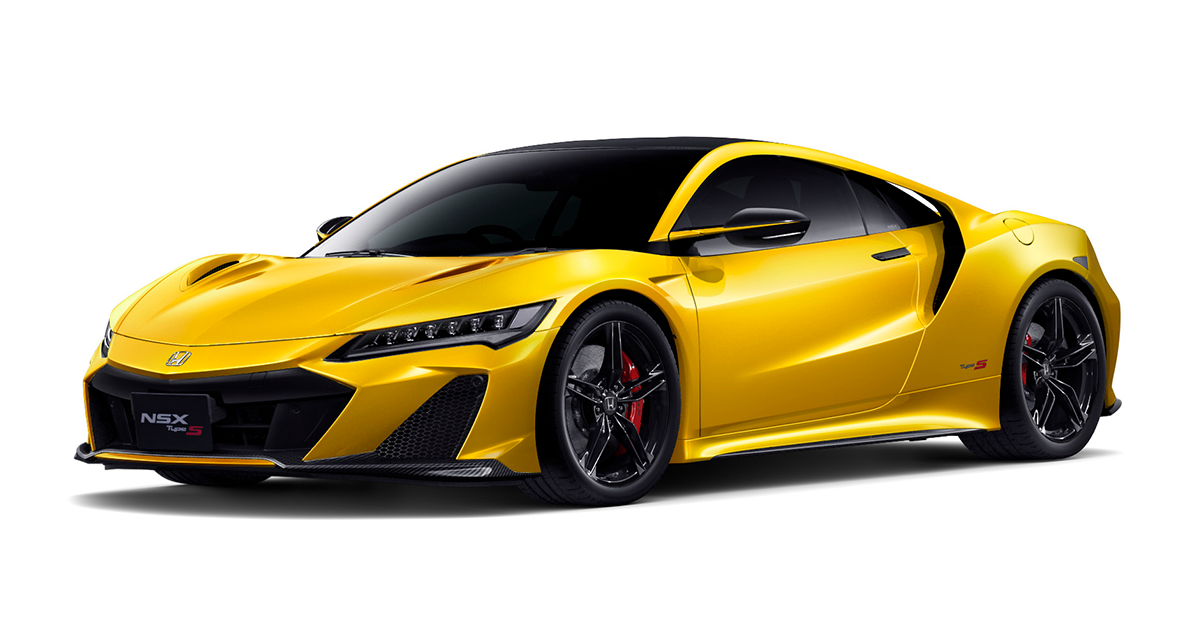
Official press image of the Honda NSX Type S. | © Honda Motor Co., Ltd.
The NSX was Honda's mid-engine supercar, built in two generations. Here are Honda's own Japan and US prices, power figures, Type R and Type S details and how production ended in 2005 and 2022.
The Honda NSX is a two-seat, mid-engine supercar that Honda built in two generations. Honda’s own pages place the first generation’s sales start in September 1990 and its production end in 2005, and the second generation’s launch in August 2016 and its production end in December 2022 (Honda). In North America the car was sold as the Acura NSX, and Honda’s 2005 release says the Acura NSX went on sale in the US in August 1990 and the NSX in Japan in September (Honda). Our Honda Models article covers the cars Honda sells today, and this article covers the NSX from first prototype to final car.
| First generation sales start, Japan | September 1990 (Honda) |
| First generation output, manual | 280 PS at 7,300 rpm (Honda) |
| First generation Japan price | ¥8,000,000 to ¥8,644,000 before tax (Honda) |
| First generation weight, manual | 1,350 kg (Honda) |
| Worldwide sales to June 2005 | More than 18,000 (Honda) |
| Second generation introduced | August 2016 (Honda) |
| Second generation Japan price | ¥23,700,000 with tax (Honda) |
| Type S US price | $169,500 (Honda) |
| Type S Japan price | ¥27,940,000 with tax (Honda) |
| Second generation production end | December 2022 (Honda) |
Honda’s numbers for the first generation come from its 1990 Japanese release. It lists a 3.0-liter 90-degree V6 with 24 valves, DOHC and VTEC, rated at 280 PS at 7,300 rpm with the five-speed manual and 265 PS at 6,800 rpm with the four-speed automatic (Honda). Prices in Japan ran from ¥8,000,000 to ¥8,644,000 before consumption tax, depending on the transmission and the dealer region (Honda). The body is an all-aluminum monocoque that Honda describes as a world first for mass-production vehicles, and the car weighs 1,350 kg with the manual (Honda).
The second generation is a different car. Honda’s release of 25 August 2016 lists a mid-mounted, direct-injected 3.5-liter V6 DOHC twin-turbo, a nine-speed dual-clutch transmission and four-wheel drive called Sport Hybrid SH-AWD, with one rear motor and a front twin-motor unit (Honda). The Japanese price was ¥23,700,000 including 8 percent consumption tax, the first-year sales plan in Japan was 100 units, and customer deliveries began on 27 February 2017 (Honda). The car was built at the Performance Manufacturing Center in Marysville, Ohio (Honda).
The final model is the NSX Type S. Honda’s US release gives it 600 horsepower and 492 lb-ft of torque, up from 573 horsepower and 476 lb-ft on the 2021 NSX, with a US price of $169,500 and $182,500 with the Lightweight Package (Honda). Honda’s Japanese release gives ¥27,940,000 including 10 percent consumption tax and a plan for 350 units worldwide, 30 of them for Japan, with Japanese sales planned for July 2022 (Honda). Honda’s August 2021 release calls it the final model of the second-generation NSX (Honda).
The end of each generation is documented. Honda announced on 12 July 2005 that it would discontinue the NSX, with production for North America ending at the end of December 2005 and production for Europe ending at the end of September 2005, after more than 18,000 units worldwide as of the end of June 2005 (Honda). Honda’s August 2021 release says the second generation’s history concludes in December 2022, when the final Type S is produced (Honda). Reports say the last car was completed on 16 November 2022, and that the second generation sold just under 3,000 cars (reported).
A note on method: figures from Honda’s own pages carry a (Honda) tag, and everything else is tagged as reported. Where sources disagree, we print both values and do not choose between them. Some Honda releases were available to us only through a summary of the page, and where a release did not state a figure we say so rather than fill it from a report without a tag. Prices and availability may have changed since publication, and the last section lists what we could not confirm. Our Honda history article covers the wider company timeline.
Honda’s heritage page dates the start to January 1984, when basic research began at the Wako R&D Center on an underfloor, midship-engine, rear-wheel-drive layout (Honda). In February 1984 the team built a test vehicle from a first-generation City, and the project was shelved because the technology of the time could not deliver a real advantage over front-wheel drive (Honda). Work on the new sports car, code-named NSX, began in earnest in the fall of 1985, and a first prototype followed in mid-1986 (Honda).
| Basic research begins | January 1984 (Honda) |
| Work on NSX in earnest | Fall 1985 (Honda) |
| Chicago Auto Show debut | February 1989 (Honda) |
| Tochigi Plant completed | May 1990 (Honda) |
| Japan sales start | September 1990 (Honda) |
| Type R added | November 1992 (Honda) |
| Type T and F-Matic added | March 1995 (Honda) |
| 3.2-liter manual and Type S | February 1997 (Honda) |
| New NSX-R | May 2002 (Honda) |
| Discontinuation announced | 12 July 2005 (Honda) |
The aluminum body was chosen early. Honda says it settled on an all-aluminum monocoque for the first prototype, and built an aluminum-bodied CR-X with the Suzuka factory to test the material (Honda). It states that aluminum saved about 140 kg on the body and nearly 200 kg on the whole car, and that five aluminum alloys were ultimately used (Honda). The same page says Ayrton Senna drove the test car at Suzuka in February 1989 and called it “a little fragile,” after which Honda raised its rigidity targets (Honda).
The public debut came in February 1989, when Honda showed the NS-X at the Chicago Auto Show as an Acura-brand car (Honda). Test drives began in Japan in June 1989 and then moved to Laguna Seca in the US and to Europe near the Nürburgring (Honda). The page says rigidity rose 50 percent over the figure before the West German tests (Honda). The dedicated Tochigi Plant, now the Takanezawa Plant, was completed in May 1990 and built about 25 cars per day by hand-finishing (Honda).
Honda’s 2005 release lists the model changes. The Type R was added in November 1992, the Type T and the F-Matic automatic arrived in March 1995 with drive-by-wire, and the 3.2-liter manual model with a six-speed manual and the Type S followed in February 1997 (Honda). A new NSX-R was introduced in May 2002 (Honda). Honda’s 2002 release says the original NSX-R, released in November 1992, had a three-year limited production run (Honda). Reports say 209 Type S cars were built between 1997 and 2001 (reported).
The end of the first generation is Honda’s announcement of 12 July 2005. Production for North America would end at the end of December 2005 and production for Europe at the end of September 2005, with more than 18,000 units sold worldwide by the end of June 2005 (Honda). Honda said a successor was in development, described as a new sports car for a new era, and that it would continue maintenance, a Refresh Plan and owners’ meetings (Honda). The release does not give a reason for ending production or a date for other markets (Honda).
The Honda Factbook sets the second generation’s background. It says Honda developed SH-AWD in 2004 and fitted it to the Legend, evolved it in 2014 into the three-motor Sport Hybrid SH-AWD, and in 2016 applied it to a mid-engine layout (Honda). Honda’s August 2021 release says the second generation kept the first generation’s “human-centered supercar” concept (Honda). Our Honda Legend article covers the car that carried SH-AWD first, and our Honda history article covers the company timeline around these dates.
Honda’s 1990 Japanese release gives the engine as a 3.0-liter 90-degree V6 with 24 valves, DOHC and VTEC, displacing 2,977 cm³ with a bore of 90.0 mm, a stroke of 78.0 mm and a compression ratio of 10.2 (Honda). The five-speed manual car is rated at 280 PS at 7,300 rpm and the four-speed automatic at 265 PS at 6,800 rpm, both net, with 30.0 kgm of torque at 5,400 rpm in each case (Honda). Honda’s 35th-anniversary page repeats 280 PS at 7,300 rpm and 30.0 kgf·m at 5,400 rpm (Honda).
| Engine | 3.0-liter V6, 24 valves, VTEC (Honda) |
| Displacement | 2,977 cm³ (Honda) |
| Output, manual | 280 PS at 7,300 rpm (Honda) |
| Output, automatic | 265 PS at 6,800 rpm (Honda) |
| Torque | 30.0 kgm at 5,400 rpm (Honda) |
| Size | 4,430 by 1,810 by 1,170 mm (Honda) |
| Weight, manual and automatic | 1,350 kg and 1,390 kg (Honda) |
| Japan sales plan | 2,000 units a year (Honda) |
| 2002 NSX-R price, Tokyo | ¥11,957,000 before tax (Honda) |
| US price in a report | $60,000 (reported) |
The body and size are listed. The release describes a two-seat, mid-engine, rear-drive coupe with an all-aluminum monocoque, 4,430 mm long, 1,810 mm wide and 1,170 mm tall on a 2,530 mm wheelbase (Honda). Vehicle weight is 1,350 kg with the manual and 1,390 kg with the automatic, and the body-in-white weighs 210 kg (Honda). Honda planned to sell 2,000 units a year in Japan, through its Verno dealers (Honda). Honda’s page also lists a four-channel digital antilock braking system, traction control and an SRS airbag (Honda).
Prices are given before consumption tax. Honda lists ¥8,000,000 for the five-speed manual built at Tochigi and ¥8,644,000 for the four-speed automatic at the Sapporo price, and says prices vary by region (Honda). Sales began on 14 September 1990, the day after the press conference of 13 September (Honda). Reports give a US price of $60,000 (reported) and give the output as 270 horsepower and 210 lb-ft, or 274 PS, which differs from Honda’s 280 PS for Japan (reported). We print both and do not choose between them.
Later engines are covered by reports and Honda’s timeline. Honda’s 2005 release says a 3.2-liter model with a six-speed manual arrived in February 1997 (Honda), and a report gives 290 horsepower for that engine (reported). A report says the automatic kept the 3.0-liter engine at 252 horsepower in some markets (reported). Honda’s own pages we read do not give an output for the 3.2-liter engine, so we give none from Honda. Honda says the Type T, an open-top version, was added in March 1995 (Honda).
The Type R is documented by Honda in Japan. Its 2002 release says the original NSX-R was released in November 1992 as a pure sports model, with a three-year limited production run (Honda). Honda’s archive says it was 120 kg lighter than the base coupe, and the 35th-anniversary page lists the same 4.430 by 1.810 by 1.170 m size and 2.530 m wheelbase (Honda). The page says the Type R name was later inherited by the Integra and the Civic (Honda). Our Honda Integra article covers the Integra Type R.
The 2002 NSX-R came with a published price. Honda lists ¥11,957,000 in Tokyo before consumption tax, rising to ¥12,018,000 in Okinawa, with pearl colors adding ¥150,000, and a 6-speed manual with the 3.2-liter DOHC VTEC V6 (Honda). Honda planned 100 units a year in Japan for the NSX and NSX-R together (Honda). It lists a carbon fiber hood, a rear diffuser, Recaro seats and 215/40R17 front and 255/40R17 rear tires (Honda). Honda’s release does not give an output or a weight for that car (Honda).
Honda’s release of 25 August 2016 says Honda began taking custom orders in Japan that day for the all-new NSX, the first full redesign in 26 years (Honda). The price was ¥23,700,000 including 8 percent consumption tax, excluding insurance, other taxes and registration, and a recycling charge was separate (Honda). The first-year sales plan in Japan was 100 units, and customer deliveries were to begin on 27 February 2017, with cars with iron brake rotors scheduled for May 2017 (Honda).
| Orders opened, Japan | 25 August 2016 (Honda) |
| Deliveries began, Japan | 27 February 2017 (Honda) |
| Japan price | ¥23,700,000 with tax (Honda) |
| Japan first-year plan | 100 units (Honda) |
| Engine | 3.5-liter V6 twin-turbo (Honda) |
| Transmission | 9-speed DCT (Honda) |
| Motors | Three, one rear and two front (Honda) |
| Driving modes | Quiet, Sport, Sport+, Track (Honda) |
| Tires | 19-inch front, 20-inch rear (Honda) |
| Taiwan price in a report | NT$12.8 million (reported) |
The powertrain is described as a mid-mounted, direct-injected 3.5-liter V6 DOHC twin-turbo with dry sump lubrication (Honda). It drives through a nine-speed dual-clutch transmission and four-wheel drive branded Sport Hybrid SH-AWD (Honda). Honda explains that a high-output rear direct drive motor sits with the engine and that a front twin-motor unit drives the left and right front wheels independently, three motors in all (Honda). Honda’s Japanese page adds that the direct-drive motor is connected to the crankshaft (Honda).
Honda’s Japanese page describes the front unit as the TMU, and says it controls negative torque as well as positive torque for torque vectoring across the speed range (Honda). The car has four driving modes, Quiet, Sport, Sport+ and Track, selected with a Dynamic Mode dial (Honda). The brakes are monoblock calipers with six pistons at the front and four at the rear, with carbon ceramic discs as a manufacturer’s option (Honda). Forged aluminum wheels carry 19-inch front and 20-inch rear tires (Honda).
The structure is a multi-material space frame made mostly of high-rigidity extruded aluminum, with fully independent all-aluminum suspension at both ends (Honda). Eight body colors were offered in Japan, and Valencia Red Pearl and Nouvelle Blue Pearl cost ¥670,000 extra while Nord Gray Metallic, Source Silver Metallic and Casino White Pearl cost ¥285,000 extra (Honda). Berlina Black, 130R White and Curva Red were no-cost colors, and four interiors were listed: Ebony, Orchid, Red and Saddle (Honda). The Japanese release lists these in the same order (Honda).
Honda’s North American production began at the Performance Manufacturing Center. Honda’s Japanese release of 18 March 2016 announced that Acura would begin mass production of the North American-specification NSX from late April 2016 (Honda). The August 2016 release says the center is next to Honda’s plant in Marysville, Ohio, and that about 100 associates handle body construction, painting and final assembly (Honda). Honda’s Type S release in the US says the first second-generation car, VIN #001, sold at the 2016 Barrett-Jackson auction for $1.2 million (Honda).
Honda’s pages do not give everything. They do not state a system output, a torque figure, a battery capacity, dimensions or a weight for the 2016 Japanese car (Honda). A report says the first-year planned production sold out, at about three times the price of the first-generation car (reported). A report gives a Taiwan price of NT$12.8 million with a quota of eight cars for 2016 (reported). Honda’s December 2016 release says the NSX won a special prize in the 2016-2017 Japan Car of the Year awards (Honda).
Honda’s Japanese pages for the second generation do not give a system output. A report quoting the specification table gives a system maximum output of 427 kW (581 PS) and a system maximum torque of 646 Nm (65.9 kgm) (reported). The same report gives the rear motor as 35 kW (48 PS) at 3,000 rpm with 148 Nm from 500 to 2,000 rpm, and 73 Nm from 0 to 2,000 rpm for each front motor (reported).
| System output in a report | 427 kW (581 PS) (reported) |
| System torque in a report | 646 Nm (reported) |
| 2021 system output in Honda release | 573 hp (Honda) |
| 2021 system torque in Honda release | 476 lb-ft (Honda) |
| 2021 engine alone | 500 hp, 406 lb-ft (Honda) |
| Type S engine alone | 520 hp, 443 lb-ft (Honda) |
| Type S turbo boost | 16.1 psi peak (Honda) |
| Weight in a report | 1,776 kg (reported) |
| 0 to 60 mph in a report | 3.3 seconds (reported) |
| Top speed in a report | 308 km/h (reported) |
The horsepower figures describe the same output. 581 PS is about 573 horsepower (our calculation), and Honda’s US release for the Type S says the 2021 NSX made 573 horsepower and 476 lb-ft (Honda). The Honda release gives the engine alone as 500 horsepower and 406 lb-ft for the 2021 car (Honda). A report gives a weight of 1,776 kg, a 0 to 60 mph time of 3.3 seconds and a top speed of 191 mph, or 308 km/h (reported). Honda’s pages we read give none of these three figures for the standard car.
Taiwan figures differ in detail. A report on the Taiwanese launch gives a length of 4,485 mm, a width of 1,940 mm, a height of 1,215 mm and a wheelbase of 2,630 mm, with a weight of 1,780 kg (reported). It says the top speed is 308 km/h and that Honda said 0 to 100 km/h took under three seconds (reported). The 1,776 kg and 1,780 kg weights differ by 4 kg and the sources are not the same market, so we print both without choosing. Honda’s pages give none of them.
Standard-car engine figures are limited. Honda’s US release for the Type S says the engine alone made 500 horsepower and 406 lb-ft in the 2021 car, and that the Type S raises it to 520 horsepower and 443 lb-ft (Honda). It says the Type S’s battery has 20 percent more usable capacity and 10 percent more output, but gives no kilowatt-hour figure (Honda). The release lists the Twin Motor Unit gear ratio changing from 8.050:1 to 10.382:1 (Honda). The page does not state a 0 to 60 time or a curb weight (Honda).
The Type S changes are more fully documented. Honda’s US release says the turbochargers are shared with the NSX GT3 Evo, with boost up 6 percent from a peak of 15.2 psi to 16.1 psi, the fuel injectors flow 25 percent more and the intercoolers dissipate 15 percent more heat (Honda). It says the nine-speed dual-clutch transmission gets 50 percent faster upshift response in Sport and Sport+ modes and a Rapid Downshift function (Honda). It says the car laps Suzuka Circuit 2 seconds faster than the 2021 NSX (Honda).
There are conflicts to note. The standard car’s system output is 581 PS in a report and 573 horsepower in Honda’s own US release, which are the same figure in different units (Honda, reported, our calculation). The Type S is 600 horsepower in Honda’s release and 449 kW in a report, while 600 horsepower is about 447 kW (Honda, reported, our calculation). A report puts the 3.3-second 0 to 60 mph time and Honda’s under-three-seconds 0 to 100 km/h claim side by side (reported). We found no Honda page that reconciles them.
Honda’s release of 3 August 2021 says the NSX Type S is the final model of the second-generation NSX and a special model developed in gratitude to customers (Honda). It describes limited production of 350 units worldwide (Honda). Honda’s US release says it debuted on 12 August 2021 at Monterey Car Week and that customer orders opened that day, with a base price of $169,500 and $182,500 with the Lightweight Package (Honda). A report says the destination charge was $1,995, taking the base car to $171,495 (reported).
| World premiere | 3 August 2021 (Honda) |
| US debut | 12 August 2021 (Honda) |
| Output | 600 hp, 492 lb-ft (Honda) |
| Gain over 2021 | 27 hp, 16 lb-ft (Honda) |
| US price | $169,500 (Honda) |
| US price with Lightweight Package | $182,500 (Honda) |
| Lightweight Package weight saving | About 57.8 lbs (Honda) |
| Japan price | ¥27,940,000 with tax (Honda) |
| Production | 350 units (Honda) |
| Destination charge in a report | $1,995 (reported) |
The Type S output is 600 horsepower and 492 lb-ft of torque, up 27 horsepower and 16 lb-ft, from a 3.5-liter twin-turbocharged 75-degree V6 and a three-motor hybrid system (Honda). The engine alone makes 520 horsepower and 443 lb-ft, up from 500 and 406 (Honda). The transmission is a nine-speed dual-clutch unit with faster shifts and a Rapid Downshift function that selects the lowest appropriate gear when the paddle is held for 0.6 seconds (Honda). Honda says Track mode raises the downshift rev threshold by 1,500 rpm (Honda).
The chassis and body changes are listed. Honda says the track is wider by 0.4 inches at the front and 0.8 inches at the rear, with Pirelli P Zero tires in 245/35ZR19 at the front and 305/30ZR20 at the rear and a 6 percent gain in lateral grip (Honda). Standard brakes are Brembo with six-piston front and four-piston rear calipers, and the Lightweight Package adds carbon ceramic Brembo brakes (Honda). The package reduces curb weight by about 57.8 lbs, or 26.2 kg (Honda). A report says the package costs $13,000, which matches the $182,500 less $169,500 (reported, our calculation).
Aerodynamics changed. Honda’s US release lists a larger front grille, four additional sub-radiator openings, a carbon fiber front spoiler, side sills, deck-lid spoiler and rear diffuser, with the diffuser modeled on the NSX GT3 Evo (Honda). A carbon fiber roof is standard and lowers the center of gravity (Honda). Forged split five-spoke wheels come in Matte Shark Grey or Gloss Berlina Black, and the mirrors, door handles and exhaust finisher are Gloss Berlina Black (Honda). The engine cover can be carbon fiber, and the standard cover is red (Honda).
Colors and trim are listed in Honda’s US release. There are 10 colors in all, and Gotham Gray, a matte metallic, is limited to 70 of the 350 cars (Honda). Interiors combine Alcantara and Semi-Aniline Leather in Ebony, Orchid or Red, and full Semi-Aniline seats in Ebony or Red are optional (Honda). The brake calipers come in Black, Silver, Red or Orange with the carbon ceramic option (Honda). Honda’s page does not state a 0 to 60 time, the curb weight or the battery capacity in kilowatt-hours (Honda).
Honda’s Japanese release gives ¥27,940,000 including 10 percent consumption tax, excluding insurance, registration and recycling fees (Honda). It lists 10 exterior colors and 3 interior colors, with Carbon Matte Grey Metallic, Valencia Red Pearl and Nouvelle Blue Pearl at ¥693,000 extra and Long Beach Blue Pearl, Thermal Orange Pearl, Indy Yellow Pearl II and Casino White Pearl at ¥88,000 extra (Honda). The tires are 19-inch front and 20-inch rear (Honda). The Japanese release gives no output, weight or fuel economy (Honda).
Honda’s US release says production is limited to 350 units, with 300 for the US market, and that this is the first NSX Type S sold outside Japan (Honda). Honda’s English release of 3 August 2021 gives 30 for Japan and 320 outside Japan (Honda). Reports give 300 for the US, 20 for Europe and 30 for Japan, which adds up to the same 350 (reported, our calculation). Honda says every 2022 NSX built at the Performance Manufacturing Center in Marysville, Ohio is a Type S (Honda).
| Type S total | 350 units (Honda) |
| US allocation | 300 units (Honda) |
| Japan allocation | 30 units (Honda) |
| Outside Japan in Honda release | 320 units (Honda) |
| Europe allocation in a report | 20 units (reported) |
| Gotham Gray units | 70 (Honda) |
| Japan orders opened | 2 September 2021 (Honda) |
| Japan sales planned | July 2022 (Honda) |
| US sales in 2021 in a report | 128 (reported) |
| US sales in 2020 in a report | 238 (reported) |
The Japanese sale was scheduled for July 2022. Honda’s release of 30 August 2021 says orders opened on 2 September 2021 at NSX Performance Dealers and that 30 units would be sold in July 2022 (Honda). Reports say the Japanese 30 sold out in less than a month and that some dealers stopped taking orders on the first day (reported). A report says the 300 US cars sold out in one day (reported). Honda’s pages we read give no sell-out statement, so these remain reports.
Color names differ between markets. Honda’s US release calls the matte color Gotham Gray and limits it to 70 of the 350 cars (Honda). Honda’s Japanese release lists Carbon Matte Grey Metallic at ¥693,000 extra (Honda), and a report says it is limited to 10 cars in Japan and is Honda’s first matte color (reported). We print both names and do not say whether they are the same paint. The 70-car figure is for the full production run and the 10-car figure is for Japan only, in the sources we read.
Sales of the second generation are reported, not stated by Honda. A report says global sales were just over 2,500 (reported), and another says production ended just short of 3,000 cars (reported). A report says Acura sold 128 NSX in the US in 2021, down from 238 in 2020 (reported). A report says Honda Australia discontinued the car in 2020 after nine sold there (reported), while another says 10 examples arrived between 2016 and 2022, at A$420,000 each (reported). We print each value and its tag.
A few figures sit outside the main production. A report says the rights to the first Type S were sold for $1.1 million at a charity auction in 2021 (reported). Honda’s US release says VIN #001 of the 2016 second-generation car sold for $1.2 million at the 2016 Barrett-Jackson auction, and that it was the base NSX and not a Type S (Honda). These are two different cars. A report says 70 of the Type S cars were Gotham Gray and 350 were built in total (reported).
The final car is covered by reports. They say the 350th car, numbered 350 of 350, was completed on 16 November 2022 in Gotham Gray at the Marysville center (reported). Honda’s August 2021 release says the final Type S would be produced in December 2022 (Honda). A report says the center would continue with limited-edition Acura TLX Type S PMC Edition cars, 100 of each of three NSX-derived colors (reported). The two dates, 16 November 2022 and December 2022, differ, and we print both.
Honda’s own pages announce the end of each generation and give no reason. The 2005 release says production would be discontinued, with North America ending at the end of December 2005 and Europe at the end of September 2005, and that the release does not state a reason (Honda). The August 2021 release says the second generation concludes in December 2022 with the final Type S, and describes the Type S as an expression of gratitude toward customers (Honda). We offer no reason of our own for either decision. Honda’s 2005 release does promise continued maintenance and owners’ meetings after production ends (Honda).
| First generation production end, North America | End of December 2005 (Honda) |
| First generation production end, Europe | End of September 2005 (Honda) |
| First generation total sales | More than 18,000 (Honda) |
| Second generation production end | December 2022 (Honda) |
| Final car date in reports | 16 November 2022 (reported) |
| Second generation sales in reports | About 2,500 to 3,000 (reported) |
| Honda engine-end target in a report | 2040 (reported) |
| Successor in a report | Electric supercar (reported) |
| Honda statement on the reason | Not found |
| Honda page for third generation | Not found |
Reports add context. One says Honda CEO Toshihiro Mibe announced in April 2021 that Honda would end production of petrol and diesel engines globally by 2040, switching to battery and hydrogen fuel-cell electric cars (reported). Another says Acura has reiterated that the next-generation NSX will be an electric supercar, and that other details are scarce (reported). Honda’s 2005 release says a successor was in development at that time (Honda). We found no Honda page on a third-generation car.
Conflicts to note. The 1990 output is 280 PS in Honda’s Japanese release and 274 PS or 270 horsepower in reports (Honda, reported). The second-generation system output is 581 PS in a report and 573 horsepower in Honda’s US release, which are the same figure in different units (reported, Honda, our calculation). The final car was completed on 16 November 2022 in reports and is dated December 2022 in Honda’s release (reported, Honda). Australian sales are nine in one report and 10 in another (reported).
More conflicts: second-generation sales are just over 2,500 in one report and just under 3,000 in another (reported). The 2016 weight is 1,776 kg in one report and 1,780 kg in another (reported). The matte paint is Gotham Gray in Honda’s US release and Carbon Matte Grey Metallic in Honda’s Japanese release (Honda). The Type S Europe allocation is 20 in reports, and Honda’s English release says 320 outside Japan, which is consistent with 300 plus 20 (Honda, reported, our calculation). We kept every value.
What we could not confirm: a Honda page with the second-generation system output and torque, the standard car’s weight and its 0 to 60 time, the Type S’s 0 to 60 time, curb weight and battery capacity in kilowatt-hours, the 3.2-liter engine’s output from Honda, the 2016 US price from a Honda page, the exact number of second-generation cars built, and any Honda statement on the reason for ending. We also did not check Honda Europe pages. Our Honda Models article covers the cars Honda sells now.
A final note on tags. A (Honda) tag means the figure came from a Honda-owned page, including Honda’s global newsroom, its US news site and its Japanese pages, which we read in English extraction. A (reported) tag means the figure came from another outlet, and we do not name outlets in the article. A (our calculation) tag means we derived the figure from tagged values. Prices and availability may have changed since publication, and we will update this article if Honda publishes more on the NSX.
