 Brands
Honda S2000 — Prices, F20C Specs, 2.2L, CR and Final Year
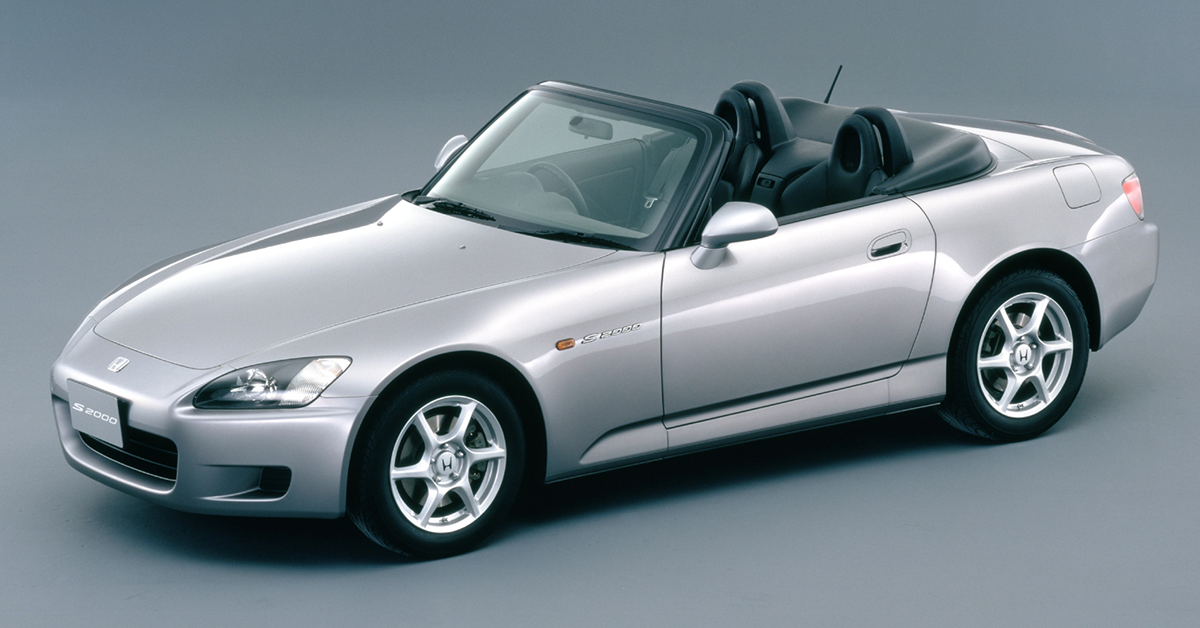
Official press image of the Honda S2000. | © Honda Motor Co., Ltd.
The S2000 was Honda's front-engine, rear-drive roadster. Here are Honda's own Japan and US prices, F20C and 2.2-liter specs, Type V, CR and Type S details and how production ended in 2009.
The Honda S2000 was a front-engine, rear-wheel-drive, two-seat open sports car that Honda no longer builds. Honda’s own pages place its Japanese debut in April 1999 and the end of production for all regions at the end of June 2009 (Honda). Honda’s US release says it was introduced in 1999 as a 2000 model and was originally planned as a limited-edition tribute to Honda’s 50th anniversary (Honda). Our Honda Models article covers the cars Honda sells today, and this article covers the S2000 from prototype to final model year.
| Prototype announced | 24 September 1998 (Honda) |
| Japan debut | 15 April 1999 (Honda) |
| Original Japan output | 250 PS at 8,300 rpm (Honda) |
| Original Japan torque | 22.2 kgm at 7,500 rpm (Honda) |
| Original Tokyo price | ¥3,380,000 (Honda) |
| Engine enlarged to 2.2 liters in Japan | November 2005 (Honda) |
| US CR price, 2008 | $36,300 (Honda) |
| Worldwide sales to December 2008 | More than 110,000 (Honda) |
| US sales | More than 65,000 (Honda) |
| Production end, all regions | End of June 2009 (Honda) |
Honda’s Japanese figures for the original car come from its release of 15 April 1999. It lists a 2.0-liter four-cylinder naturally aspirated DOHC VTEC engine rated at 250 PS at 8,300 rpm and 22.2 kgm of torque at 7,500 rpm, with a maximum engine speed of 9,000 rpm (Honda). Honda says that is 125 horsepower per liter and the highest output of any 2.0-liter four-cylinder naturally aspirated engine at that time (Honda). The Tokyo price for the six-speed manual was ¥3,380,000, and tax treatment is not stated on the page (Honda).
The engine changed in 2005. Honda’s Japanese release of 24 November 2005 says the displacement rose from 2.0 liters to 2.2 liters and that drive-by-wire throttle was added (Honda). Honda’s US release of 1 October 2003 had already described a 2.2-liter engine for the 2004 model year, with 240 horsepower at 7,800 rpm and 162 lb-ft of torque at 6,500 rpm, and a fuel cutoff lowered from 9,000 rpm to 8,200 rpm (Honda). Honda’s 2008 US pricing release lists 237 horsepower at 7,800 rpm and 162 lb-ft at 6,800 rpm (Honda).
The final years added two special models. Honda’s US release says the S2000 CR, a club-racer trim, was first offered in the 2008 model year and starts at $36,300 against $34,300 for the base car, plus a $635 destination charge (Honda). Honda’s Japanese release of 22 October 2007 added a Type S grade with an exclusive interior, aluminum shift knob, front spoiler and large rear spoiler, at ¥3,990,000 including tax (Honda). Both are covered in their own section below.
Honda’s release of 27 January 2009 says production for all regions would conclude by the end of June 2009 and gives total worldwide sales of more than 110,000 units during nine years, as of the end of December 2008, including more than 20,000 in Japan (Honda). Honda’s US release of 26 January 2009 says more than 65,000 had been sold in the US and that the car was sold in 64 countries (Honda). The Honda release gives no reason for ending production (Honda).
A note on method: figures from Honda’s own pages carry a (Honda) tag, and everything else is tagged as reported. Where sources disagree, we print both values and do not choose between them. Some Honda pages were read through a summary of the page, and where a page did not state a figure we say so instead of filling it from a report without a tag. The last section lists what we could not confirm, and prices and availability may have changed since publication.
Honda’s prototype announcement of 24 September 1998 says the S2000 was a concrete form of the Sports Study Model, or SSM, concept car shown at the 31st Tokyo Motor Show in 1995 (Honda). Honda presented the prototype at its 50th anniversary ceremony and said it planned to sell the car in Japan and around the world from the spring of 1999 (Honda). The release describes a front-engine, rear-drive open sports car and says Honda chose a 2-liter displacement (Honda). Honda’s 2009 release also dates the prototype to September 1998 (Honda).
| SSM concept shown | 1995 Tokyo Motor Show (Honda) |
| Prototype announced | 24 September 1998 (Honda) |
| Japan sales start | 15 April 1999 (Honda) |
| Japan domestic plan, 1999 | 500 units a month (Honda) |
| US price announced in a report | $32,000 on 17 September 1999 (reported) |
| Type V added, Japan | July 2000 (Honda) |
| Production moved to Suzuka | April 2004 (Honda) |
| Type S grade added, Japan | October 2007 (Honda) |
| Production end announced | 27 January 2009 (Honda) |
| Last car date in reports | 7 or 19 August 2009 (reported) |
Sales began on 15 April 1999 in Japan through Honda’s Verno dealers, with a domestic plan of 500 units a month (Honda). Honda’s US pages say the car would be built at the new Takanezawa plant in Tochigi, Japan, where the NSX was also built, and would be released in the fall of 1999 as a year 2000 model (Honda). A reproduction of Honda’s US release says the car was priced at $32,000 on 17 September 1999 (reported). Our Honda NSX article covers the other car built at Takanezawa.
The Japanese timeline is in Honda’s 2009 release. The Type V arrived in July 2000, a custom-color plan in September 2001, the Gioire special edition in October 2002 and a minor change with 17-inch wheels in October 2003 (Honda). In April 2004 production moved from the Tochigi factory, called the Takanezawa Plant, to the Suzuka factory (Honda). In November 2005 the engine grew from 2.0 to 2.2 liters, and in October 2007 VSA, satellite speakers and the Type S grade were added (Honda).
The US story differs in timing. Honda’s US release of 1 October 2003 says the S2000 was introduced in 2000 to commemorate Honda’s 50th anniversary, with the aim of a daily driver that is also a capable weekend track car (Honda). Honda’s US release for 2004 names the 2.2-liter engine, 17-inch wheels and retuned suspension as the main changes (Honda). Honda’s 2009 US release says the S2000 CR was first offered in the 2008 model year (Honda). A report says the 2009 model was a continuation with no significant changes (reported).
Honda’s US release of 26 January 2009 says production was extended beyond the limited-edition plan in response to customer demand and critical acclaim (Honda). It says more than 65,000 had been sold in the US since 1999, that the car had been sold in 64 countries, and that it had appeared four times on a leading US magazine’s annual 10Best list (Honda). A report from a 2006 test drive says that with NSX production over, the S2000 stood alone as the car that kept Honda’s origins alive (reported). We found no Honda statement that says so.
The end is dated in three ways. Honda’s global release says production for all regions would conclude by the end of June 2009 (Honda). A report says the last S2000 was produced on 7 August 2009 and the line was shut down (reported), and another report gives 19 August 2009 as the date production ceased (reported). We print all three dates and do not choose between them. A report on the UK market says an Edition 100 marked the end of production with no replacement (reported).
Honda’s Japanese engine page lists the F20C as a water-cooled in-line four with DOHC and four valves per cylinder, displacing 1,997 cm³, with a bore of 87.0 mm, a stroke of 84.0 mm and a compression ratio of 11.7 (Honda). It uses Honda PGM-FI electronic fuel injection and is rated at 250 PS at 8,300 rpm and 22.2 kgm at 7,500 rpm (Honda). Honda’s 2001 specification sheet gives the same output as 184 kW (250 PS) and the torque as 218 N·m (22.2 kgm), both net (Honda).
| Engine code | F20C (Honda) |
| Displacement | 1,997 cm³ (Honda) |
| Bore by stroke | 87.0 by 84.0 mm (Honda) |
| Compression ratio | 11.7 (Honda) |
| Output, Japan | 250 PS at 8,300 rpm (Honda) |
| Torque, Japan | 22.2 kgm at 7,500 rpm (Honda) |
| Maximum engine speed | 9,000 rpm (Honda) |
| High-valve-timing range | 5,850 to 9,000 rpm (Honda) |
| Weight distribution | 50:50 (Honda) |
| Fuel economy, 10·15 mode | 12.0 km/L (Honda) |
Honda’s engine page says the high-valve-timing range runs from 5,850 rpm to 9,000 rpm, a very wide range that gives high response and high output (Honda). The same page credits the output to an evolved VTEC structure, a short stroke and straight intake ports (Honda). Honda’s technical review says the F20C has a 2 mm larger bore and a 4 mm shorter stroke than the F20B engine used in the Accord (Honda). Honda’s tech page says the block uses a half-skirt design split at the crankshaft center and a ladder-frame crankcase (Honda).
The chassis is described in the 1999 release. The engine sits behind the front axle for a 50:50 front-to-rear weight distribution, and the suspension is a newly designed in-wheel double wishbone at all four corners (Honda). Brakes are 16-inch ventilated discs at the front and 15-inch discs at the rear with a compact ABS, and a torque-sensing limited-slip differential is fitted (Honda). The six-speed manual is new, with a short stroke and cross-ratio gearing (Honda). Honda’s page does not state the weight, dimensions or tires (Honda).
Body and equipment are listed. Honda says the open body achieves rigidity and crash safety equal to or better than a closed body, through a High X-Bone frame (Honda). An electric soft top opens or closes in about six seconds, a push-button starter and the main switches sit around the steering wheel, and fuel economy is 12.0 km/L in the 10·15 mode (Honda). The fuel tank holds 50 liters of unleaded premium (Honda). The release says the car meets the 2000 emissions standard with carbon monoxide, hydrocarbons and nitrogen oxides at least 50 percent below the limits (Honda).
Output figures differ by market. Honda’s Japanese release gives 250 PS, which is about 247 horsepower (our calculation), while Honda’s US release for 2004 gives 240 horsepower at 8,300 rpm and 153 lb-ft at 7,500 rpm for the 2003 car (Honda). Honda’s European release calls the car a 240 PS roadster (Honda). A report gives 247 horsepower for Japan and Europe and 240 for the US, and another report says output ranged from 241 to 250 PS by market (reported). We print each value and do not choose between them.
Prices in Japan varied by dealer region. Honda lists the six-speed manual at ¥3,380,000 in Tokyo, ¥3,391,000 in Nagoya, ¥3,396,000 in Osaka, ¥3,407,000 in Fukuoka, ¥3,384,000 in Sendai, ¥3,421,000 in Sapporo and ¥3,461,000 in Okinawa (Honda). Okinawa costs ¥81,000 more than Tokyo (our calculation). Options were BBS alloy wheels at ¥200,000, leather seats at ¥100,000 and Honda DVD navigation at ¥220,000 (Honda). Honda’s page does not say whether these prices include tax (Honda).
Honda’s release of 7 July 2000 announced the S2000 Type V, which went on sale on 14 July 2000 throughout Japan through Honda’s Verno dealerships (Honda). Its headline feature was variable gear ratio steering, called VGS, which Honda described as the first in automotive history (Honda). The system changes the steering gear ratio continuously according to vehicle speed and steering angle, and Honda says it almost halves the lock-to-lock turns, to 1.4 turns, for low-speed maneuvering (Honda). At high speeds Honda says the system gives a smooth ratio similar to conventional steering, without excessive sensitivity (Honda).
| Type V on sale, Japan | 14 July 2000 (Honda) |
| VGS lock-to-lock turns | 1.4 (Honda) |
| Type V monthly plan | 350 units, whole series (Honda) |
| Custom color plan | September 2001 (Honda) |
| Custom plan exterior colors | 13 (Honda) |
| Gioire special edition | October 2002 (Honda) |
| 17-inch wheels, Japan | October 2003 (Honda) |
| 2.2L and drive-by-wire, Japan | 25 November 2005 (Honda) |
| 2005 S2000 price with tax | ¥3,780,000 (Honda) |
| 2005 Type V price with tax | ¥3,990,000 (Honda) |
Honda gave the Type V other changes as well. The release lists a specially developed chassis with dedicated damper units, stabilizer and limited-slip differential, an exclusive Type V steering wheel, a VGS badge on the rear, a new Midnight Pearl body color for all trim levels, and optional red leather seats in all colors (Honda). The domestic monthly sales plan was 350 units for the whole S2000 series (Honda). Honda’s page does not state an engine output for the Type V (Honda).
The price table for the Type V is hard to read. The page gives two unlabeled rows across seven cities, with the first running from 3,380 (thousand yen) in Tokyo to 3,461 in Okinawa and the second beginning at 3,560 in Tokyo, and the final figure in the second row repeats the first row’s Okinawa value (Honda). We do not say which trim each row covers, and the second row may contain a typing error (Honda). Tax treatment is not stated on that page (Honda).
Honda’s 2009 timeline lists the later Japanese steps. In September 2001 a custom-color plan offered 13 exterior colors, five interior colors or patterns and two hood colors (Honda). In October 2002 the Gioire special edition added two exclusive exterior colors, chrome door mirrors, gold wheels and a tan interior (Honda). In October 2003 a minor change brought 17-inch aluminum wheels and exterior and interior changes (Honda). In April 2004 production moved from Tochigi to Suzuka (Honda).
The 2005 change is documented in Honda’s Japanese release. The 2.2-liter DOHC VTEC engine, lower gear ratios and drive-by-wire throttle arrived on 25 November 2005, with 17-inch wheels, 13 body colors including the new Bermuda Blue Pearl and Deep Burgundy Metallic, and two premium colors, Platinum White Pearl and New Imola Orange Pearl (Honda). The S2000 cost ¥3,780,000 including tax and the Type V ¥3,990,000, with a monthly domestic plan of 100 units (Honda). The release gives no output, weight or fuel economy (Honda).
Honda’s Tokyo Motor Show fact book of October 2005 adds that the seats were redesigned from the seat-back frame to raise strength and hold, and that Honda called the car one form of completion for the real open sport car (Honda). A report from a 2006 test drive of the Type V gives a price of ¥4,095,000 for the test car (reported). Honda’s pages we read give no separate Type V price after 2005, so we give none from Honda beyond ¥3,990,000.
Honda’s US release of 1 October 2003 sets out the 2004 changes against the 2003 car. The engine grew from 2.0 to 2.2 liters through a longer stroke, and output stayed at 240 horsepower, but peaked at 7,800 rpm instead of 8,300, while torque rose from 153 lb-ft at 7,500 rpm to 162 lb-ft at 6,500 rpm (Honda). The fuel cutoff dropped from 9,000 to 8,200 rpm, which Honda calls a 9 percent reduction caused by higher piston speed, and the compression ratio went from 11.0 to 11.1 (Honda).
| 2004 engine | 2.2 liters, DOHC VTEC (Honda) |
| 2004 output | 240 hp at 7,800 rpm (Honda) |
| 2004 torque | 162 lb-ft at 6,500 rpm (Honda) |
| 2003 output | 240 hp at 8,300 rpm (Honda) |
| 2003 torque | 153 lb-ft at 7,500 rpm (Honda) |
| 2004 fuel cutoff | 8,200 rpm (Honda) |
| 2004 curb weight | 2,835 lbs (Honda) |
| 2008 US output | 237 hp at 7,800 rpm (Honda) |
| Final Japan output | 178 kW (242 PS) at 7,800 rpm (Honda) |
| Final Japan torque | 221 N·m (22.5 kgm) (Honda) |
Honda says torque and horsepower rise roughly 4 to 10 percent between 1,000 and 8,000 rpm, and that useful power for acceleration starts near 3,000 rpm instead of about 6,000 rpm (Honda). The gear ratios were reconfigured, with first to fourth 4 percent lower, fifth 1 percent lower and sixth 2 percent higher (Honda). Honda’s engine bore and stroke are not in its release, and a reproduction of the 2004 specification sheet gives a 2,157 cc F22C1 with a bore of 87.0 mm and a stroke of 90.7 mm (reported).
The wheels and tires changed too. The 2004 car has 17 by 7 inch front and 17 by 8.5 inch rear wheels with P215/45R17 and P245/40R17 tires, in place of 16 by 6.5 and 16 by 7.5 inch wheels with P205/55R16 and P225/50R16 tires on the 2003 car (Honda). Honda says the front spring rate rose 6.7 percent and the rear fell 10 percent, and the rear stabilizer bar grew from 25.4 to 27.2 mm (Honda). Honda says the drag coefficient improved 5 percent with the new front bumper (Honda).
Size and weight are listed. Honda gives the 2004 curb weight as 2,835 lbs against 2,811 lbs for 2003, with the 24 lb gain attributed to added rigidity and the new wheels and tires, and the dimensions as 162.2 by 68.9 by 50.0 inches, unchanged (Honda). 2,835 lbs is about 1,286 kg, and 162.2 inches is about 4,120 mm (our calculation). Honda’s release lists a shoulder room of 50.7 inches against 48.4 inches, though it states the gain as 0.9 inches or 20 mm, which does not match the table (Honda).
Later US figures differ slightly. Honda’s 2008 pricing release lists the 2.2-liter engine at 237 horsepower at 7,800 rpm and 162 lb-ft at 6,800 rpm for all S2000 models (Honda), while Honda’s 2004 release lists 240 horsepower at 7,800 rpm and 162 lb-ft at 6,500 rpm (Honda). A report puts the 2009 car at 237 horsepower and a 2004 report gives 163 lb-ft of torque (reported). Honda’s page does not say why the rating changed, and we offer no reason of our own.
The Japanese 2.2-liter rating is also given by Honda. Its archive page lists 178 kW (242 PS) at 7,800 rpm and 221 N·m (22.5 kgm) from 6,500 to 7,500 rpm for the final Japanese car (Honda). 242 PS is about 239 horsepower (our calculation), so the Japanese and US ratings are close but not identical. Honda’s 2004 US release notes that the 2.2-liter engine meets California low-emission vehicle standards (Honda). A report gives the 2004 US fuel economy as 20 mpg city (reported).
Honda’s US release of 4 April 2007 introduced the 2008 S2000 CR prototype at the New York show as a club racer-inspired trim, due on sale in the fall of 2007 (Honda). Honda’s pricing release says it went on sale on 9 October 2007 at $36,300, or $37,300 with air conditioning and an AM/FM/CD audio system, against $34,300 for the base car, plus a $635 destination charge (Honda). The base price was $50 higher than 2007 (Honda). The extra cost over the base car is $2,000 (our calculation).
| CR prototype shown | 4 April 2007 (Honda) |
| CR on sale, US | 9 October 2007 (Honda) |
| 2008 base price | $34,300 (Honda) |
| 2008 CR price | $36,300 (Honda) |
| CR with air conditioning and audio | $37,300 (Honda) |
| Destination charge, 2008 | $635 (Honda) |
| CR weight saving, hardtop on | 51 lb (Honda) |
| CR weight saving, hardtop off | 99 lb (Honda) |
| Type S price, Japan | ¥3,990,000 with tax (Honda) |
| CR units reaching the US, report | 699 (reported) |
The CR changes are listed. Honda says a removable aluminum hardtop replaces the soft top, cumulative weight savings total 51 lb with the hardtop installed and 99 lb with it removed, and the car has the new 17-inch wheel design in Kaiser Silver with Bridgestone Potenza RE070 tires and a larger rear tire size (Honda). The suspension has firmer springs and dampers and larger stabilizer bars, the steering ratio is quicker, and there is an added rear body brace, aerodynamic spoilers, a sport-tuned muffler and a peak-power indicator light (Honda).
The CR’s weight savings convert to about 23 kg and about 45 kg (our calculation). Honda’s US release says the engine is the same 2.2-liter, 237 horsepower, 162 lb-ft unit as in all S2000 models (Honda), and a report says there is no difference in power ratings between the base car and the CR (reported). Honda’s page does not state a CR production number or limit (Honda). A report says Honda planned 1,500 to 2,000 CR cars and that records show 699 reached the US (reported), and another report says a limited run of 1,500 (reported).
Japan received a different special grade. Honda’s release of 22 October 2007 added the Type S on 25 October 2007 with VSA and satellite speakers now standard on every type (Honda). The Type S has exclusive black and yellow fabric seats and interior, an aluminum shift knob, a black emblem, a front spoiler, a large rear spoiler, tuned suspension, Kaiser Silver wheels and a tire repair kit (Honda). Honda describes the aero parts and the suspension as aimed at aerodynamic performance and steering response (Honda). Our Honda Integra article covers Honda’s Type R and Type S names on other cars.
Japanese prices rose slightly. The 2007 S2000 cost ¥3,864,000 including tax (¥3,680,000 before tax) and the Type S ¥3,990,000 (¥3,800,000 before tax), with a domestic plan of 100 units a month (Honda). The base car cost ¥84,000 more than the 2005 price of ¥3,780,000 (our calculation), and the Type S cost ¥126,000 more than the 2007 base car (our calculation). Honda says the October 2007 change also made every Honda sold in Japan meet the health ministry’s guideline on interior volatile organic compounds (Honda).
Honda’s US release of 26 January 2009 lists the 2009 S2000 CR as a club racer-inspired trim, with photos and a prototype video but no unit count, price or specifications (Honda). A report lists the 2009 US price as $35,465 to $38,465 (reported). Honda’s Japanese pages describe the final model as announced in October 2007 and ended in June 2009 (Honda). We found no Honda statement on the total number of CR cars built, and the unit figures here are reports.
Honda’s own US price pages we could read cover 2008. They give $34,300 for the base car, $36,300 for the CR and $37,300 for the CR with air conditioning and audio, with a $635 destination charge (Honda). That adds up to $34,935 for the base car with destination (our calculation). For the launch, a reproduction of Honda’s US release gives $32,000 for the 2000 car (reported), and a report gives a $415 transportation charge, for $32,415 (reported). The base car therefore cost $2,300 more in 2008 than at launch (our calculation). A listing gives $32,440 as the 2000 base price, which differs from the $32,000 list price (reported).
| Launch price in a report, US | $32,000 (reported) |
| Launch transportation charge in a report | $415 (reported) |
| 2008 base price, US | $34,300 (Honda) |
| 2008 base price with destination | $34,935 (Honda, our calculation) |
| 2004 MSRP in four reports | $32,800 to $33,315 (reported) |
| 2009 range in a report | $35,465 to $38,465 (reported) |
| 1999 Japan price, Tokyo | ¥3,380,000 (Honda) |
| 2005 Japan price with tax | ¥3,780,000 (Honda) |
| 2007 Japan price with tax | ¥3,864,000 (Honda) |
| 2007 Type S price with tax | ¥3,990,000 (Honda) |
Reports disagree on the 2004 price. One gives $33,290 as the original MSRP (reported), another $32,800 (reported), another $33,315 (reported) and another $33,260 (reported). A report gives $33,150 for 2005 (reported). Honda’s 2004 release in the text we read gives no price, so we print all four values and do not choose between them. They range over $515 from lowest to highest (our calculation). A report lists the 2009 US range as $35,465 to $38,465 (reported).
For Japan, Honda’s pages give prices at several points. The 1999 car cost ¥3,380,000 in Tokyo (Honda). The 2005 car cost ¥3,780,000 including tax or ¥3,600,000 before tax, and the Type V ¥3,990,000 or ¥3,800,000 (Honda). The 2007 car cost ¥3,864,000 or ¥3,680,000, and the Type S ¥3,990,000 or ¥3,800,000 (Honda). The 5 percent consumption tax difference matches the 2005 figures, since ¥3,600,000 plus 5 percent is ¥3,780,000 (our calculation).
Options and extras are priced in Honda’s Japanese releases. In 1999, BBS alloy wheels cost ¥200,000, leather seats ¥100,000 and Honda DVD navigation ¥220,000 (Honda). In 2005, navigation cost ¥231,000 including tax and leather seats and interior ¥105,000, and premium colors added ¥210,000 (Honda). In the US, a report says no options were offered at launch, a Honda tradition (reported), and Honda’s US release lists an aluminum hardtop and satellite radio as dealer-installed options for 2009 (Honda).
Elsewhere, reports give other prices. A report from Australia lists the S2000 at A$73,590 in 2009, with three cars left in dealer stock and orders accepted until the end of April (reported). A report from 2004 says the 2.2-liter car cost $33,260 in the US and returned 20 mpg in the city and 28 mpg on the highway (reported), while another gives 20 and 25 (reported). Honda’s pages we read give no fuel economy for the US car, so we offer the conflicting highway figures without choosing.
Used-car prices are outside Honda’s pages. A report says the S2000 has become a modern classic with a significant appreciation in price for good examples (reported). Honda’s own pages give no residual value, and we make no price forecast. Honda’s Japanese monthly sales plan fell from 500 units in 1999 to 350 for the series in 2000 and 100 units in 2005 and 2007 (Honda). Honda’s US release says the car was sold in 64 countries, so prices outside Japan and the US are not covered here (Honda). Our Honda Models article covers the Honda sports cars on sale now, and prices and availability may have changed since publication.
Honda’s global release of 27 January 2009 announces that production for all regions would conclude by the end of June 2009 and gives no reason (Honda). It says the S2000 achieved total sales of more than 20,000 units in Japan and more than 110,000 worldwide in the nine years of production, as of the end of December 2008 (Honda). Honda’s US release says the car was originally meant as a limited-edition tribute and that production was extended in response to demand (Honda). We give no reason of our own for the decision.
| Production end, Honda | End of June 2009 (Honda) |
| Last car in one report | 7 August 2009 (reported) |
| Last car in another report | 19 August 2009 (reported) |
| Worldwide sales to December 2008 | More than 110,000 (Honda) |
| Japan sales to December 2008 | More than 20,000 (Honda) |
| US sales | More than 65,000 (Honda) |
| Countries sold in | 64 (Honda) |
| Built, in one report | 110,673 (reported) |
| Reason for ending, Honda | Not stated (Honda) |
| Successor from Honda | Not found |
Reports offer context, which we mark as theirs. One says a steady decline in sales made the end a foregone conclusion and that no replacement was on the horizon (reported). Another says global sales were falling for most brands (reported). A third says Honda had only ever meant it as a limited-run model (reported). A report from the US says the end came during a deep recession (reported). A report on the Australian market says three cars were left in stock when the news came (reported). None of these is a Honda statement.
Conflicts to note. The end of production is the end of June 2009 in Honda’s release, 7 August 2009 in one report and 19 August 2009 in another (Honda, reported). The final-car plant is the Suzuka factory in Honda’s timeline from April 2004, while a report from January 2009 says the car was built in Tochigi (Honda, reported). The 2004 US price is $33,290, $32,800, $33,315 or $33,260 in four reports (reported). The CR build number is 699 in one report and 1,500 in another (reported).
More conflicts: the original Japanese output is 250 PS in Honda’s Japanese release and 240 PS in Honda’s European release (Honda). The 2.2-liter US output is 240 horsepower in Honda’s 2004 release and 237 horsepower in its 2008 release (Honda). The final Japanese output is 242 PS (Honda). The torque in 2004 is 162 lb-ft in Honda’s release and 163 lb-ft in a report (Honda, reported). The total built is 110,673 in one report, against Honda’s more than 110,000 sold (reported, Honda). We kept every value.
What we could not confirm: a Honda page with the S2000’s curb weight and dimensions for the original 1999 car, Honda’s US price page for the 2000 model, the 2005 to 2007 US prices from Honda, the number of CR cars built, the number of Type S cars sold in Japan, the exact date the last car was built, and any Honda statement on a successor. We also did not check Honda Europe pages beyond the 1999 launch note. Our Honda history article covers the company timeline around these dates.
A final note on tags. A (Honda) tag means the figure came from a Honda-owned page, including Honda’s global newsroom, its US news site, its Japanese pages and its European news site, which we read in English extraction. A (reported) tag means another outlet gave it, and we do not name outlets in the article. A (our calculation) tag means we derived the figure from tagged values. Prices and availability may have changed since publication, and we will update this article if Honda publishes more on the S2000.