 Brands
Honda Element — Prices, i-VTEC Specs and Trims
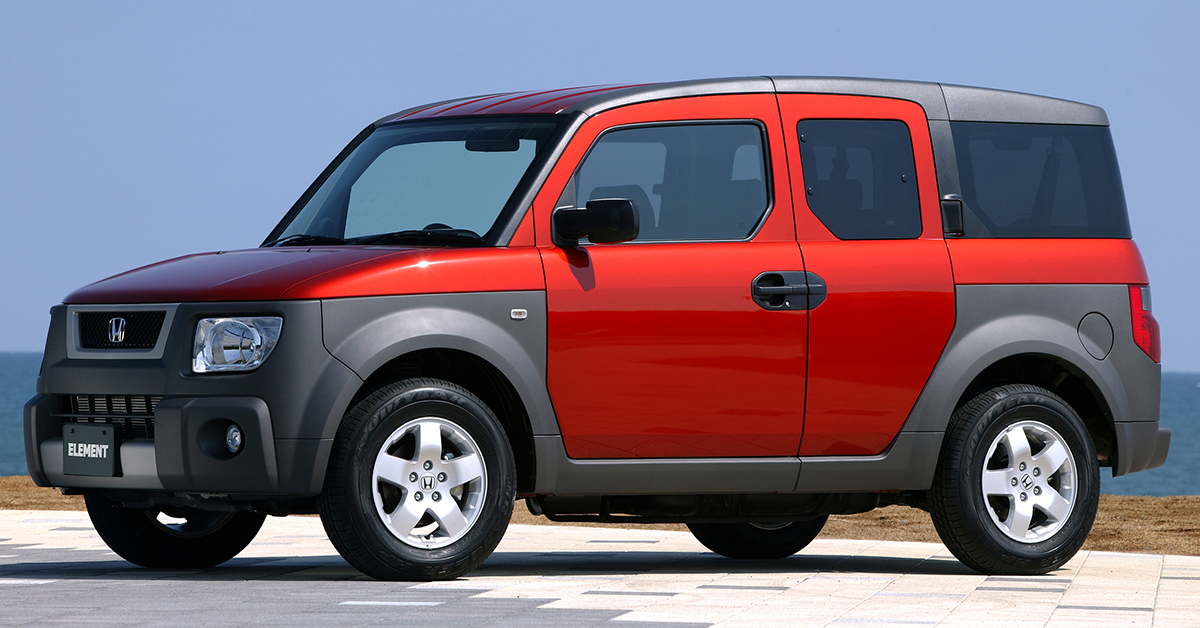
Official press image of the Honda Element. | © Honda Motor Co., Ltd.
The Element is Honda's boxy compact SUV, sold from 2002 to the 2011 model year. Here are Honda's own specs, trims and prices, plus what reports say about how it ended.
The Honda Element is a boxy compact SUV that Honda sold in the United States from December 2002 to the 2011 model year (Honda). Honda’s own release describes it as a vehicle with a multi-functional cargo area, versatile seating, a durable interior, energetic performance and outstanding value (Honda). It was built at the East Liberty Auto Plant in Ohio (Honda). Honda developed it through Honda R&D Americas, and it grew out of the Model X concept shown in Detroit in 2001 (Honda). Our Honda Models article covers the rest of the range. Honda’s overview says the cargo area can haul items up to 10 feet long, such as a surfboard, and that the Element has side cargo doors and a functional rear tailgate (Honda).
| Body style | Boxy compact SUV (Honda) |
| Production plant | East Liberty, Ohio (Honda) |
| On sale in the U.S. | December 2002 (Honda) |
| Model X concept shown | 2001 Detroit show (Honda) |
| 2003 engine | 2.4 L i-VTEC, 160 hp (Honda) |
| 2007 engine | 2.4 L i-VTEC, 166 hp (Honda) |
| 2003 starting MSRP | $16,100 (Honda) |
| 2011 starting MSRP | $20,825 (Honda) |
| Final model year, in reports | 2011 (reported) |
| U.S. sales, in reports | More than 325,000 (reported) |
Honda lists a 2.4-liter DOHC i-VTEC four-cylinder engine for the 2003 Element, with 160 hp at 5,500 rpm and 161 lb-ft of torque at 4,500 rpm (Honda). It came with a 4-speed automatic or a 5-speed manual, and Real Time 4WD was available (Honda). For 2007 Honda raised output to 166 hp and added a 5-speed automatic (Honda). The 2003 car had a 101.4-inch wheelbase and cargo space of 25.1 to 74.6 cubic feet (Honda).
Honda’s 2003 price list started at $16,100 for the 5-speed manual and $16,900 for the 4-speed automatic (Honda). By 2011 Honda’s list started at $20,825 for the 2WD LX and reached $24,185 for the 4WD EX, before an $810 destination charge (Honda). The 2011 LX 2WD is $4,725 above the 2003 manual price (Honda, our calculation). Prices and availability may have changed since publication, and these are original prices, not used-car values.
Honda ended the Element after the 2011 model year. Reports say American Honda announced on December 3, 2010, that 2011 would be the final model year of production, and that more than 325,000 had been sold in the United States since December 2002 (reported). Honda’s own 2011 pricing release, dated October 22, 2010, lists only the LX and EX in 2WD and 4WD, with no SC (Honda). We cover the reports on the end of production in the last section.
The Element had a few trims over its life. Honda’s 2003 pages list the DX and the EX (Honda), and the 2004 release added an LX (Honda). The 2007 release added the sport-tuned SC (Honda), and Honda’s 2009 release describes three styles that ranged from the LX to the EX to the SC (Honda). The 2011 price list shows the LX and EX only (Honda). The tables in each section repeat the dated figures.
A note on method: figures from Honda’s own pages carry a (Honda) tag, and everything else is tagged as reported. Where sources disagree, we print both values and do not choose between them. Figures we derive ourselves are tagged as our calculation. Honda’s Element pages are from 2002 to 2010, so some of their figures use rating methods that Honda has since changed, and exchange rates are not applied to any figure here. The last section lists what we could not confirm.
Honda’s 2003 overview says development began in 1998 with a group of young designers and engineers from Honda R&D Americas (Honda). Their goal was a vehicle with the utility that young, active buyers wanted but could not get in a pickup truck or a large SUV (Honda). The Model X concept debuted at the 2001 North American International Auto Show in Detroit, and the strong response led to production as the Element for the 2003 model year (Honda). The same release calls the Element rugged, basic and accommodating (Honda).
| Development began | 1998 (Honda) |
| Model X concept | 2001 Detroit show (Honda) |
| Production announced | March 27, 2002, New York (Honda) |
| U.S. on-sale month | December 2002 (Honda) |
| First-year sales forecast | About 50,000 (Honda) |
| Forecast price range, 2002 | $16,000 to $21,000 (Honda) |
| Core buyer age, Honda | 16 to 24 (Honda) |
| Median buyer age, a survey | 42 (reported) |
| Japan on-sale date | April 18, 2003 (Honda) |
| Japan price before tax | ¥2,590,000 (Honda) |
American Honda announced the Element on March 27, 2002, at the New York International Auto Show (Honda). The release calls it an all-new light truck based on the Model X concept, built on Honda’s Global Compact Platform and powered by a 2.4-liter, 160 hp i-VTEC four-cylinder (Honda). It says the Element would have center-opening “swing-wide” doors with no B pillar and that Honda targeted a Five Star side impact rating (Honda). It expected about 50,000 sales in 2003 and pricing from $16,000 to $21,000 (Honda).
Honda’s overview gives the target buyer. It says the core market was buyers aged 16 to 24, the upper end of Generation Y, and adds that the vehicle should appeal more to a frame of mind than to an age group (Honda). It says 60 percent of first-time new car buyers were 29 or younger (Honda). It says sales in the 16 to 24 group were roughly 100,000 units in 1995 and roughly 850,000 by 2001 (Honda). A report says a survey of 2003 buyers found that 67 percent were over 35 and the median age was 42 (reported).
Honda’s release says the 2003 Element would go on sale in December 2002 (Honda). Tom Elliott, executive vice president of American Honda Motor Co., Inc., is quoted saying the Element incorporates a wide variety of unique features based on input from a new, active, young generation of buyers (Honda). The 2004 release says the Element was developed by Honda R&D Americas in Torrance, California, and Raymond, Ohio, and manufactured at Honda’s East Liberty Plant in Ohio using domestic and globally sourced parts (Honda).
Honda’s Japanese release, dated April 16, 2003, says the Element would go on sale on April 18 at Honda Verno dealers throughout Japan (Honda). It says the Element was developed by Honda R&D Americas, Inc., and built at the East Liberty Auto Plant of Honda of America Mfg., Inc., for import to Japan (Honda). It lists one model, with a 2.4-liter DOHC i-VTEC engine, a 4-speed automatic and real-time 4WD, at ¥2,590,000 before consumption tax (Honda). Honda rates its fuel use at 10.6 km per liter in the 10-15 mode (Honda).
Honda’s Japanese release explains the design and the name. It says the design follows a lifeguard station motif, familiar to young Americans who seek a free and active lifestyle, and that the name draws on the four elements of earth, air, fire and water (Honda). It lists five colors for Japan, including a new Sunset Orange Pearl (Honda). It says the body is centre-pillarless with freestyle doors on both sides, and that the cargo space can take a ten-foot surfboard (Honda).
Honda’s 2003 fast facts list a 2.4-liter aluminum alloy in-line four of 2,354 cc, with a DOHC 16-valve i-VTEC valve train and multi-point fuel injection (Honda). It makes 160 hp at 5,500 rpm and 161 lb-ft at 4,500 rpm (Honda). Honda’s page prints emissions as LEV-II and Tier 2 Bin 5 and lists an electronic ignition with immobilizer (Honda). The drivetrain is front-wheel drive with a 4-speed automatic or a 5-speed manual (Honda), and Honda’s overview adds that Real Time 4WD was available (Honda).
| Engine, 2003 | 2.4 L DOHC i-VTEC, 2,354 cc (Honda) |
| Output, 2003 | 160 hp at 5,500 rpm (Honda) |
| Torque, 2003 | 161 lb-ft at 4,500 rpm (Honda) |
| Wheelbase | 101.4 in. (Honda) |
| Length, width, height, 2003 | 166.5, 71.5, 70.4 in. (Honda) |
| Curb weight, 2003 manual and automatic | 3,352 and 3,403 lb (Honda) |
| Cargo volume, 2003 | 25.1 to 74.6 cu ft (Honda) |
| Fuel tank | 15.9 gal. (Honda) |
| Towing | 1,500 lb (Honda) |
| EPA, 2003 manual | 21 city, 25 highway (Honda) |
The chassis is a unit body on the Global Compact Platform, which Honda says is structurally similar to the 2002 CR-V (Honda). The front suspension is a MacPherson strut and the rear is a double wishbone, with 30.0 mm and 21.0 mm stabilizer bars (Honda). Honda’s chassis page says the Element has a lower floor than the CR-V and no B pillar (Honda). It says the suspension design facilitates light-duty off-road use and gives a turning radius of 34.2 feet (Honda). Our Honda CR-V article covers the sister model. Honda’s 2004 release says the underpinnings are similar to the CR-V’s, with changes to the unit body for the pillarless design, and that composite panels around the fenders improve dent resistance (Honda).
Honda lists the 2003 dimensions: a 101.4-inch wheelbase, a 166.5-inch length, a 71.5-inch width and a 70.4-inch height, with a track of 62.1 inches front and 62.3 inches rear (Honda). Curb weight is 3,352 lb for the manual and 3,403 lb for the automatic, and towing is 1,500 lb (Honda). Reports give base curb weights of 3,595 lb and 3,577 lb for the 2003 EX (reported), which are above Honda’s 3,352 and 3,403 lb. We print both as a conflict.
Honda lists cargo volume of 25.1 to 74.6 cubic feet and passenger volume of 58.6 cubic feet in front and 103.6 cubic feet for front and rear together (Honda). Seating capacity is four (Honda). The fuel tank holds 15.9 gallons (Honda). EPA mileage is 21 city and 25 highway for the manual and 22 and 26 for the automatic (Honda). Reports list 21 and 24 for one 2003 EX and 19 and 23 for another listing (reported), and neither matches Honda’s figures.
Brakes and steering are described twice. Honda’s fast facts list four-wheel disc brakes with anti-lock braking and a variable-assist power rack-and-pinion steering (Honda). Honda’s chassis page lists four-wheel discs, 11.1-inch ventilated front discs and 11.1-inch solid rear discs, with ABS and Electronic Brake Distribution on EX models, and a power steering box with internal dampening valves (Honda). We print both descriptions, since Honda’s own pages differ on whether ABS was standard and on the steering type.
Wheels and tires also carry a printing conflict. Honda’s fast facts list 16-inch steel wheels and P215/70 R16 99(S) tires (Honda). Honda’s chassis page lists wheels of 16 by 16.5 inches in a five-bolt pattern, silver-painted steel with a black center cap on the DX and silver alloy on the EX, with Goodyear Wrangler HP tires (Honda). Honda’s 2007 specification page lists 16 by 6.5 inch wheels (Honda), so the 16.5 figure looks like a misprint, but Honda does not say so.
Honda’s 2003 interior release says much of the Element’s functionality comes from an interior that combines the best traits of a pickup truck, an SUV and a cargo van (Honda). It lists four missions: everyday driving, cargo hauling, base camp functionality and sleep capability (Honda). The seats fold into several positions from upright to fully flat or removed, and Honda lists “versatile seating arrangements (64+)” as a design feature (Honda). Upright, the Element seats four including the driver (Honda).
| Seating | Four seats (Honda) |
| Front seat slide | 11 in. (Honda) |
| Rear seat split | 50/50, flip-up, removable (Honda) |
| Floor | TPO topcoat with urethane coating (Honda) |
| Cargo hooks | Six (Honda) |
| Cupholders | Five (Honda) |
| EX audio | 7 speakers, 270 watts (Honda) |
| EX subwoofer | 6.5 in. (Honda) |
| 10-foot surfboard | 120.0 x 24.0 x 2.7 in. (Honda) |
| 4WD roof option | Removable rear skylight (Honda) |
The front seats slide 11 inches forward and back, and the passenger seat has a memory fold-forward feature (Honda). The removable flip-up rear seats split 50/50 and recline independently, and they can fold up and latch to the side with carabiner hooks or be removed entirely (Honda). A walk-through space between the front seats is available when the vehicle is stationary (Honda). Honda says the seats fold down to form a flat lounge suitable for napping (Honda).
The floor is a hard, flat utility floor with a thermoplastic olefin topcoat and a urethane coating (Honda). Honda says it is scratch resistant and water resistant and can be swept or wiped clean, and that no carpeting is standard (Honda). The front seats use waterproof FXC fabric, and the rear seats use vinyl on the DX and water-repellent fabric on the EX (Honda). The spare tire sits under the floor behind the rear seats, and its cover can serve as a table with accessory legs (Honda). Honda’s 2004 release says waterproof seat material covered the front and rear bucket seats, and the front only on the DX (Honda).
Honda gives benchmark cargo sizes. A 10-foot surfboard is listed as 120.0 by 24.0 by 2.7 inches, a mountain bike as 70.0 by 24.0 by 39.3 inches, and skis as 74.0 inches long (Honda). A 27-inch television is 24.8 by 31.1 by 27.6 inches and a bookcase is 11.8 by 36.2 by 48.0 inches (Honda). The release lists six cargo hooks and an accessory roof rack (Honda). The 2004 release says the rear tailgate bottom opens to seat two people and the top forms a canopy (Honda).
The EX audio is a 7-speaker, 270-watt AM/FM/CD/AUX system with a 6.5-inch subwoofer, which Honda says performs like a 10-inch unit (Honda). The DX has no audio unit or speakers but a pre-wired 2DIN slot, and its subwoofer space is a storage bin (Honda). The release lists five cupholders, a three-bin tray above the glove box, door pockets on all four doors and an overhead bin on the EX (Honda). It lists air conditioning with high airflow and 360-degree direction control (Honda).
Honda lists trim equipment. The EX adds cruise control, air conditioning, power mirrors, a driver armrest and rear 12-volt outlets (Honda). The 2004 release says the DX had 16-inch steel wheels and power windows, the LX added AM/FM/CD audio with four speakers and air conditioning with micron filtration, and the EX had alloy wheels, ABS, cruise control, power mirrors and the 270-watt audio (Honda). Real Time 4WD models add a removable rear skylight that tilts (Honda), and the 2004 release says it stores inside the vehicle (Honda).
Honda’s 2003 fast facts list MSRPs of $16,100 for the 5-speed manual and $16,900 for the 4-speed automatic (Honda). The 2004 release gives a starting price of $16,100 (Honda). Honda’s March 2002 announcement had forecast a range of $16,000 to $21,000 (Honda). A report lists 2003 prices of $17,500 for the 4WD DX manual, $18,300 for the 4WD DX automatic and $19,450 for the 2WD EX automatic (reported). Honda’s pages that we read do not list those trims. Honda’s 2004 release lists the DX, LX and EX trims by equipment but gives only the $16,100 starting price (Honda).
| 2003 DX manual | $16,100 (Honda) |
| 2003 DX automatic | $16,900 (Honda) |
| 2009 LX 2WD, release | $20,175 (Honda) |
| 2009 LX 2WD, price page | $20,275 (Honda) |
| 2009 destination | $670 and $710 (Honda) |
| 2010 LX 2WD | $20,525 (Honda) |
| 2010 EX 2WD | $22,635 (Honda) |
| 2010 SC 2WD | $24,320 (Honda) |
| 2011 LX 2WD | $20,825 (Honda) |
| 2011 EX 4WD | $24,185 (Honda) |
Honda’s Japanese release priced the single Japanese model at ¥2,590,000 before consumption tax (Honda). The 2002 U.S. forecast and the Japanese price are in different currencies and markets, and exchange rates are not applied here. Honda’s 2007 release does not list prices (Honda), and Honda’s 2007 specification page lists none either (Honda). A report lists 2007 prices from $18,900 to $22,695 (reported), and another gives $21,100 for a 2007 LX (reported).
Honda’s October 2008 release gave the 2009 Element a starting price of $20,175 for the 2WD LX plus a $670 destination charge (Honda). Honda’s 2009 pricing and EPA page lists the 2WD LX automatic at $20,275 with a $710 destination charge, the 2WD EX at $22,385 and the 2WD SC at $23,270 for the manual and $24,070 for the automatic (Honda). It lists the 4WD LX at $21,475 and the 4WD EX at $22,785 for the manual and $23,585 for the automatic (Honda). We print $20,175 and $20,275 as a conflict.
Honda’s 2010 list, dated October 9, 2009, gives $20,525 for the 2WD LX, $22,635 for the 2WD EX, $24,320 for the 2WD SC, $24,335 for the 2WD EX with navigation, $21,775 for the 4WD LX, $23,885 for the 4WD EX and $25,585 for the 4WD EX with navigation, with a $780 destination charge (Honda). The 2010 LX is $250 above the $20,275 2009 figure (Honda, our calculation). The 2010 EX is $250 above the 2009 EX (Honda, our calculation).
Honda’s 2011 list, dated October 22, 2010, gives $20,825 for the 2WD LX, $22,935 for the 2WD EX, $21,075 for the 4WD LX and $24,185 for the 4WD EX, with an $810 destination charge (Honda). Reports give $22,075 for the 4WD LX and $780 for destination (reported), and one report lists the EX at $22,935 with a $1,250 all-wheel-drive charge (reported). The 4WD EX is $1,250 above the 2WD EX (Honda, our calculation), and the 4WD LX is $250 above the 2WD LX (Honda, our calculation).
The 4WD price gaps conflict. Honda’s 2011 list gives a $250 gap on the LX and $1,250 on the EX (Honda, our calculation), while a report says all-wheel drive costs $1,250 in both 2010 and 2011 (reported). Honda’s 2010 list gives $1,250 on the LX and $1,250 on the EX (Honda, our calculation). Honda does not explain the smaller 2011 gap on the LX (Honda). Honda’s 2010 and 2011 lists both say MSRP excludes tax, license, registration, destination and options, and that dealer prices may vary (Honda). We print the number as Honda printed it. Prices and availability may have changed since publication.
Honda’s 2004 release is dated October 6, 2003. It adds a new LX trim level that brings popular features to the DX, a passenger seat armrest on the EX, keyless entry on the EX and bungee cords on the driver-side front and rear seatbacks of the EX (Honda). It replaces Eternal Blue Pearl with Fiji Blue Pearl (Honda). It quotes a starting price of $16,100 (Honda). It says the Element has attracted new people to the Honda family who want a rugged and practical vehicle (Honda).
| 2004 release date | October 6, 2003 (Honda) |
| 2004 new trim | LX (Honda) |
| 2004 starting MSRP | $16,100 (Honda) |
| 2004 front crash rating | Five stars (Honda) |
| 2007 release date | August 24, 2006 (Honda) |
| 2007 output | 166 hp (Honda) |
| 2007 automatic | 5-speed (Honda) |
| 2007 SC ride height | Lowered 20 mm (Honda) |
| 2007 SC wheels | 18 x 7 in. alloy (Honda) |
| 2007 SC new color | Root Beer Metallic (Honda) |
The 2004 release gives safety details. It says the Element earned a five-star government crash rating for front passengers (Honda). Driver and passenger front airbags are standard, along with front seat belts with load limiters and buckle pre-tensioners, and side airbags are available on EX models only (Honda). The 2003 overview had said Honda anticipated five-star ratings for front and side impacts (Honda). Honda’s 2004 release gives no side-impact result (Honda).
Honda’s release for the 2007 model year is dated August 24, 2006. It says the Element underwent a significant transformation with updated exterior and interior styling, enhanced safety equipment and more horsepower (Honda). All models gained side curtain airbags, Vehicle Stability Assist, Brake Assist, a tire pressure monitoring system and integrated front seat belts (Honda). The release also lists a Drive-by-Wire Throttle System, a black cargo floor, new instrument panel and radio styling, and keyless entry on the LX (Honda).
The 2007 engine gained 10 hp. Honda’s release gives 166 hp at 5,500 rpm and 160 lb-ft at 4,000 rpm, with a 5-speed automatic replacing the 4-speed (Honda). Honda’s 2007 specification page lists 166 hp at 5,800 rpm for the LX and 5,500 for the EX and SC, with torque of 161 lb-ft at 4,000 rpm (Honda). We print 160 and 161 lb-ft, and 5,500 and 5,800 rpm, as conflicts. A global Honda release notes the rating is SAE net revised in August 2004 (Honda).
The SC was new for 2007. Honda’s release lists a sport-tuned suspension with a ride height lowered by 20 mm, exclusive 18-inch alloy wheels, a carpeted floor in the seating areas, a center console with beverage holders, an auxiliary audio jack and copper-hue meter illumination (Honda). It adds its own grille, projector beam headlights and a monochromatic paint scheme with painted bumpers and trim (Honda). A new SC-only color was Root Beer Metallic (Honda). Honda’s April 2006 release called the SC a prototype that would go on sale that fall (Honda).
Honda’s 2007 specification page lists the SC at 170.8 inches long and 69.5 inches high, against 169.3 and 70.4 inches for the LX and 170.3 and 70.4 inches for the EX (Honda). It lists the SC on 18 by 7 inch alloy wheels with P225/55R18 tires and curb weights of 3,529 lb for the manual and 3,596 lb for the automatic in 2WD (Honda). It gives cargo volume of 25.1, 70.1 and 74.6 cubic feet for 2WD and up to 77.1 for 4WD (Honda). It lists total interior volume of 133.2 cubic feet for 2WD and 135.7 for the 4WD LX and EX (Honda).
Honda’s October 2008 release announced the restyled 2009 Element with a more chiseled exterior and a refreshed interior (Honda). It lists a new front grille and bumper design, metal front fenders in place of composite, a new hood, squared wheel arches and new headlight and taillight configurations (Honda). It names three styles that ranged from the rugged and simple LX to the more refined EX to the sporty SC (Honda). It quotes Dick Colliver, executive vice president of American Honda Motor Co., Inc. (Honda).
| 2009 release | October 2008 (Honda) |
| 2009 styles | LX, EX and SC (Honda) |
| 2009 front fenders | Metal, not composite (Honda) |
| 2009 new options | Navigation, rearview camera, USB (Honda) |
| 2009 SC drive | 2WD only (Honda) |
| 2010 price list date | October 9, 2009 (Honda) |
| 2010 destination | $780 (Honda) |
| 2011 price list date | October 22, 2010 (Honda) |
| 2011 destination | $810 (Honda) |
| 2011 SC | Dropped (reported) |
The interior was updated for 2009. Honda lists brighter color schemes with titanium-look side linings, new fabric patterns, revised switchgear and meter graphics, and a restyled low-profile center console that is standard on the LX (Honda). The EX gets a convertible center console with a removable cooler and storage box, and the EX and SC get a modular three-compartment overhead console (Honda). Honda’s list of new features includes a satellite-linked navigation system with voice activation on automatic EX and SC models, a rearview camera and USB connectivity (Honda).
Honda’s 2009 release keeps the powertrain. It lists the 2.4-liter i-VTEC four-cylinder with a standard 5-speed manual or an available 5-speed automatic, and Real Time 4WD on the LX and EX (Honda). It says the LX and EX came in 2WD and 4WD and that the SC was 2WD only (Honda). It gives EPA mileage of 20 city and 25 highway for 2WD automatics and 18 and 23 for manuals (Honda). Honda’s price page lists 19 and 24 for 4WD automatics and 18 and 23 for the 4WD manual (Honda).
The 2010 and 2011 years were mostly carryovers. Honda’s 2010 list adds navigation versions of the EX at $24,335 for 2WD and $25,585 for 4WD (Honda). A report says Honda dropped the youth-oriented SC for the 2011 model year (reported), and Honda’s 2011 list shows no SC (Honda). The 2011 list gives EPA figures of 20, 25 and 22 for 2WD and 19, 24 and 21 for 4WD, and advises against comparing them with models before 2008 (Honda). A report says navigation was no longer offered on the 2011 EX (reported).
The Dog Friendly package has a date conflict. Reports say Honda launched a Dog Friendly Element accessory package in 2009 (reported), while another report says Honda added it for 2010 (reported). A report puts its price at $1,000 for 2010 and 2011 and says it came after the Element won a pet-oriented Dog Car of the Year award in 2007 (reported). The package included a cushioned pet bed and rear ventilation, according to a report (reported). Honda’s 2010 pricing page does not mention the package (Honda).
Reports say Honda’s 2009 restyle took its grille from the Pilot. One report says the Element received the Pilot-style family grille and lost some of its black body cladding (reported), and another says the restyle matched the new fascia on the Ridgeline and Pilot (reported). A report says the SC lost 2 mpg in city and highway mileage compared with the earlier model (reported). Honda’s own release does not mention the Pilot (Honda). Our Honda Pilot article covers that SUV.
Reports say American Honda announced on December 3, 2010, that the 2011 Honda Element would be the final model year of production (reported). A report quotes John Mendel, executive vice president of American Honda, saying the Element proved that ultimate functionality can often come from thinking inside the box and that it made boxy vehicle designs cool (reported). Another report says Honda would offer 2011 models in the United States while Canada wound down sales with remaining 2010 stock (reported). Honda’s own pages that we read carry no end-of-production notice (Honda).
| End announced, in reports | December 3, 2010 (reported) |
| Final model year, in reports | 2011 (reported) |
| U.S. sales since 2002, in reports | More than 325,000 (reported) |
| 2003 U.S. sales, one report | 67,478 (reported) |
| 2003 U.S. sales, another report | 67,099 (reported) |
| 2010 sales, one report | 12,961 (reported) |
| Canada, in a report | Remaining 2010 stock (reported) |
| Honda end-of-production page | Not found (Honda) |
| Dog Friendly package, reports | 2009 or 2010 (reported) |
| Replacement, in a report | None indicated (reported) |
Reports give the sales story. One says the Element sold 67,478 units in the United States in 2003, its first full year (reported), while another says 67,099 (reported). A report says sales peaked near 70,000 in 2003 and later fell below 15,000 a year (reported), and another gives a 2010 total of 12,961 (reported). A report quotes Honda saying the Element accounted for nearly 9 percent of Honda’s sales in 2004 and just over 1 percent in the past two years (reported). We print 67,478 and 67,099 as a conflict.
Reports offer reasons for the end. One says the Element was long in the tooth and that competition grew with the Scion xB, the Kia Soul and the Nissan Cube (reported). A report says the Element made up nearly 10 percent of compact SUV sales in 2003 and 2.5 percent in 2010 (reported). Another says the median age of buyers rose from 42 to 52 (reported). A report says there was no indication of a direct replacement and that a lifestyle-oriented model might come from the next CR-V (reported). Honda’s pages give no reason (Honda).
Several figures conflict. Honda’s 2003 pages give 160 hp at 5,500 rpm and 161 lb-ft (Honda), while its 2007 pages give 166 hp at two different speeds and torque of 160 or 161 lb-ft (Honda). The 2009 LX is $20,175 in a release and $20,275 on a price page (Honda). Destination was $670 in the release and $710 on the price page (Honda). The Dog Friendly package dates to 2009 or 2010 in reports (reported). Reports disagree on 2003 sales and Honda’s 2003 pages disagree on ABS and steering (reported, Honda).
What we could not confirm: a Honda page announcing the end of production, Honda’s own sales totals by year, the Dog Friendly package date and price, a Honda crash-test result beyond the 2004 front-passenger rating, the full 2003 trim prices, a Honda page for 2005 and 2006 model-year changes, the ground clearance and the AWD system details. Honda’s 2009 pricing chart in the release is an image, so we used the separate price page. We also did not read Honda’s Canadian pages.
Reports say Honda sold nearly 325,000 in the United States since December 2002 (reported), and Honda’s pages that we read do not state a total (Honda). Honda’s 2003 overview says the Element defines its own spot in the entry-level corner of the light truck segment (Honda). Prices and availability may have changed since publication, and exchange rates are not applied to any figure here. Our Honda history article covers the models that followed it.