 Brands
Honda Freed — Prices, e:HEV Specs and Generations
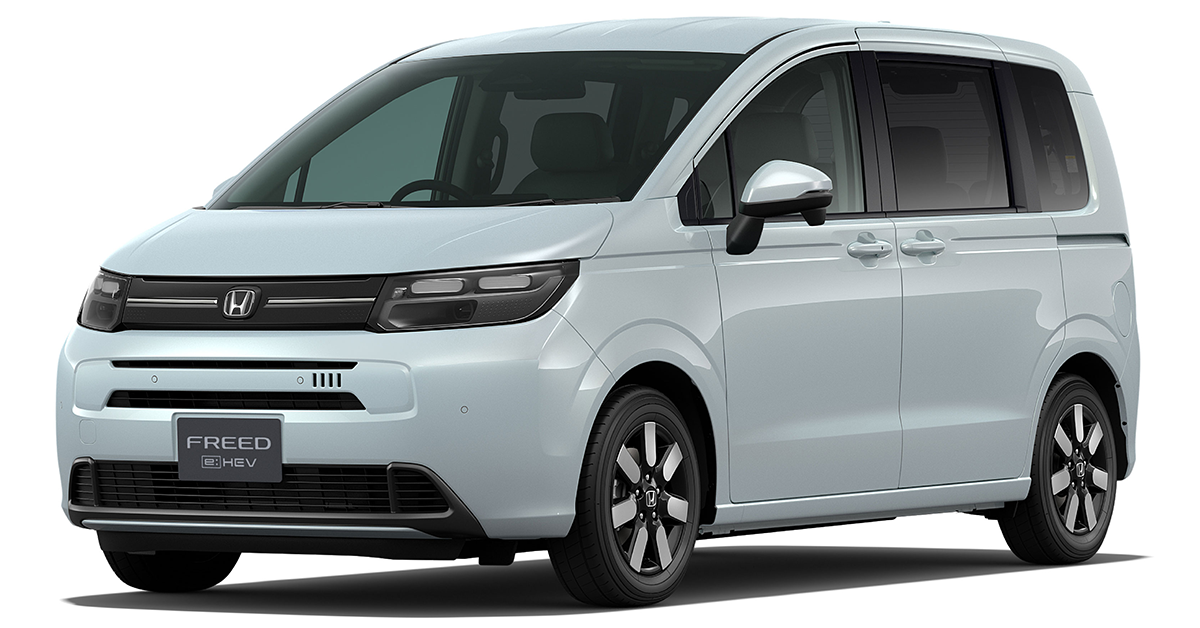
Official press image of the Honda Freed. | © Honda Motor Co., Ltd.
The Freed is Honda's Japan-market compact minivan, now in its third generation. Here are Honda's own specs and yen prices for every generation, plus where Honda pages and reports disagree.
The Honda Freed is a compact minivan that Honda began selling in Japan on May 30, 2008 (Honda). Honda’s 2024 release describes the current model as the third-generation Freed, on sale from June 28, 2024 (Honda). The Honda pages we read are Japanese-market releases, and they quote prices in yen with consumption tax, so every price in this article is in yen and we do not convert currencies. Our Honda Models article covers the wider range, and our Honda Step WGN article covers another Honda minivan sold in Japan. Honda’s 2008 release explains the name as a combination of “freedom” with “free” and “do” (Honda). Prices and availability may have changed since publication, and exchange rates are not applied.
| Body style | Compact minivan (Honda) |
| First sale | May 30, 2008 (Honda) |
| Generations to date | Three (Honda) |
| Current generation on sale | June 28, 2024 (Honda) |
| Styles | AIR, AIR EX, CROSSTAR (Honda) |
| Powertrains | 1.5 L e:HEV hybrid, 1.5 L gasoline (Honda) |
| Seating | 5, 6 or 7 (Honda) |
| Launch sales plan | 6,500 units a month (Honda) |
| Orders after one month | About 38,000 (Honda) |
| Price range, November 2026 | ¥2,673,000 to ¥3,848,900 (Honda) |
Honda’s November 2026 release lists the current Freed in two styles, AIR and CROSSTAR, with an AIR EX grade and a BLACK STYLE special edition on the AIR EX and CROSSTAR (Honda). Honda’s 2024 release says the hybrid models carry Honda’s two-motor e:HEV system, fitted to the Freed for the first time (Honda). It adds that a gasoline model with a 1.5-liter DOHC i-VTEC engine stayed in the range (Honda). Honda lists seating for 5, 6 or 7 depending on the type (Honda). Honda’s May 2024 preview page describes the grand concept as “Smile Just Right Mover” and says both AIR and CROSSTAR have three-row seating (Honda).
Honda’s November 2026 price table runs from ¥2,673,000 for the gasoline AIR in front-wheel drive with six seats to ¥3,848,900 for the e:HEV CROSSTAR in 4WD with five seats, both with tax included (Honda). The e:HEV AIR in front-wheel drive with six seats is ¥3,022,800 in the same table (Honda). Honda also lists welfare models that are exempt from consumption tax, such as the e:HEV CROSSTAR slope at ¥3,679,000 (Honda). Honda notes that these are reference prices and that dealers set the actual selling price (Honda).
Honda’s July 2024 order release says cumulative orders reached about 38,000 units by July 27, 2024, about a month after launch, against a monthly sales plan of 6,500 units (Honda). Honda calls that about six times the plan (Honda), and our arithmetic gives 5.85 times (our calculation). The same release says the e:HEV took 83 percent of orders and gasoline models 17 percent (Honda). It also says front-wheel drive took 85 percent and 4WD 15 percent (Honda).
The Freed range has grown in steps that Honda documents release by release. The compact multi-wagon Freed Spike followed on July 8, 2010 (Honda), and the first hybrids, the Freed Hybrid and Freed Spike Hybrid, went on sale on October 28, 2011 (Honda). The second-generation Freed and Freed+ followed on September 16, 2016 (Honda), the CROSSTAR grade was added on October 18, 2019 (Honda), and the third generation went on sale in June 2024 (Honda). Later sections cover each step in turn, with Honda’s own figures first.
A few widely repeated claims did not appear on the Honda pages we read. One report says the third-generation Freed won the Japan Car of the Year award for 2024 (reported), and another report gives cumulative Freed sales of 1.47 million units (reported). A third report says Honda’s November 2026 update changed the grand concept to “Flair Just Right Mover” (reported), but Honda’s November 2026 release page does not mention that wording. We label each of these as reported and do not treat them as Honda statements.
Honda announced the first Freed on May 29, 2008, and sales in Japan began on May 30, 2008 (Honda). Honda’s release says the car was developed under the concept “Freedom to create the perfect lifestyle” (Honda). It gives the front-wheel-drive body as 4,215 mm long, 1,695 mm wide and 1,715 mm high, with a 2,740 mm wheelbase and a 5.2 m minimum turning radius (Honda). The same release lists a second-row floor height of 390 mm on front-wheel-drive models and a 600 mm opening for the sliding rear doors (Honda). Our Honda — History, Models and Everything You Need to Know article places the Freed within the wider Honda range.
| Announced | May 29, 2008 (Honda) |
| Sales began | May 30, 2008 (Honda) |
| Concept | Freedom to create the perfect lifestyle (Honda) |
| Length x width x height, FF | 4,215 x 1,695 x 1,715 mm (Honda) |
| Wheelbase | 2,740 mm (Honda) |
| Minimum turning radius | 5.2 m (Honda) |
| Second-row floor height, FF | 390 mm (Honda) |
| Seating | 5, 7 or 8 (Honda) |
| Launch sales target | 4,000 units a month (Honda) |
| Lowest launch price | ¥1,638,000, Freed Flex 5 CVT FF (Honda) |
Honda’s 2008 release describes three seating layouts. The seven-passenger layout has captain’s seats in the second row with a walk-through, and Honda calls it the first seven-passenger vehicle in its class (Honda). The eight-passenger layout uses a 60:40 split tumble bench in the second row, and Honda says it is the only 1.5-liter-class minivan with eight-passenger capacity (Honda). The five-passenger layout has two rows and what Honda calls best-in-class cargo space (Honda). The release lists a CVT and a 5-speed automatic, depending on the model (Honda).
Honda’s launch price list ran from ¥1,638,000 for the Freed Flex 5 with a CVT in front-wheel drive to ¥2,257,500 for the Gi Aero with a CVT in front-wheel drive, with tax included (Honda). The release also gives the before-tax figures of ¥1,560,000 and ¥2,150,000 (Honda), which implies a 5 percent consumption tax at the time (our calculation). Honda set a monthly sales target of 4,000 units in Japan (Honda). It gave the front-wheel-drive fuel economy as 16.4 km per liter in the 10-15 mode (Honda).
Honda’s release also covered mobility versions. Honda lists a side lift-up seat model, a passenger lift-up seat model and a wheelchair-accessible model, the last with an aluminum ramp at an 11-degree slope (Honda). The side and passenger lift-up versions went on sale May 30, 2008, and the wheelchair-accessible model on June 20, 2008 (Honda). Honda’s before-tax prices were ¥2,058,000 for the side lift-up seat X, ¥2,098,000 for the passenger lift-up seat G and ¥2,210,000 and ¥2,250,000 for the two wheelchair-accessible models (Honda).
Honda’s early 2009 release gives the first sales figures. It says the 3-row Freed sold 35,758 units in the second half of 2008, from July to December, which ranked first among registered minivans (Honda). The same release says the Freed ranked fourth among registered passenger cars in the same period (Honda). It also records that the Freed won the 2008-2009 Japan Car of the Year special award, “Best Value,” in November 2008 (Honda). The release attributes the monthly registration data to the Japan Automobile Dealers Association (Honda).
Two more first-generation steps are on Honda’s pages. The Freed Spike, a compact multi-wagon, was announced on July 8, 2010 with a monthly target of 2,500 units and a type C price of ¥1,598,000, or ¥1,521,905 before tax (Honda). Honda explains the name as “Free” plus “do,” with the idea of a tough, functional and playful car like spike shoes (Honda). On October 27, 2011 Honda announced the Freed Hybrid and Freed Spike Hybrid for sale on October 28, 2011, with the Integrated Motor Assist system and 21.6 km/L in the JC08 mode (Honda). Honda calls them Japan’s first 5-number class minivan and tall wagon hybrids, based on its September 2011 data (Honda).
Honda began sales of the all-new Freed and Freed+ in Japan on September 16, 2016 (Honda). Honda’s Japanese release gives the concept as “7days Wonderful Mobility,” aimed at use anytime, anywhere and by anyone, and says it evolves the “just right” idea of the first model (Honda). The Freed is the three-row version for 6 or 7 occupants, and the Freed+ is a two-row version for 5 (Honda). Honda’s sales plan was 6,000 units a month in Japan (Honda). Honda lists 16 type variations and 9 body colors (Honda).
| Sales began | September 16, 2016 (Honda) |
| Models | Freed (3-row) and Freed+ (2-row) (Honda) |
| Monthly sales plan | 6,000 units (Honda) |
| Orders after one month | More than 27,000 by October 16, 2016 (Honda) |
| Gasoline engine | 1.5 L direct-injection DOHC i-VTEC, CVT (Honda) |
| Hybrid system | SPORT HYBRID i-DCD (Honda) |
| Hybrid fuel economy | 27.2 km/L, JC08 (Honda) |
| Length | 4,265 mm (Honda) |
| Wheelbase | 2,740 mm (Honda) |
| Entry price, Freed B FF | ¥1,880,000 (Honda) |
Honda’s English release lists two powertrains. The gasoline model uses a 1.5-liter direct-injection DOHC i-VTEC engine with a CVT, and the hybrid uses a 1.5-liter Atkinson-cycle DOHC i-VTEC engine with SPORT HYBRID i-DCD, a one-motor system with a 7-speed dual-clutch transmission (Honda). Honda gives 27.2 km/L for the hybrid in the JC08 mode, and 19.0 km/L for the front-wheel-drive gasoline model (Honda). Honda’s 2022 specification list gives the hybrid engine 81 kW [110 PS] and 134 N·m, and the gasoline engine 95 kW [129 PS] and 153 N·m (Honda).
Honda says the Intelligent Power Unit, the hybrid battery pack, was made smaller and moved from beneath the third-row seats to beneath the first-row seats (Honda). That change freed cabin space for the wheelchair-accessible option and made a hybrid 4WD possible, which Honda describes as the first hybrid 4WD version of a compact minivan on the market (Honda). Honda’s 2016 factbook gives a 4,265 mm length, a 1,695 mm width, a 2,740 mm wheelbase and 185/65R15 tires (Honda). The first model was 4,215 mm long, so the length rose by 50 mm (our calculation).
Honda’s English release gives a sample of the 2016 launch prices, with tax included. The Freed B in front-wheel drive was ¥1,880,000, the Freed Hybrid B was ¥2,256,000 and the Freed Hybrid EX was ¥2,656,000 (Honda). The Freed+ B with five seats was ¥1,900,000, the Freed+ Hybrid G Honda SENSING was ¥2,516,000 and the Freed+ Hybrid G in 4WD was ¥2,628,200 (Honda). The release lists the wheelchair-accessible and lift-up seat models before tax (Honda). Honda’s page says Honda SENSING was available on certain types (Honda).
Honda describes the cabin in specific numbers. The three-row Freed has captain’s seats with a 360 mm slide, and both the 6-seat and 7-seat types allow first-and-second-row and second-and-third-row flat modes (Honda). The Freed+ has an ultra-low cargo floor with a 335 mm tailgate opening and a flat space for a semi-double mattress with underfloor storage (Honda). Honda lists Smart Entry with a start switch on all types (Honda). It also lists the Traffic Signal Prediction System on all types, which needs a dealer-option VICS beacon (Honda).
Honda’s October 2016 release reports the early order result. Cumulative orders passed 27,000 units by October 16, 2016, over four times the monthly plan of 6,000 (Honda). Honda gives the order mix as 38 percent Freed hybrid, 36 percent Freed gasoline, 15 percent Freed+ hybrid and 11 percent Freed+ gasoline (Honda). Honda lists the purchase points as Honda SENSING, the exterior design, the seat arrangements and the cabin space (Honda). The third generation later started faster against its own plan, at about 38,000 orders against 6,500 (Honda), or 5.85 times against about 4.5 times in 2016 (our calculation).
Honda previewed the 2019 update on its Freed site on August 30, 2019, and put the minor model change on sale on October 18, 2019 (Honda). Honda says it refreshed the exterior and interior design of the Freed and Freed+ and added the crossover-style CROSSTAR grade (Honda). Honda SENSING became standard on all types, with a new function that suppresses unintended rearward starts (Honda). Honda’s release says adaptive cruise control was tuned for smoother acceleration and deceleration (Honda).
| Preview on Honda site | August 30, 2019 (Honda) |
| On sale | October 18, 2019 (Honda) |
| New grade | CROSSTAR (Honda) |
| Honda SENSING | Standard on all types (Honda) |
| New function | Rearward unintended-start suppression (Honda) |
| Gasoline-only feature | Step-down shift control (Honda) |
| Hybrid CROSSTAR, FF, 6 seats | ¥2,781,900 (Honda) |
| Hybrid CROSSTAR, 4WD, 6 seats | ¥3,018,400 (Honda) |
| Gasoline B, FF, 6 seats | ¥1,997,600 (Honda) |
| Freed+ Hybrid CROSSTAR, FF, 5 seats | ¥2,803,900 (Honda) |
For the standard grades, Honda lists a revised front end, with a changed hood, grille, bumper and lower grille, plus dark-grey alloy wheel accents and walnut-tone panels (Honda). Honda’s release also lists new seat upholstery for the standard grade, which sits alongside the new panels (Honda). For the CROSSTAR, it lists a unique front grille and bumpers, LED fog lights, roof rails, alloy wheels, and special-color door handles and mirrors (Honda). The CROSSTAR interior has plywood-tone panels and camouflage-pattern seats (Honda). Honda’s factbook describes the CROSSTAR as a style meant to look at home in outdoor scenes while keeping the compact size and minivan space (Honda).
Honda’s release introduces step-down shift control on gasoline models. It gives engine-braking deceleration on downhill grades using only the brake pedal, and Honda describes it as the first such system in a Honda minivan (Honda). Honda’s factbook also says the electric power steering was tuned to keep the light handling in town while improving straight-line stability (Honda). Honda’s accessory arm launched a hands-free sliding door accessory for the right-side door at the same time (Honda).
Honda’s October 2019 hybrid prices, with 10 percent tax included, were ¥2,781,900 for the Freed Hybrid CROSSTAR in front-wheel drive with six seats and ¥3,018,400 for the same car in 4WD (Honda). The Freed Hybrid G was ¥2,561,900 with six seats in front-wheel drive and ¥2,583,900 with seven seats (Honda). The Freed+ Hybrid CROSSTAR with five seats was ¥2,803,900 in front-wheel drive and ¥3,040,400 in 4WD (Honda). The Freed+ Hybrid G was ¥2,583,900 in front-wheel drive (Honda).
Honda’s gasoline prices for 2019 started lower. The Freed B in front-wheel drive with six seats was ¥1,997,600, and the Freed G in front-wheel drive with six seats was ¥2,160,400 (Honda). The Freed CROSSTAR gasoline model was ¥2,380,400 in front-wheel drive and ¥2,616,900 in 4WD (Honda). The Freed+ G gasoline model with five seats was ¥2,182,400, and the Freed+ CROSSTAR was ¥2,402,400 (Honda). Honda lists the front-wheel-drive CROSSTAR hybrid at ¥2,781,900, which is ¥220,000 above the Freed Hybrid G with six seats (our calculation).
Honda also priced welfare models without consumption tax. The Freed Hybrid G with a side lift-up seat and four seats was ¥2,824,900, and the Freed G with a passenger-side lift-up seat and six seats was ¥2,564,600 (Honda). The Freed+ Hybrid G wheelchair model, with five seats and six when a wheelchair is carried, was ¥2,881,400 (Honda). Honda lists nine body colors and surcharges of ¥33,000 or ¥55,000 for some of them (Honda). Honda’s June 2023 release later added a CROSSTAR BLACK STYLE special edition for the Freed and Freed+ (Honda).
Honda first showed the third-generation Freed on its special site on May 9, 2024, and announced the sale on June 27, 2024, for June 28, 2024 (Honda). Honda’s English release gives the grand concept as “Smile: Just Right Mover,” and sets a monthly sales plan of 6,500 units in Japan (Honda). It says the car was developed to bring smiles by supporting people’s everyday lives and feelings (Honda). Honda’s Japanese preview names two types, the simple, refined AIR and the rugged, playful CROSSTAR (Honda). Our Honda Odyssey article covers the minivan Honda sells in North America.
| Preview on Honda site | May 9, 2024 (Honda) |
| Announced | June 27, 2024 (Honda) |
| On sale | June 28, 2024 (Honda) |
| Grand concept | Smile Just Right Mover (Honda) |
| Types | AIR and CROSSTAR (Honda) |
| Hybrid system | Two-motor e:HEV, new to the Freed (Honda) |
| Length increase | 45 mm (Honda) |
| Third-row seat gap | About 160 mm wider (Honda) |
| Meter | 7-inch TFT display (Honda) |
| All-wheel drive | Real Time AWD, hybrid and gasoline (Honda) |
Honda says it limited the length increase to 45 mm to keep the easy-to-handle body size, even with the two-motor e:HEV installed (Honda). Our arithmetic from Honda’s figures agrees, since 4,265 mm in 2016 and 4,310 mm now differ by 45 mm (our calculation). Honda describes e:HEV as its global name for the high-efficiency two-motor hybrid system, and says it is the core of Honda’s electrification technologies (Honda). The two-motor system replaced the one-motor i-DCD of the second generation, which Honda’s 2016 release described (Honda).
Honda’s release describes the cabin in some detail. The third-row seats are lighter and thinner, and the gap between the two flipped-up seats is about 160 mm wider than on the current model it replaced (Honda). The first-row seat shape was changed to improve walk-through to the second row (Honda). Honda lists a flat horizontal beltline, a horizontal dashboard and a 7-inch TFT meter display (Honda). Honda’s July 2024 order release lists walk-through from the first to the third row among the points customers valued (Honda).
On drive systems, Honda says Real Time AWD is offered on both the hybrid and the gasoline versions (Honda). In its Japanese release, Honda says the large torque of the motor drive is distributed quickly across the wheels in the e:HEV version (Honda). Honda’s gasoline model uses a 1.5-liter DOHC i-VTEC port-injected engine with a CVT that includes a torque converter (Honda). Honda’s specification list gives the 4WD models a taller 1,780 mm height than the 1,755 mm of front-wheel-drive models (Honda).
Honda’s July 29, 2024 release gives the grade mix of the first month of orders, with gasoline and e:HEV combined as 100 percent. The e:HEV AIR EX took 55 percent, the e:HEV CROSSTAR 25 percent and the gasoline AIR EX 11 percent (Honda). The e:HEV AIR took 3 percent, the gasoline CROSSTAR 3 percent and the gasoline AIR 2 percent (Honda). Honda says buyers came mainly from the previous Freed, kei cars and compact cars, including families and single buyers (Honda).
Honda also published the favorite colors. For the AIR, the top three were Platinum White Pearl at 43 percent, Fjord Mist Pearl at 19 percent and Sonic Gray Pearl at 9 percent (Honda). For the CROSSTAR, they were Desert Beige Pearl at 33 percent, Platinum White Pearl at 20 percent and Sonic Gray Pearl at 19 percent (Honda). The release does not give delivery timing (Honda). One report says the model won Japan Car of the Year at the end of 2024 (reported), a claim we could not match to a Honda page.
Honda’s Freed specification list gives the e:HEV engine as a 1.5-liter, four-cylinder, DOHC unit with 4 valves per cylinder, a 73.0 x 89.4 mm bore and stroke and a 13.5 compression ratio (Honda). Its output is 78 kW [106 PS] and its torque is 127 N·m [13.0 kgf·m] (Honda). The list gives the e:HEV motor 90 kW [123 PS] and 253 N·m [25.8 kgf·m] (Honda). The hybrid uses an electric CVT, with a 2.454 motor-drive first ratio and a 0.805 engine-drive ratio (Honda). Honda’s specification table is poorly aligned in its PDF form, so we checked these numbers against a report.
| e:HEV engine output | 78 kW [106 PS] (Honda) |
| e:HEV engine torque | 127 N·m [13.0 kgf·m] (Honda) |
| e:HEV motor output | 90 kW [123 PS] (Honda) |
| e:HEV motor torque | 253 N·m [25.8 kgf·m] (Honda) |
| Gasoline engine output | 87 kW [118 PS] (Honda) |
| Gasoline engine torque | 142 N·m [14.5 kgf·m] (Honda) |
| Length | 4,310 mm (Honda) |
| Wheelbase | 2,740 mm (Honda) |
| Tires | 185/65R15 88S (Honda) |
| Fuel tank | 42 L FF, 53 L 4WD (Honda) |
The gasoline model uses the L15D engine on Honda’s list, with 87 kW [118 PS] and 142 N·m [14.5 kgf·m] (Honda). It uses a CVT with a torque converter and a 5.436 final drive (Honda). A report gives the same 118 PS and 14.5 kgf·m for the gasoline engine, and 106 PS and 13 kgf·m for the e:HEV engine with a 123 PS, 25.8 kgf·m motor (reported). Those match Honda’s list, which is why we use them. The 2022 list for the second generation gave the gasoline engine 95 kW [129 PS], so the current gasoline engine is lower in peak power (Honda, our calculation).
Honda gives the current Freed a 4,310 mm length and a 2,740 mm wheelbase (Honda). The list gives the AIR a 1,695 mm width and the CROSSTAR a 1,720 mm width (Honda). Height is 1,755 mm in front-wheel drive and 1,780 mm in 4WD (Honda). The track is 1,480 mm at the front and 1,485 mm at the rear, and ground clearance is 135 mm in front-wheel drive and 150 mm in 4WD (Honda). A report gives the AIR as 4,310 mm long, 1,695 mm wide and 1,755 mm high, matching Honda (reported). Honda’s welfare list shows the CROSSTAR slope as a 3-number vehicle (Honda).
Honda lists 185/65R15 88S tires, with a MacPherson strut front suspension and a torsion beam rear on front-wheel-drive models and a De Dion rear on 4WD (Honda). The list gives front ventilated discs and rear discs, and rack-and-pinion electric power steering (Honda). The fuel tank holds 42 L in front-wheel drive and 53 L in 4WD (Honda). The list gives the interior width as 1,470 mm and the interior height as 1,270 mm, with 1,260 mm on seven-seat models (Honda).
Honda SENSING is standard on all types of the third generation, using a front wide-view camera and eight sonar sensors (Honda). Honda’s English release lists 17 functions, including collision mitigation braking, adaptive cruise control with low-speed follow, lane keeping assist, traffic jam assist and blind spot information (Honda). Low Speed Braking Control is off by default and needs a dealer setup for a fee (Honda). Since February 2025 for the e:HEV and July 2025 for gasoline models, adaptive driving beam, reverse exit support, a multi-view camera and LED active cornering lights are offered as options on all AIR EX and CROSSTAR types (Honda).
Fuel economy needs care. Honda’s English launch release does not state a WLTC figure (Honda), and Honda’s specification PDF lists WLTC city, suburban and highway values in a table whose columns do not map cleanly to trims in the text we extracted. A report cites a best fuel economy of 25.6 km/L (reported), and a catalog listing shows 25.6 km/L for the front-wheel-drive e:HEV AIR and 21.3 km/L for the 4WD version (reported). We therefore treat 25.6 km/L as reported and do not present a full WLTC table. Curb weights are also not confirmed here.
Honda’s June 27, 2024 release gives the launch prices with 10 percent tax included. The e:HEV AIR was ¥2,857,800 in front-wheel drive and ¥3,088,800 in 4WD, both with six seats (Honda). The e:HEV AIR EX was ¥3,047,000 with six seats and ¥3,091,000 with seven seats in front-wheel drive, and ¥3,278,000 in 4WD (Honda). The e:HEV CROSSTAR started at ¥3,162,500 with five seats and reached ¥3,437,500 with six seats in 4WD (Honda). Honda sets body color surcharges of ¥38,500 for most colors and ¥60,500 for Premium Crystal Garnet Metallic (Honda).
| e:HEV AIR FF 6-seat, 2024 launch | ¥2,857,800 (Honda) |
| e:HEV AIR EX FF 6-seat, 2024 launch | ¥3,047,000 (Honda) |
| e:HEV CROSSTAR 4WD 6-seat, 2024 launch | ¥3,437,500 (Honda) |
| Gasoline AIR FF 6-seat, 2024 launch | ¥2,508,000 (Honda) |
| Gasoline AIR EX FF 7-seat, 2024 launch | ¥2,741,200 (Honda) |
| Gasoline CROSSTAR FF 5-seat, 2024 launch | ¥2,812,700 (Honda) |
| e:HEV AIR FF 6-seat, February 2025 | ¥3,022,800 (Honda) |
| e:HEV AIR EX 4WD 6-seat, February 2025 | ¥3,443,000 (Honda) |
| Gasoline AIR FF 6-seat, July 2025 | ¥2,623,500 (Honda) |
| Gasoline rise, July 2025 | ¥115,500 on every trim (Honda) |
The gasoline launch prices were lower. The AIR was ¥2,508,000 in front-wheel drive and ¥2,739,000 in 4WD, with six seats (Honda). The AIR EX was ¥2,697,200 with six seats and ¥2,741,200 with seven seats in front-wheel drive, and ¥2,928,200 in 4WD with six seats (Honda). The CROSSTAR was ¥2,812,700 with five seats and ¥2,856,700 with six seats in front-wheel drive, and ¥3,043,700 and ¥3,087,700 in 4WD (Honda). The e:HEV AIR in front-wheel drive was ¥349,800 above the gasoline AIR (our calculation).
Honda’s welfare models in 2024 were based on the CROSSTAR. The gasoline wheelchair-accessible CROSSTAR was ¥2,977,000, with five seats normally and six when a wheelchair is carried (Honda). The CROSSTAR with a passenger lift-up seat was ¥2,995,000 with six seats (Honda). Honda lists an electric winch with speed adjustment and course correction, Super Flex Slope and a rear air conditioning unit for the wheelchair version (Honda). Honda says the model is now a type-designated vehicle, which shortens delivery time (Honda).
On January 20, 2025 Honda announced a partial change for the Freed e:HEV, on sale February 6, 2025, together with a price revision because of global rises in raw material and logistics costs (Honda). The e:HEV AIR rose from ¥2,857,800 to ¥3,022,800, and the 4WD from ¥3,088,800 to ¥3,253,800 (Honda). The e:HEV AIR EX rose from ¥3,047,000 to ¥3,212,000 in front-wheel drive with six seats (Honda). Each of those rises is ¥165,000 (our calculation). A report gives a range of ¥150,000 to ¥165,000 across 10 models (reported).
The same January 2025 release lists the other e:HEV changes. The AIR EX with seven seats went from ¥3,091,000 to ¥3,256,000, and the AIR EX in 4WD from ¥3,278,000 to ¥3,443,000 (Honda). The e:HEV CROSSTAR with five seats in front-wheel drive went from ¥3,162,500 to ¥3,327,500, and the 4WD with five seats from ¥3,393,500 to ¥3,558,500 (Honda). A report gives the new top e:HEV price as ¥3,602,500, which would be ¥165,000 above the launch ¥3,437,500 (reported, our calculation). Honda’s release also says the new clear coat raises paint durability by more than 1.5 times (Honda).
For the gasoline models, Honda’s March 27, 2025 release opened orders on April 10, 2025 and set the sale for July 24, 2025 (Honda). Every listed gasoline trim rose by ¥115,500 (Honda). The AIR in front-wheel drive went from ¥2,508,000 to ¥2,623,500, and the CROSSTAR with six seats in 4WD from ¥3,087,700 to ¥3,203,200 (Honda). The two welfare models rose by ¥105,000, to ¥3,082,000 for the slope and ¥3,100,000 for the lift-up seat (Honda). Honda gives the same reason as for the e:HEV, global rises in raw material and logistics costs (Honda).
Honda announced a partial change for the Freed on November 19, 2026, and put it on sale on November 20, 2026 (Honda). Honda’s release adds a 5-seat, two-row AIR EX and a BLACK STYLE special edition for the AIR EX and CROSSTAR (Honda). It also adds new colors, Premium Crystal Red Metallic for the AIR EX and Botanical Green Pearl for the AIR EX and CROSSTAR (Honda). Honda describes the update as improving comfort and convenience inside the cabin (Honda).
| Announced | November 19, 2026 (Honda) |
| On sale | November 20, 2026 (Honda) |
| New seating option | 5-seat AIR EX (Honda) |
| Special edition | BLACK STYLE on AIR EX and CROSSTAR (Honda) |
| New colors | Premium Crystal Red Metallic, Botanical Green Pearl (Honda) |
| e:HEV AIR FF 6-seat | ¥3,022,800 (Honda) |
| e:HEV AIR EX BLACK STYLE FF 5-seat | ¥3,356,100 (Honda) |
| e:HEV CROSSTAR 4WD 5-seat | ¥3,848,900 (Honda) |
| Gasoline AIR FF 6-seat | ¥2,673,000 (Honda) |
| e:HEV CROSSTAR slope, welfare | ¥3,679,000 (Honda) |
For the AIR EX and CROSSTAR, Honda lists a 9-inch Honda CONNECT navigation system and an ETC2.0 unit as standard, except on BLACK STYLE (Honda). It also lists seatback tables with convenience hooks, LED room, luggage and tailgate lamps, and illuminated sun visors with vanity mirrors (Honda). Five-seat models get rear air conditioning vents as standard (Honda), and 6- and 7-seat models get a multi-utility belt on the back of the third-row seat for items such as strollers and bicycles (Honda). The CROSSTAR gets gunmetal paint on several exterior parts and a black and khaki interior (Honda).
Honda’s BLACK STYLE equipment includes a leather-wrapped steering wheel with grey stitching, a black front grille design, black chrome Honda and FREED emblems and crystal-black pearl mirrors and door handles (Honda). It also includes a shark-fin antenna, a Honda CONNECT for Gathers navigation preparation package, adaptive driving beam, reverse exit support, a multi-view camera and LED active cornering lights (Honda). The AIR EX version adds two-tone seats and dark machined-clear 15-inch wheels (Honda). A report says the black chrome Honda emblem is a first for Honda (reported).
Honda’s November 2026 e:HEV prices, with tax included, are ¥3,022,800 for the AIR with six seats in front-wheel drive and ¥3,444,100 for the AIR EX with five or six seats (Honda). The AIR EX BLACK STYLE is ¥3,356,100 in front-wheel drive, which is ¥88,000 below the AIR EX (our calculation). The e:HEV CROSSTAR is ¥3,617,900 with five seats and ¥3,603,600 with six seats in front-wheel drive, and ¥3,848,900 and ¥3,834,600 in 4WD (Honda). The CROSSTAR BLACK STYLE ranges from ¥3,515,600 to ¥3,760,900 (Honda).
The gasoline prices are lower. The AIR is ¥2,673,000 in front-wheel drive and ¥2,904,000 in 4WD, and the AIR EX is ¥3,094,300 with five or six seats (Honda). The seven-seat AIR EX is ¥3,138,300 in front-wheel drive only (Honda). The CROSSTAR is ¥3,268,100 with five seats and ¥3,253,800 with six seats in front-wheel drive, and ¥3,499,100 and ¥3,484,800 in 4WD (Honda). The gasoline AIR is ¥49,500 above its July 2025 price of ¥2,623,500 (our calculation). The e:HEV AIR EX is ¥232,100 above its February 2025 price of ¥3,212,000, and Honda’s release does not itemize the reason (our calculation).
Several points are not settled by Honda’s pages. One report says the update was due in August 2026, while Honda’s release says November 20, 2026 (reported). A report gives a cumulative Freed total of 1.47 million units, and a Russian-language report labels the Car of the Year award season 2024-2025, while a Taiwan report calls it the 45th Japan Car of the Year at the end of 2024 (reported). Our extract of Honda’s English launch release returned the e:HEV welfare price in a form that did not parse cleanly, so we do not use it. Welfare prices carry no consumption tax, and prices and availability may have changed since publication.
