 Brands
Lucid Motors Is in Crisis — $1 Billion Loss, Gravity Recall and No Production Target

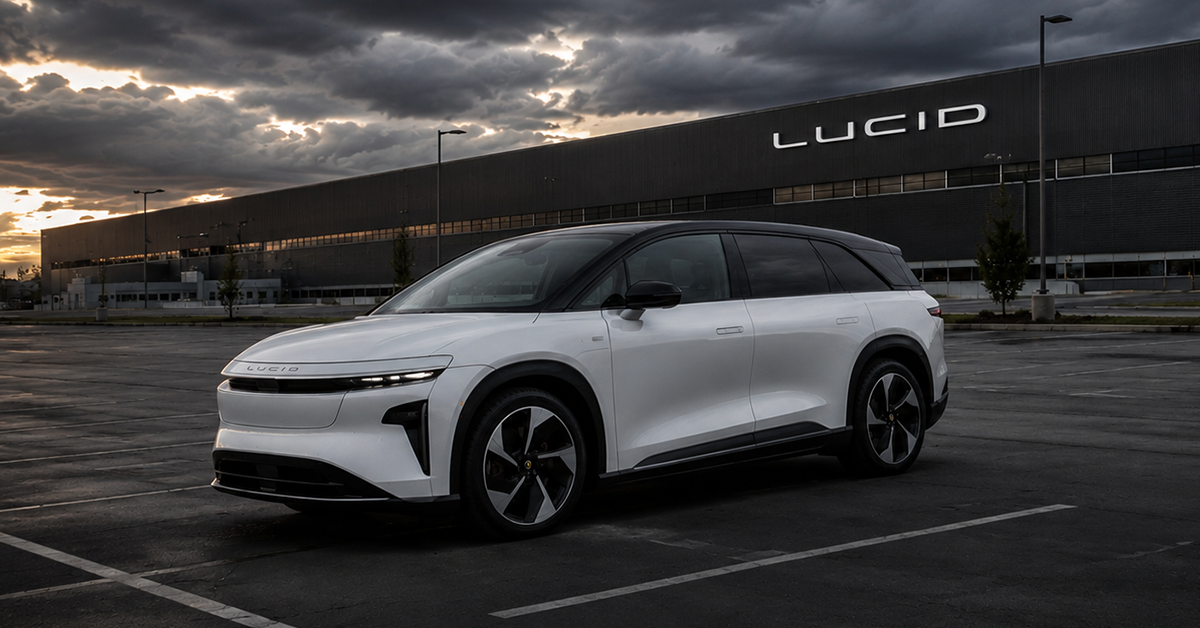
AI-generated illustration of the Lucid Gravity outside the Lucid Motors factory. | Rev N Rise
Lucid Motors is fighting for survival. The California EV startup reported a $1 billion net loss in Q1 2026, suspended its full-year production guidance, recalled nearly 4,500 Gravity SUVs over a faulty seat weld and watched its stock fall 64 percent over the past year. A new CEO is in place. Saudi Arabia is keeping the lights on. But the question being asked on Wall Street right now is whether Lucid has enough road left ahead of it.
The chain of events that triggered Lucid's worst quarter begins with a seat. In January 2026, Lucid discovered a safety defect in the second-row seats of its Gravity SUV — the company's second model and the vehicle on which its growth story depends entirely. The problem traced back to seat supplier Camaco, which had made unauthorised changes to the lap belt anchor weld without Lucid's knowledge or approval. An improperly positioned weld on the second-row lap seatbelt anchor could rupture during a collision — a direct safety risk to passengers.
Lucid responded immediately, issuing a stop-sale order and halting Gravity deliveries. The disruption lasted 29 days — nearly a full month of zero Gravity sales during a quarter when the company was trying to prove its ramp-up story to investors. In April 2026, NHTSA formally logged the recall covering 4,476 Gravity SUVs built before February 14, 2026. Vehicles built after that date meet a higher standard and are not affected.
The 29-day halt created what analysts described as a nearly 40 percent miss against consensus for Q1 deliveries. Lucid delivered just 3,093 vehicles in the quarter — slightly below the 3,109 it delivered in Q1 2025 — despite producing approximately 5,500 units during the same period. The gap between production and deliveries created bloated inventory that now has to be carefully managed.
The Q1 2026 results tell a story that goes beyond one bad quarter caused by one supplier's mistake. Lucid's cost of revenue in Q4 2025 was $944.64 million against revenue of just $522.73 million — meaning the company is losing money on every single car it sells at the unit level. Full-year 2025 free cash flow was negative $3.8 billion. The company burned through cash at a rate that financing inflows — which fell roughly 75 percent year-over-year in 2025 — cannot fully offset.
By Q4 2025, total liquidity had fallen to approximately $4.6 billion, kept above zero primarily by Saudi Arabia's Public Investment Fund, which extended a $2.0 billion term loan facility to the company and has been Lucid's primary financial lifeline since its founding. Pro forma liquidity of $5.5 billion includes this facility — without Saudi backing, Lucid's position would be dramatically more precarious.
The market has priced in the risk. Lucid stock has fallen 64 percent over the past 12 months, trading near 52-week lows. Prediction market traders on Polymarket currently price a 48 percent probability of Lucid filing for bankruptcy before the end of 2026. That is not a fringe view — it is a coin flip on the company's survival.
| Q1 2026 Net Loss | $1 billion |
| Q1 2026 Deliveries | 3,093 vehicles |
| Q1 2026 Production | 5,500 vehicles |
| Delivery Miss vs Consensus | ~40% |
| Gravity Halt Duration | 29 days |
| Gravity Units Recalled | 4,476 SUVs |
| Recall Cause | Unauthorised weld change — supplier Camaco |
| Affected Build Dates | Pre-February 14, 2026 |
| Full-Year 2025 Cash Burn | $3.8 billion |
| Total Liquidity (Q4 2025) | ~$4.6 billion |
| Saudi PIF Support | $2.0 billion term loan facility |
| Stock Drop (12 months) | 64% |
| Bankruptcy Probability (Polymarket) | 48% |
| Full-Year Guidance | Suspended — no 2026 production target |
| Prior Guidance | 25,000–27,000 vehicles |
| CEO | Silvio Napoli — new, conducting review |
| Saudi Arabia Production | Targeted by end of 2026 |
The decision that rattled investors most was not the recall itself — it was what Lucid did next. Rather than reaffirm its previously published full-year production guidance of 25,000 to 27,000 vehicles for 2026, the company's new CEO Silvio Napoli — who joined Lucid only recently — suspended guidance entirely, citing his ongoing review of the business.
CFO Taoufiq Boussaid described it as a governance decision during the Q1 earnings call, stating that the company is not constrained by capacity but by its own discipline not to build inventory ahead of demand. The company said it would provide a full updated outlook at the Q2 earnings call. That framing — disciplined, controlled — did not prevent Wall Street from driving shares down as much as 5 percent on the announcement, though the stock partially recovered by end of day.
For investors, the suspension of guidance removes a key metric for evaluating Lucid's progress. Without a production target, it becomes significantly harder to assess whether the company is on track toward profitability — or falling further behind. That uncertainty, combined with the cash burn rate, is why the bankruptcy probability remains so elevated.
To understand why the recall hit so hard, you have to understand what the Gravity SUV means to Lucid's future. The company's original model — the Air sedan — is an extraordinary vehicle. It holds the record for the longest EPA-rated range of any electric car ever tested. But it sells in small volumes at a high price point to a limited audience. It was never going to save Lucid by itself.
The Gravity is different. A large luxury electric SUV competing directly with the Rivian R1S, Cadillac Escalade IQ and Mercedes EQS SUV, it gives Lucid access to the most popular vehicle segment in America. Every month the Gravity isn't being delivered is a month Lucid isn't building the revenue base it needs to survive. Twenty-nine days of zero Gravity sales in Q1 didn't just hurt the quarter — it hurt the company's credibility at exactly the moment it needed to demonstrate momentum.
The Public Investment Fund of Saudi Arabia owns approximately 60 percent of Lucid Motors and has been the company's financial backstop since its early days. Without PIF's repeated capital injections and the $2.0 billion term loan facility extended in 2025, Lucid would almost certainly not still be operating. That backing is both Lucid's greatest strength and its most important vulnerability — the company's fate is tied directly to the continued willingness of a sovereign wealth fund to absorb losses.
PIF's motivation is not purely financial. Saudi Arabia is building a domestic automotive manufacturing capability, and Lucid is central to that ambition. A production facility in Saudi Arabia is targeted to open before the end of 2026 — a milestone that keeps PIF's strategic interest in the company very much alive. As long as Saudi production remains on schedule, PIF has strong reasons to continue supporting Lucid regardless of the US financial performance.
"We are not constrained by capacity. We are constrained by our own discipline not to build inventory ahead of demand. As market conditions develop, we will scale production accordingly."
— Taoufiq Boussaid, CFO, Lucid Motors — Q1 2026 Earnings CallThe seat defect has been fixed. Gravity deliveries have resumed. New CEO Silvio Napoli is conducting his review and will provide updated guidance at the Q2 earnings call. On paper, the immediate crisis is contained. But the underlying numbers — $1 billion quarterly losses, negative unit economics, a 64 percent stock decline and a 48 percent bankruptcy probability — make clear that this is not a company that has solved its fundamental problem. It has survived another quarter. That is not the same thing.
What Lucid needs is time, volume and a path to unit-level profitability. The Gravity gives it the best chance of all three — but only if deliveries can be sustained at scale without further disruption. Every recall, every guidance suspension, every missed delivery quarter makes the remaining road shorter. The Q2 earnings call, and the guidance that accompanies it, will be the most important moment in Lucid's recent history.
Lucid makes genuinely extraordinary cars. The Air is a technological masterpiece. The Gravity is the right vehicle for the right segment at the right time. But extraordinary cars do not guarantee survival when you are losing a billion dollars a quarter and burning through cash faster than Saudi Arabia can supply it. The seat recall was a supplier's mistake. The guidance suspension was a governance decision. The 48 percent bankruptcy probability is the market's verdict. Lucid has until Q2 to show it has a plan. The clock is running.