 Brands
Pagani Zonda Cervino — The V12 Supercar That Won't Die

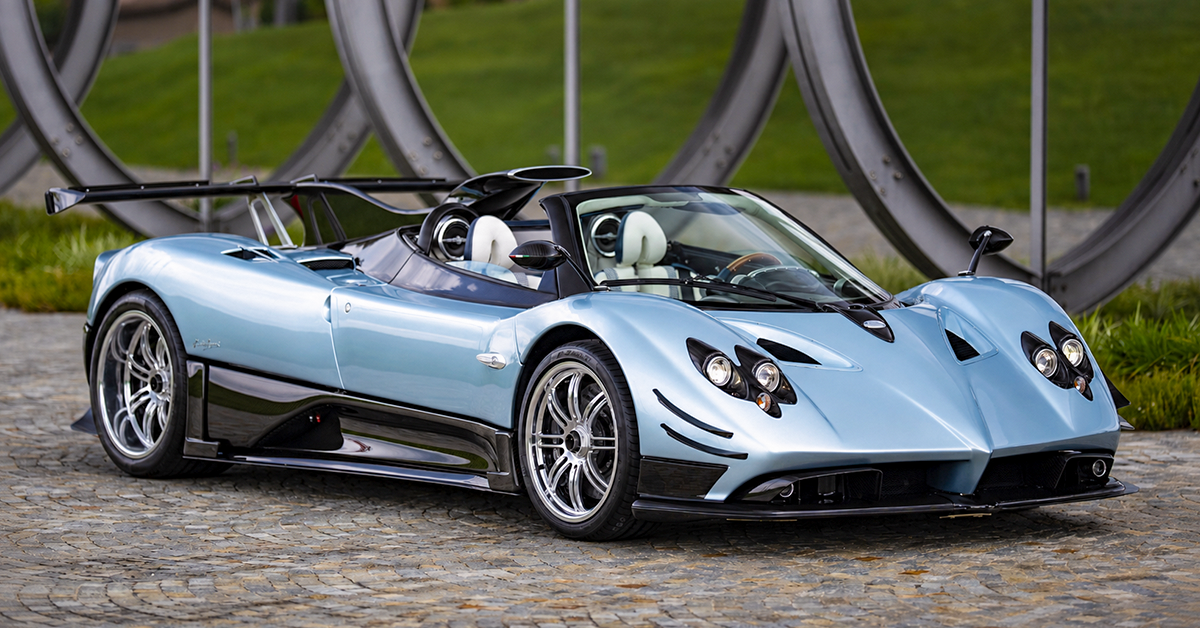
AI-generated concept illustration of the Pagani Zonda Cervino — not an official Pagani image. | Rev N Rise
Pagani officially retired the Zonda in 2017. Then it built another one in 2019. And 2021. And 2023. Now it is 2026, and Pagani has just unveiled the Zonda Cervino at Lake Como's FuoriConcorso — a brand new one-off with a naturally aspirated V12, a 6-speed manual gearbox, bespoke metallic blue carbon bodywork and a name inspired by alpine peaks. The Zonda is dead. Long live the Zonda.
The Pagani Zonda first appeared at the Geneva Motor Show in 1999. It was a car built by a former Lamborghini engineer named Horacio Pagani, working out of a factory in San Cesario sul Panaro, with a naturally aspirated V12 engine sourced from Mercedes-AMG and a carbon-titanium monocoque that weighed almost nothing. It was extraordinary. It was also supposed to have a limited production run — a small number of special cars for a small number of special people.
Twenty-seven years later, Pagani is still building Zondas. Not because the company has run out of ideas — the Huayra and Utopia have both been extraordinary successors — but because collectors keep asking for them, and Pagani keeps saying yes. The Zonda platform is mature. The manufacturing process is known. And when a collector walks into the Atelier in San Cesario sul Panaro with a vision and a blank cheque, Horacio Pagani finds it very difficult to say no. The result is a family of one-off special projects that have kept the Zonda alive long past its official retirement date. The Cervino is the latest — and, once again, probably not the last.
To understand the Cervino, you first need to understand how Pagani builds cars like this. The Unico programme is Pagani's bespoke one-off service — the equivalent of Ferrari's Special Projects or Brabus's coachbuilding division, but filtered through Pagani's uniquely artisanal approach to manufacturing. A client comes to the Atelier with a concept. Pagani's design team interprets it. The engineers execute it. The result is a car that exists nowhere else in the world.
In the Cervino's case, the starting point was an existing Zonda chassis — specifically the Oliver Evolution Roadster, a previous one-off that had recently been sold to a new owner. Rather than simply drive the car as delivered, the new owner approached Pagani with a request for a complete reimagining. New bodywork. New suspension. New interior. New identity. The Oliver Evolution Roadster was essentially used as a blank canvas — and what emerged from the Atelier has almost nothing in common with what went in.
The Cervino's name comes from the Matterhorn — known as Cervino in Italian — the iconic alpine peak on the border between Switzerland and Italy. The reference is deliberate. The car's colour palette draws directly from those alpine landscapes: a two-tone exterior in metallic blue and exposed carbon fibre, the blue panels catching light like glacier ice, the carbon weave beneath providing dark contrast. It is one of the most visually striking Zondas ever built — which is saying something for a family of cars that has never done restraint.
The bespoke bodywork is entirely new. Every panel has been redesigned to reflect the client's aesthetic vision. The Zonda R-inspired taillights of the original Oliver Evolution Roadster have been replaced with conventional round units — a deliberate step back from aggression toward elegance. The large rear wing of the Evolution has also been replaced with a less imposing spoiler, giving the Cervino a slightly more refined, grand-touring character than its predecessor. The result is a Zonda that looks fast at a standstill but does not announce itself by screaming.
Inside, the cabin has been completely re-trimmed in blue and white leather — matching the exterior palette with the precision you would expect from a car that costs somewhere north of ten million euros. The aluminium switchgear, the exposed carbon panels, the manual gear lever — all bespoke, all built to the client's specification, all assembled by the same craftsmen who have been building Pagani interiors since the late 1990s.
The Cervino uses the same 7.3-litre naturally aspirated V12 engine that powers the Oliver Evolution Roadster — sourced from Mercedes-AMG and producing approximately 750 horsepower and 575 lb-ft of torque. There are no turbochargers. No hybrid system. No electric assist. Just a large capacity V12 breathing freely, paired with a 6-speed manual gearbox that sends every one of those horsepower to the rear wheels through a traditional mechanical connection.
In 2026, when almost every new performance car is turbocharged, electrified or both, the Cervino's powertrain is almost an act of defiance. A naturally aspirated V12 with a manual gearbox is not the fastest combination available. It is not the most efficient. It is not the most technologically advanced. What it is — and what no turbocharged, electrified rival can fully replicate — is alive. Every throttle input is linear. Every gear change is physical. Every revolution of that V12 is something you hear, feel and participate in, rather than something a computer manages on your behalf. For a certain kind of driver, for a certain kind of collector, there is nothing in the world that replaces this.
The Cervino features a completely revised suspension setup — new dampers and upgraded componentry throughout — specifically designed to bridge the gap between the Zonda's analogue character and today's performance standards. The Zonda was always a car of its time in the best possible sense: direct, communicative, physical. The new suspension aims to preserve all of that while improving the precision and consistency that a modern performance car buyer expects.
Pagani has not published detailed suspension specifications — the Unico programme rarely produces published technical data — but the engineering intent is clear. The Cervino should drive better than the car it replaced. Sharper turn-in. More controlled body movement. Better high-speed stability from the revised aerodynamics. The same essential character, refined rather than replaced.
| Programme | Pagani Unico — bespoke one-off |
| Base Chassis | Zonda Oliver Evolution Roadster |
| Engine | 7.3L naturally aspirated V12 — AMG sourced |
| Output | ~750 hp / 575 lb-ft torque |
| Gearbox | 6-speed manual — rear-wheel drive |
| Body | Fully bespoke — all new panels |
| Exterior Colour | Metallic blue + exposed carbon fibre |
| Interior | Blue and white leather — fully bespoke |
| Suspension | New dampers — upgraded throughout |
| Taillights | Conventional round units — new design |
| Rear Wing | New — less aggressive than Oliver Evo |
| Name Inspiration | Cervino — Italian name for the Matterhorn |
| Revealed | FuoriConcorso — Lake Como, May 15-17 2026 |
| Units Built | 1 — for a single unnamed collector |
| Price | Undisclosed — est. €10 million+ |
The Cervino made its public debut at FuoriConcorso — the event held alongside the Concorso d'Eleganza Villa d'Este on the shores of Lake Como, May 15-17 2026. This was the same event where the Brabus Bodo was revealed — making FuoriConcorso 2026 arguably the most extraordinary single automotive weekend of the year, with two extraordinary V12 one-offs revealed within metres of each other against the backdrop of one of the most beautiful lakes in the world.
Alongside the Cervino, Pagani also displayed the Zonda C12S 7.0 — the very first one-off ever created by the Pagani Atelier, fully restored to its original specification under the Rinascimento programme. The juxtaposition was intentional and perfect: the first Zonda one-off ever built, restored to exactly as it left the factory, displayed next to the latest Zonda one-off, reimagined from the ground up. Twenty-five years of Pagani's custom programme, bookended at Lake Como in a single weekend.
"Whether through the Rinascimento program, which honours the past, or the Unico program, which pushes the boundaries of the future, the Atelier continues to create masterpieces destined to transcend time."
— Pagani Automobili, Official Statement, May 2026The Zonda was retired in 2017. Nine years and multiple one-offs later, Pagani is still building them — and the Cervino is the best argument yet for why that is exactly the right decision. A naturally aspirated V12. A 6-speed manual. Bespoke metallic blue carbon bodywork inspired by the Matterhorn. A completely new suspension. And an interior trimmed in blue and white leather to match. There is nothing else like it on earth. There never has been. The Zonda refuses to die because Pagani refuses to let excellence become a historical footnote. The Cervino is not just a car. It is a statement about what cars can still be when a single craftsman's vision is allowed to run free.