 Brands
Mercedes-Benz — History, Models and Everything You Need to Know
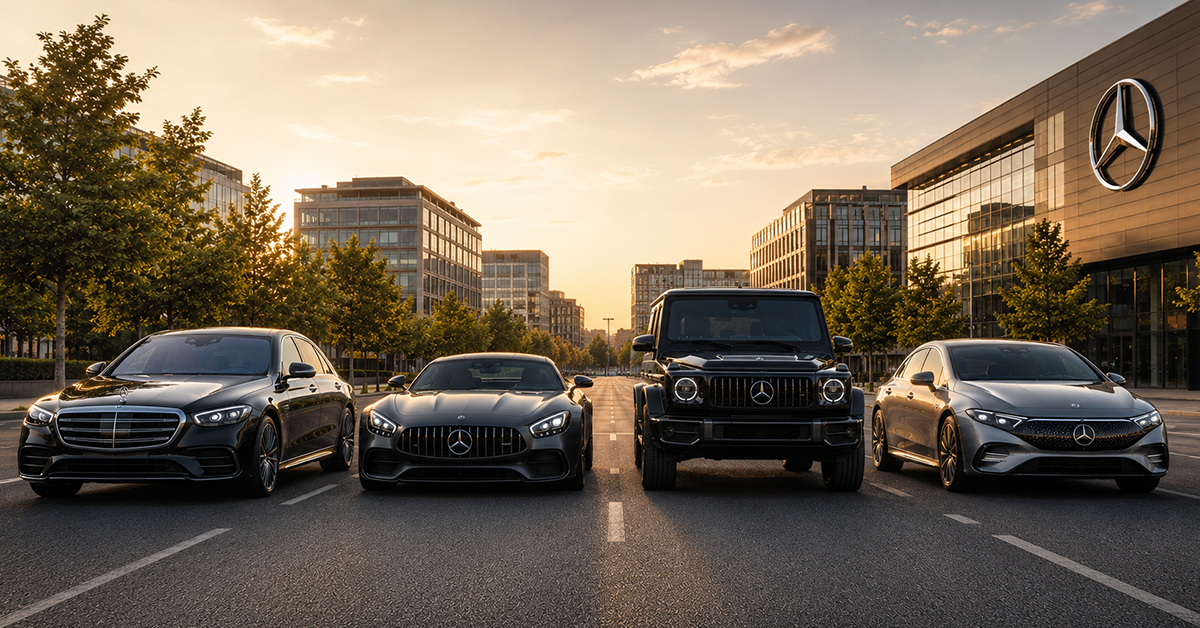
AI-generated concept illustration — Mercedes-Benz brand overview. | Rev N Rise
Mercedes-Benz is not just one of the world's most prestigious car brands — it is the brand that invented the automobile. Karl Benz built the first petrol-powered car in 1885. Nearly 140 years later, Mercedes-Benz continues to define what luxury, technology and automotive excellence look like — from the S-Class to the AMG GT to the EQS electric flagship.
The story of Mercedes-Benz begins with two men working independently in different German cities. Karl Benz built the Benz Patent-Motorwagen in Mannheim in 1885 — a three-wheeled vehicle powered by a single-cylinder petrol engine that is recognised as the world's first true automobile. His wife, Bertha Benz, conducted the first long-distance automobile journey in 1888 — driving from Mannheim to Pforzheim, a distance of approximately 104 kilometres, to prove the car's practicality to a sceptical public. Simultaneously, Gottlieb Daimler and Wilhelm Maybach were developing their own petrol engine in Stuttgart and building it into various vehicles.
The two companies — Benz & Cie and Daimler-Motoren-Gesellschaft — merged in 1926 to form Mercedes-Benz. The Mercedes name came from a key early customer: Emil Jellinek, an Austro-Hungarian diplomat who raced and promoted Daimler cars under the pseudonym Mercedes — the name of his daughter. Jellinek insisted his racing cars carry the name, which became the brand identity for Daimler's performance models before being adopted by the merged company.
Through the 1930s, Mercedes-Benz dominated Grand Prix racing with the Silver Arrows — the W125 and W154 were effectively unbeatable. The postwar period saw the legendary 300SL Gullwing of 1954 — with its dramatic upward-opening doors, spaceframe chassis and fuel-injected straight-six — become one of the most beautiful and technically advanced cars of the 20th century. The S-Class — launched in its modern form in 1972 — became the global benchmark for luxury saloons and has introduced more automotive safety technologies than any other vehicle in history. Crumple zones. ABS. ESP. Airbags. Pre-Safe. Every major passive and active safety innovation of the past 50 years made its production debut on an S-Class.
AMG — standing for Aufrecht, Melcher and Großaspach — was founded in 1967 by former Mercedes engineers Hans Werner Aufrecht and Erhard Melcher as an independent engine development and tuning company. Their first significant achievement was preparing a 300SEL 6.8 for the 1971 Spa 24 Hours — where the car finished second overall against purpose-built racing machines, an extraordinary result that brought international attention.
Mercedes-Benz acquired AMG progressively — first as a partner and then fully in 1999. Today AMG is Mercedes-Benz's performance division, producing everything from the A35 entry performance model to the AMG One — a road-legal Formula 1 car with a hybrid powertrain derived directly from the 2014 championship-winning F1 unit. The AMG GT 63 S E Performance produces 843 horsepower. The AMG C 63 uses a 2.0-litre four-cylinder hybrid system producing 476 horsepower — a controversial but technically remarkable powertrain. And the AMG GT 4-Door EV — recently revealed — represents AMG's fully electric future with over 800 horsepower.
No vehicle in automotive history has introduced more life-saving safety technology than the Mercedes-Benz S-Class. The crumple zone — which absorbs crash energy to protect occupants — was first deployed on a production car in the S-Class predecessor in 1959. ABS anti-lock braking was introduced to a production Mercedes in 1978. The Electronic Stability Programme that now prevents millions of crashes per year globally appeared on the S-Class in 1995. Front and side airbags, Pre-Safe crash anticipation, active brake assist — the list goes on. The S-Class is not merely a luxury car. It is the vehicle that has saved more lives than any other single automobile through the technologies it pioneered and which subsequently became standard equipment on every car sold globally.
Mercedes-Benz invented the automobile and has spent 140 years refining what it means to build one. The S-Class has introduced more life-saving safety technologies to the mainstream than any other vehicle. AMG builds some of the most powerful and capable performance cars in the world. And Mercedes-Benz's commitment to interior quality — the tactile feel of the controls, the quality of the materials, the precision of the assembly — remains the benchmark against which all other luxury car interiors are measured. The brand's current challenge is leading the transition to electric vehicles without losing the luxurious, refined character that defines every Mercedes product. The CLA EV on the new MMA platform — with its extraordinary efficiency and revised interior design — suggests that challenge is being met seriously.