 Brands
Audi — History, Models and Everything You Need to Know
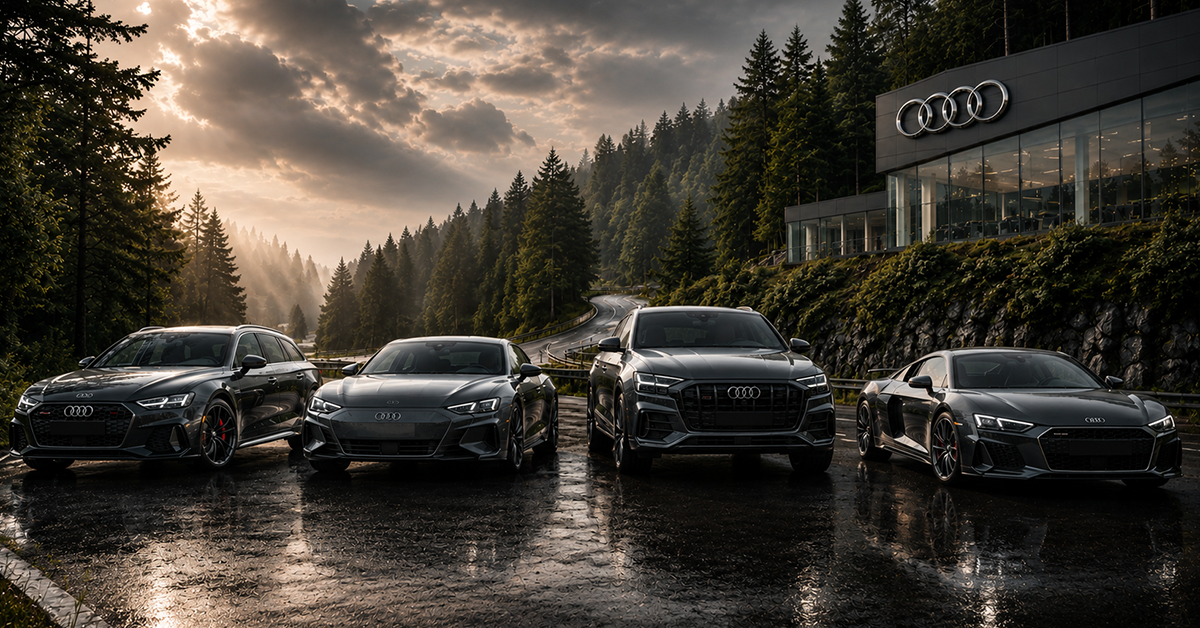
AI-generated concept illustration — Audi brand overview. | Rev N Rise
Audi is the premium division of the Volkswagen Group and one of Germany's most celebrated car brands. Founded in 1909 by August Horch, Audi built its modern reputation on three pillars — Quattro all-wheel drive, progressive design and relentless engineering ambition. From dominating the World Rally Championship to building the RS6 Avant and the e-tron GT, Audi consistently delivers technology that is ahead of its time.
August Horch founded his first car company — Horch — in 1899. After a dispute with the board, he left in 1909 and founded a new company in Zwickau, Germany. He wanted to call it Horch again, but the name was legally protected by his former company. His son suggested the Latin translation of "Horch" — which means "to listen" or "hark" in German. The Latin equivalent is Audi. The name stuck, and in 1909 Audi Automobilwerke GmbH was officially established.
In 1932, four Saxon car manufacturers — Audi, DKW, Horch and Wanderer — merged to form Auto Union. The four interlocking rings in Audi's logo commemorate this merger — one ring for each founding company. Auto Union's Grand Prix racing programme through the 1930s produced some of the most technically advanced racing cars ever built — the Silver Arrows that dominated European racing alongside Mercedes-Benz. After World War II, Auto Union reconstituted itself in West Germany, eventually becoming Audi NSU Auto Union AG and then simply Audi AG after being acquired by Volkswagen in 1966.
The modern Audi era began in 1980 with two simultaneous announcements that changed the brand forever. The original Audi Quattro coupe introduced permanent all-wheel drive to a production car for the first time — a system so effective it transformed rally racing and redefined what AWD could do on road and track. And the Audi 100 — later restyled — introduced a drag coefficient of 0.30 at a time when most saloons were closer to 0.45, demonstrating Audi's commitment to aerodynamic engineering. In the World Rally Championship, the Quattro was essentially unbeatable — winning the Manufacturers' Championship in 1982 and 1984 and the Drivers' Championship with Hannu Mikkola in 1983 and Stig Blomqvist in 1984.
Before the Audi Quattro, all-wheel drive was the preserve of off-road vehicles and military trucks. No manufacturer had successfully deployed permanent AWD in a performance road car. Audi engineer Jörg Bensinger identified the potential of AWD for performance and traction in 1977, and the team developed a system using a central differential to distribute power between front and rear axles continuously — unlike the part-time systems used in off-road vehicles. The result was transformative. On snow, ice, wet roads and dry tarmac, the Quattro offered traction and stability that rear-wheel-drive competitors simply could not match.
The WRC programme validated what the road car promised. When the Quattro appeared at the 1981 Monte Carlo Rally it was immediately faster than anything else in the field — on stages where rear-wheel-drive cars were sliding and struggling, the Quattro simply drove through. Today every Audi with AWD carries the Quattro name — and the system has been continuously developed from the original mechanical setup through to the modern torque-vectoring quattro ultra system that can disconnect the rear axle entirely for efficiency when AWD is not needed.
Audi Sport GmbH — formerly quattro GmbH — is the division responsible for Audi's RS performance models and its motorsport programme. The RS designation stands for RennSport — racing sport — and has been applied to Audi's highest-performance road cars since the RS2 Avant of 1994, developed in collaboration with Porsche. The RS6 Avant — currently producing 630 horsepower from a twin-turbocharged 4.0-litre V8 with a mild-hybrid system — is widely considered the greatest performance estate car ever built. The RS3 uses a turbocharged 2.5-litre inline-five engine — a configuration unique to Audi Sport — producing 400 horsepower and featuring a torque splitter rear differential that enables controlled oversteer, an almost unheard-of capability in a front-biased AWD car.
Audi's defining characteristic is its ability to combine technological sophistication with everyday usability in a way that BMW and Mercedes-Benz approach differently. The Quattro system remains the most refined AWD setup available in a mainstream premium car. Audi's interior quality — the Virtual Cockpit digital instrument display, the MMI infotainment system, the precision of every surface — consistently sets the benchmark for the premium segment. And the RS range delivers genuine supercar performance in practical family cars that can carry four people and their luggage in complete comfort. The upcoming R8 return — with a Lamborghini Temerario-derived V8 PHEV expected to produce close to 1,000 horsepower — will give Audi a halo product worthy of its engineering ambitions for the first time since the original R8 launched in 2006.