 Brands
Fiat — History, Models and Everything You Need to Know
AI-generated concept illustration — Fiat brand overview. | Rev N Rise
Fiat is one of the world's oldest car brands and Italy's most important automotive name — the company that put postwar Italy on wheels with the iconic Fiat 500 and has continued building affordable, characterful cars for over 125 years. From the Topolino to the 500e electric, Fiat has always understood that a small car can have a large personality — and that accessibility and style are not mutually exclusive.
Fiat — Fabbrica Italiana Automobili Torino, or Italian Automobile Factory Turin — was founded on July 11 1899 by a group of investors including Giovanni Agnelli, who became the company's dominant personality and whose family controlled Fiat for over a century. The company's early cars competed successfully in racing and established Fiat's reputation for engineering quality. By the 1910s and 1920s Fiat was one of the largest car manufacturers in Europe.
Fiat's most significant contribution to Italian society came in 1957 with the launch of the Fiat 500 — Cinquecento — a tiny two-cylinder rear-engined city car designed to motorise Italy's postwar population at a price they could actually afford. The 500 was 2.97 metres long, produced 13 horsepower and cost 465,000 lire — equivalent to a few months' wages for an average Italian worker. It became the car that gave freedom and mobility to a generation of Italians who had never owned a vehicle before. Over 3.8 million original 500s were produced between 1957 and 1975. Its cultural significance in Italy is comparable to the VW Beetle in Germany or the Mini in Britain.
Fiat grew through acquisitions — taking over Lancia in 1969, Ferrari in 1969, Alfa Romeo in 1986 and eventually merging with Chrysler in 2014 to form Fiat Chrysler Automobiles. In 2021, FCA merged with PSA Group to form Stellantis — one of the world's four largest automotive groups. Throughout these corporate transformations, Fiat has remained the affordable, accessible, Italian-spirited brand at the heart of the group.
The original Fiat 500 of 1957 is one of the most culturally significant cars ever built — not because of its performance or technology but because of what it meant to the people who drove it. Designed by Dante Giacosa, the 500 was an exercise in maximum utility from minimum resources — a front bench seat, a rear-mounted engine, a fabric sunroof and enough interior space for two adults and occasional children, all packaged into under three metres of length. It is the automotive equivalent of the Vespa scooter — a symbol of Italian style, freedom and postwar optimism.
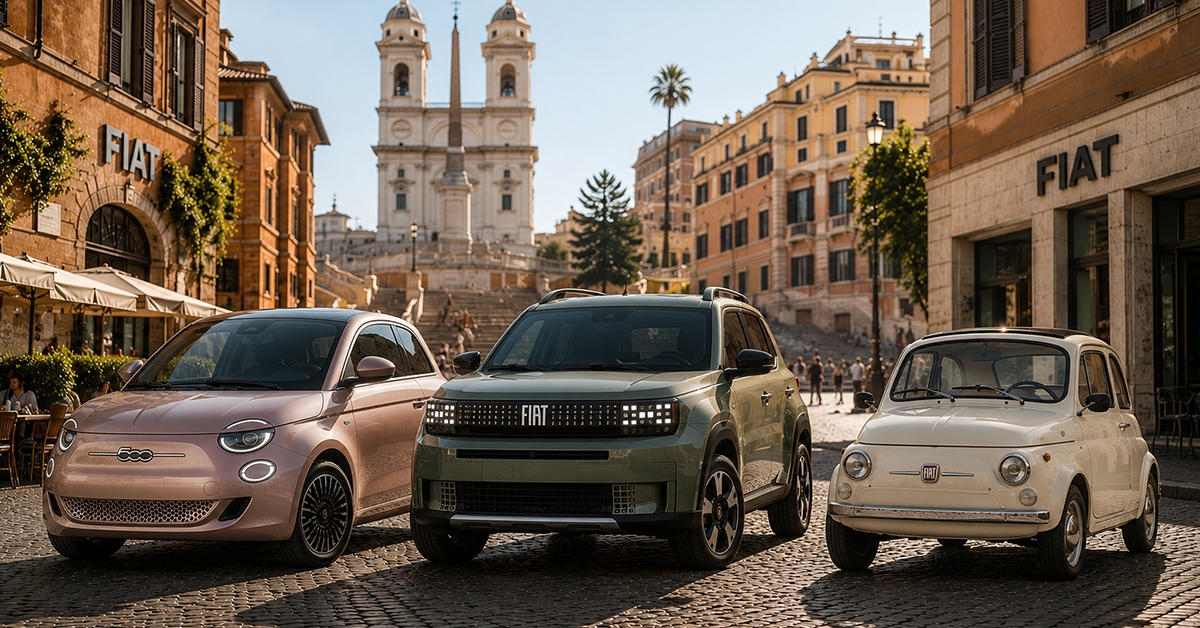
The modern Fiat 500, launched in 2007, deliberately referenced the original's proportions and personality — retro-styled bodywork, a round headlight signature and a characterful interior with circular instruments. It became one of Europe's best-loved city cars and a fashion object as much as a practical vehicle. The fully electric 500e, launched in 2020 on a dedicated EV platform, carried the tradition forward — smaller battery for city use, distinctive Italian styling and a driving experience that prioritised character over range. A larger Grande Panda joined the range in 2024 as a more practical family offering on the Stellantis Smart Car platform.
Fiat today operates as a brand within Stellantis — the group formed by the merger of Fiat Chrysler Automobiles and France's PSA Group in January 2021. Stellantis owns 14 automotive brands — Fiat, Peugeot, Citroën, Opel, Vauxhall, Jeep, Ram, Dodge, Chrysler, Alfa Romeo, Lancia, Maserati, DS Automobiles and Abarth — making it one of the four largest automotive groups globally by sales volume. Within Stellantis, Fiat occupies the volume-accessible end of the European market — positioned to compete with Volkswagen's entry models and Renault on price, with the Italian style and character that neither German nor French competitors can fully replicate.
Stellantis CEO Carlos Tavares positioned Fiat as an affordable EV brand for European markets — the 500e and Grande Panda EV representing a credible electric offering at prices that make electrification accessible to buyers who cannot afford a Tesla or a Volkswagen ID.3. The strategy is sound; whether Fiat can execute it at the required volume and profitability remains the central question facing the brand's next decade.
Fiat's competitive advantage is intangible but real — Italian character. The Fiat 500e is not the most practical city EV, the most technologically advanced or the longest-ranged. But it is the most desirable — the car that buyers choose because it makes them feel something that a Renault Zoe or a Volkswagen e-up cannot. That emotional connection, built over 70 years of the 500 nameplate, is Fiat's most durable competitive asset. The new Grande Panda brings more practicality to the lineup without sacrificing the accessibility that defines the brand. And the upcoming Grizzly off-road SUV — if it delivers on its promise — could give Fiat a product with genuine differentiation in a segment it has never previously occupied.