 Brands
Mitsubishi — History, Models and Everything You Need to Know
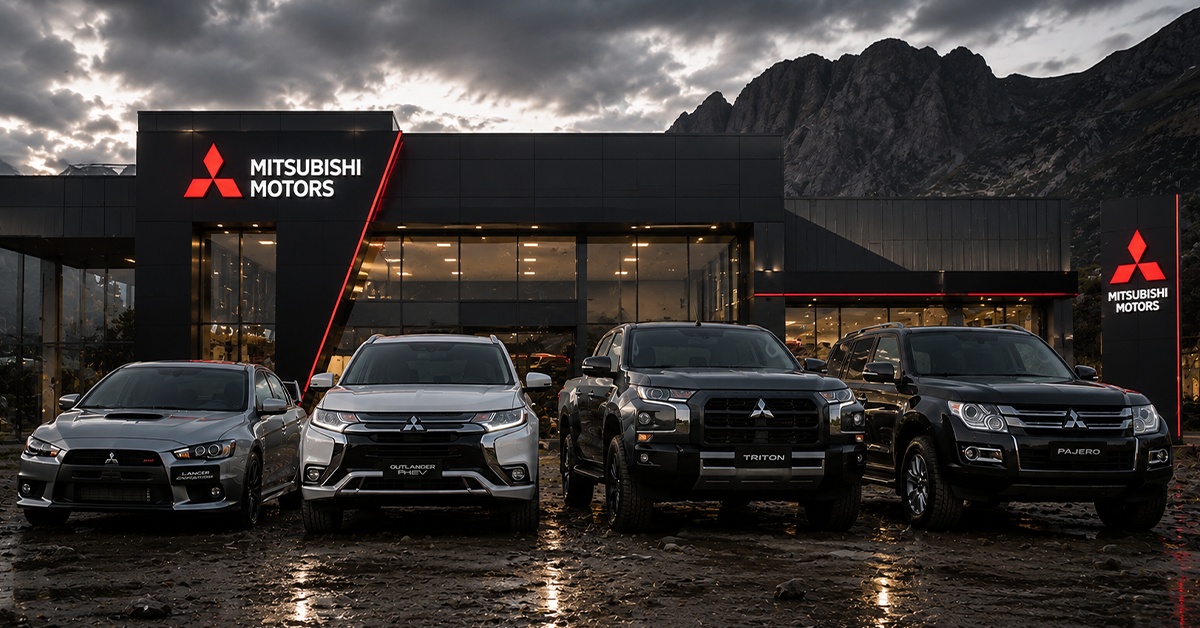
AI-generated concept illustration — Mitsubishi brand overview. | Rev N Rise
Mitsubishi is the Japanese automaker behind two of the most significant achievements in modern automotive history — the Lancer Evolution rally legend and the world's first mass-market plug-in hybrid SUV. Now, after years of product consolidation, Mitsubishi is preparing its most important comeback in decades — the return of the Pajero nameplate as a body-on-frame off-roader in 2026, targeting the Toyota LandCruiser Prado directly.
The Mitsubishi name dates back to 1870 when Yataro Iwasaki founded a shipping company in Japan. The name means "three diamonds" in Japanese — mitsu for three and hishi for diamond — and the three-diamond logo has represented the Mitsubishi brand across all its industrial activities ever since. Mitsubishi grew into one of Japan's largest industrial conglomerates — producing ships, aircraft, electrical equipment and countless other products through the 20th century.
Mitsubishi Motors Corporation was established as a standalone automotive entity in 1970, separating the car business from the broader Mitsubishi Group. Mitsubishi had been producing vehicles since 1917 — beginning with the Model A, Japan's first series-production passenger car. The modern era of Mitsubishi's automotive identity was defined by two products above all others: the Pajero — a genuine off-road icon that dominated the Dakar Rally — and the Lancer Evolution, which turned Mitsubishi into a performance car brand.
The Pajero won the Dakar Rally twelve times — more than any other manufacturer — establishing Mitsubishi's reputation for building vehicles that could survive the most brutal off-road conditions on earth. The Lancer Evolution — launched in 1992 as a homologation special for the World Rally Championship — became a cult performance car globally, revered for its turbocharged power, sophisticated AWD system and driver engagement. Mitsubishi sold Nissan a controlling stake in 2016 following a fuel economy scandal, joining the Renault-Nissan-Mitsubishi Alliance.
The Mitsubishi Lancer Evolution is one of the most celebrated performance cars of the past 30 years. Launched in 1992 as a homologation car for the World Rally Championship — where Mitsubishi needed a production version of its rally Lancer to qualify — the Evo used a turbocharged 2.0-litre engine and sophisticated AWD system to deliver supercar-matching performance in a practical saloon body. Mitsubishi driver Tommi Mäkinen won four consecutive WRC Drivers' Championships from 1996 to 1999 — making him and Mitsubishi synonymous with rally dominance during that era.
Through ten generations from 1992 to 2016, the Lancer Evolution's engineering became progressively more sophisticated — adding Active Yaw Control, Super Active Yaw Control and increasingly complex torque vectoring systems that gave it cornering ability beyond its power output. The final Evo X — discontinued in 2016 — produced 295 horsepower from its 2.0-litre turbo and remains one of the most technically complex performance saloons ever built at its price point. Mitsubishi has not replaced it — a decision that many enthusiasts consider the brand's most significant strategic mistake.
While the Evo defined Mitsubishi's performance identity, the Outlander PHEV defined its technology credentials. Launched in Japan in January 2013, it was the world's first mass-market plug-in hybrid SUV — arriving years before Toyota, Volvo, Volkswagen or any other mainstream manufacturer offered a comparable product. The Outlander PHEV uses twin electric motors — one on each axle — combined with a 2.4-litre petrol engine and a 20kWh battery to deliver AWD traction, electric-only range of around 50km and a claimed combined fuel consumption that ordinary hybrid SUVs could not approach. It has consistently been one of the best-selling PHEVs in Europe, Australia and Japan.
The most significant Mitsubishi news of 2026 is the confirmed return of the Pajero nameplate. Mitsubishi officially confirmed on May 29 2026 that a new body-on-frame SUV is coming — based on the Triton ladder-frame chassis with model-specific suspension development and a twin-turbo diesel engine. The reveal is scheduled for September to November 2026 with Australian sales beginning before year end. In North America the car will be sold as the Montero — the nameplate used there during the original model's run — avoiding the derogatory connotation of the Pajero name in Spanish-speaking markets. The new Pajero targets the Toyota LandCruiser Prado directly with aggressive pricing expected below Prado's $73,200 entry point in Australia.
Mitsubishi's competitive advantage has always been its willingness to pioneer technology that the market was not yet demanding. The Outlander PHEV in 2013 proved that plug-in hybrids could work in SUVs before any competitor believed the market existed — and it sold hundreds of thousands of units. The Lancer Evolution proved that affordable turbocharged AWD performance could match and beat cars costing three times as much. The returning Pajero will need to prove that Mitsubishi can still build a body-on-frame off-roader that justifies its heritage — against stronger competition than the original Pajero ever faced. Based on Mitsubishi's track record of engineering ambition, the expectation is that it can.