 Brands
Peugeot — History, Models and Everything You Need to Know
AI-generated concept illustration — Peugeot brand overview. | Rev N Rise
Peugeot is one of the world's oldest car manufacturers and France's most significant automotive brand — a company that has been making vehicles since 1882, won Le Mans three times and pioneered one of the most distinctive interior design concepts in the modern car industry with the i-Cockpit. Today Peugeot is rapidly electrifying its entire lineup while maintaining the French flair and driver focus that has defined its best cars for over a century.
The Peugeot family business dates back to 1810 — a steel foundry in Valentigney, eastern France, that produced springs, saws and other steel tools. Armand Peugeot — a grandson of the founder — was captivated by the emerging bicycle industry and began producing Peugeot bicycles in 1882. He then turned his attention to the new petrol engine technology emerging in Germany and produced his first car in 1889 — a steam-powered vehicle — followed by a petrol-engined car using a Panhard & Levassor engine based on a Daimler design in 1890. Armand Peugeot founded Société Anonyme des Automobiles Peugeot as a standalone automotive company in 1896, separating the car business from the family's broader industrial activities.
Peugeot built its 20th century reputation on practical, well-engineered family cars — the Peugeot 205 of 1983 is widely considered one of the greatest small cars ever built. Light, nimble, beautifully balanced and available in a legendary GTI hot hatch variant that defined the genre for a generation, the 205 established the engineering character that Peugeot has pursued ever since. The 205 GTI's combination of a 1.9-litre engine, front-wheel drive and near-perfect weight distribution made it faster through corners than many sports cars of the era. Its legacy defines Peugeot's performance identity to this day.
Peugeot became part of PSA Group — Peugeot Société Anonyme — through the merger with Citroën in 1976 and later acquired Opel and Vauxhall from General Motors in 2017. PSA then merged with Fiat Chrysler Automobiles in 2021 to form Stellantis — making Peugeot part of one of the world's four largest automotive groups.
The Peugeot i-Cockpit — introduced on the 208 in 2012 and now standard across the entire range — is the most distinctive interior design concept in the mainstream European car market. Its defining feature is a small-diameter steering wheel paired with a high-mounted instrument cluster above rather than behind the wheel. The driver looks over the top of the steering wheel at the instruments rather than through it — a layout that creates a more direct, sports-car-like connection between driver and car.
The i-Cockpit divides opinion — some drivers find the layout awkward until they adapt to it, others immediately prefer it to the conventional arrangement. What is not debatable is its effectiveness as a brand differentiator. In a segment where most competitors' interiors are broadly similar, the i-Cockpit makes a Peugeot instantly recognisable and gives the brand a design identity that competitors have been unable to replicate without direct imitation. The latest iteration — i-Cockpit 3D on the new 308 and 3008 — adds a three-dimensional instrument display that adds depth and visual sophistication to the concept.
Peugeot's motorsport heritage is defined by its Le Mans programme. The brand won the 24 Hours of Le Mans in 1992 and 1993 with the 905 — a naturally aspirated V10-powered prototype that defeated every rival across two consecutive years. The 2009 victory was arguably even more dramatic — the Peugeot 908 HDi FAP diesel prototype, powered by a 5.5-litre V12 turbodiesel, defeated Audi's previously dominant R10 TDI diesel programme in one of the most closely contested Le Mans battles ever staged. Peugeot returned to top-level endurance racing in 2022 with the hydrogen-hybrid 9X8 hypercar — a technically ambitious programme that struggled initially but demonstrated the brand's continued commitment to motorsport at the highest level.
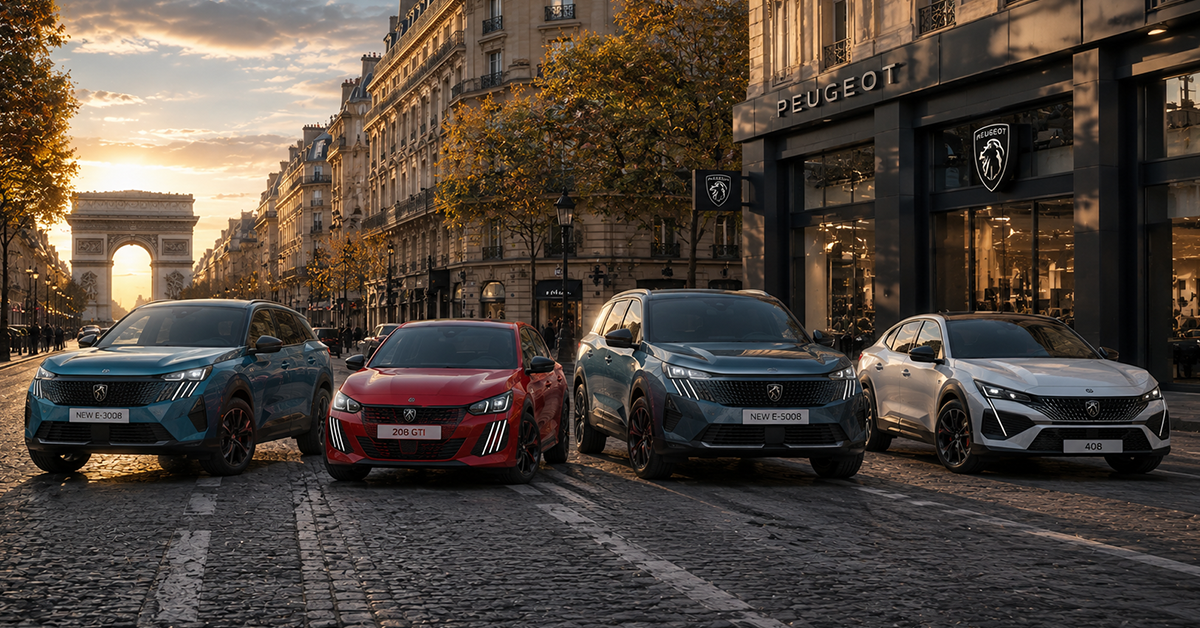
Peugeot's competitive advantage in the mainstream European market is its combination of distinctive design, genuine driving dynamics and the i-Cockpit interior concept that makes every Peugeot feel different from every competitor. The 205 GTI and 306 GTI-6 hot hatch legacy gives the brand performance credibility that Volkswagen and Renault earn through engineering — Peugeot earns it through character. The new e-3008 and e-5008 — built on Stellantis's STLA Medium platform with up to 660km of WLTP range — are among the most impressive mainstream electric SUVs launched in Europe in 2024 and 2025, demonstrating that Peugeot's electrification programme is genuinely competitive rather than merely compliant.