 Brands
Skoda — History, Models and Everything You Need to Know
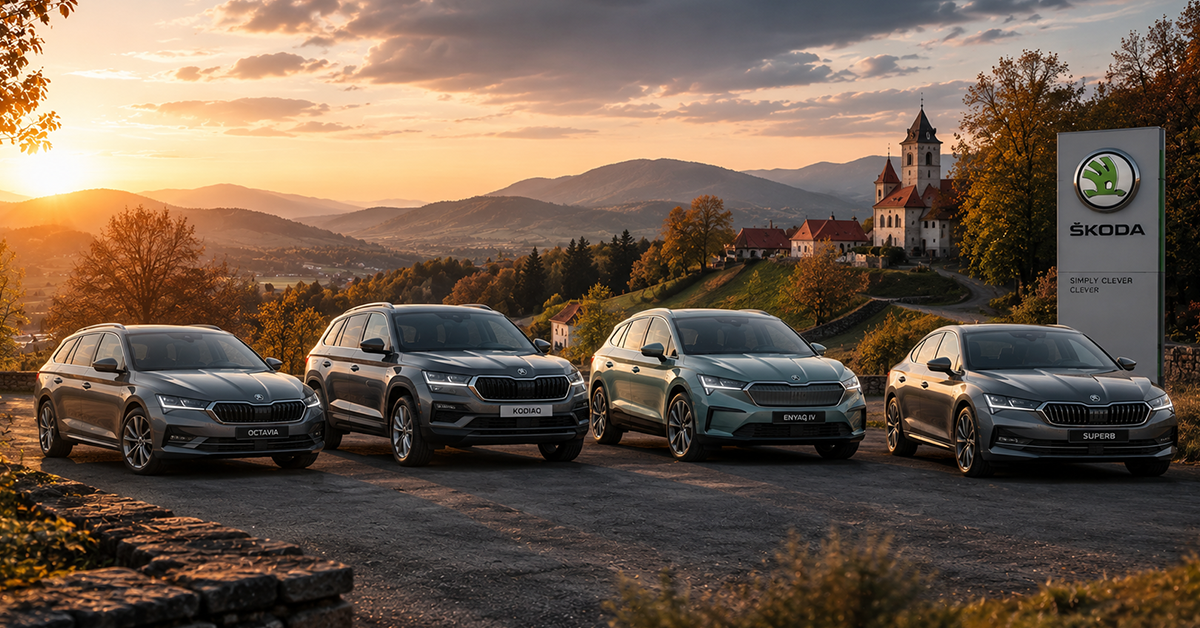
AI-generated concept illustration — Skoda brand overview. | Rev N Rise
Skoda is one of the world's oldest car manufacturers and the Volkswagen Group's most compelling value proposition — a brand that consistently delivers more space, more equipment and more practicality per pound or euro than almost any competitor in the mainstream European market. Founded in the Czech Republic in 1895, Skoda has spent three decades under VW Group ownership transforming from a punchline into a genuine award-winning brand.
Vaclav Laurin and Vaclav Klement founded Laurin & Klement in Mlada Boleslav, Bohemia — now the Czech Republic — in 1895. They began making bicycles, moved into motorcycles in 1899 and produced their first car — the Voiturette A — in 1905. The company merged with Skoda Works — a major Czech industrial conglomerate — in 1925, adopting the Skoda name. Through the interwar years Skoda produced well-regarded cars and commercial vehicles, but World War II and the subsequent communist nationalisation of Czechoslovakia in 1948 transformed the company into a state-owned manufacturer producing basic, affordable cars for the domestic market.
Under communist rule, Skoda's engineering stagnated — the brand became known internationally for cheap, unreliable cars that were the subject of widespread jokes in Western Europe. The Skoda Estelle and its successors were outdated rear-engined designs that bore no comparison to contemporary Western European cars. When Volkswagen acquired a 30 percent stake in Skoda in 1991 — just two years after the fall of communism — it was one of the most ambitious and risky automotive investments of the decade. VW acquired full ownership progressively through the 1990s.
The transformation was extraordinary. VW Group engineering, quality standards and platform access gave Skoda the foundations it needed — and Skoda's Czech engineers, who had always been technically capable but resource-constrained, delivered outstanding results. The Skoda Octavia of 1996 — the first VW Group-era product — immediately demonstrated what Skoda could do with proper resources: more space, better quality and a lower price than the equivalent Golf. Every subsequent Skoda has followed the same formula.
Simply Clever is Skoda's product philosophy — the systematic practice of adding small, thoughtful features that make everyday use more convenient. The concept emerged from Skoda's Czech engineering culture and has become one of the most recognised brand differentiators in the European market. Simply Clever features vary by model but typically include: an umbrella stored inside the door — kept dry and always to hand; an ice scraper integrated into the fuel cap; a rear seat fold-flat mechanism operated by a single lever; shopping bag hooks in the boot; a door edge protector that deploys when the door opens; and a ticket holder on the windscreen for parking tickets and toll receipts.
None of these features are individually transformative. Together, they create the impression of a car designed by people who actually use cars every day — who noticed the small frustrations of ordinary life and fixed them one by one. No other mainstream manufacturer has replicated this philosophy as consistently, and it remains one of the clearest examples in the automotive industry of how brand identity can be built through product detail rather than advertising alone.
Skoda's value proposition is the clearest of any brand in the VW Group. The Octavia consistently offers more interior space, more boot volume and more standard equipment than the Golf it shares a platform with — at a lower price. The Superb estate is the best value large family car in Europe by almost any objective measurement. The Kodiaq offers seven seats and genuine SUV practicality for less money than a five-seat Volkswagen Tiguan. Skoda has been winning What Car? Car of the Year awards in the UK and equivalent honours across Europe for years on the strength of this value formula. The brand's challenge is that VW Group pricing pressure is gradually eroding that value gap — the Enyaq and Elroq EVs are priced closer to their VW equivalents than traditional Skoda pricing would suggest. Maintaining the value advantage as electrification pushes prices upward is Skoda's central strategic challenge for the coming decade.