 Brands
Lexus — History, Models and Everything You Need to Know
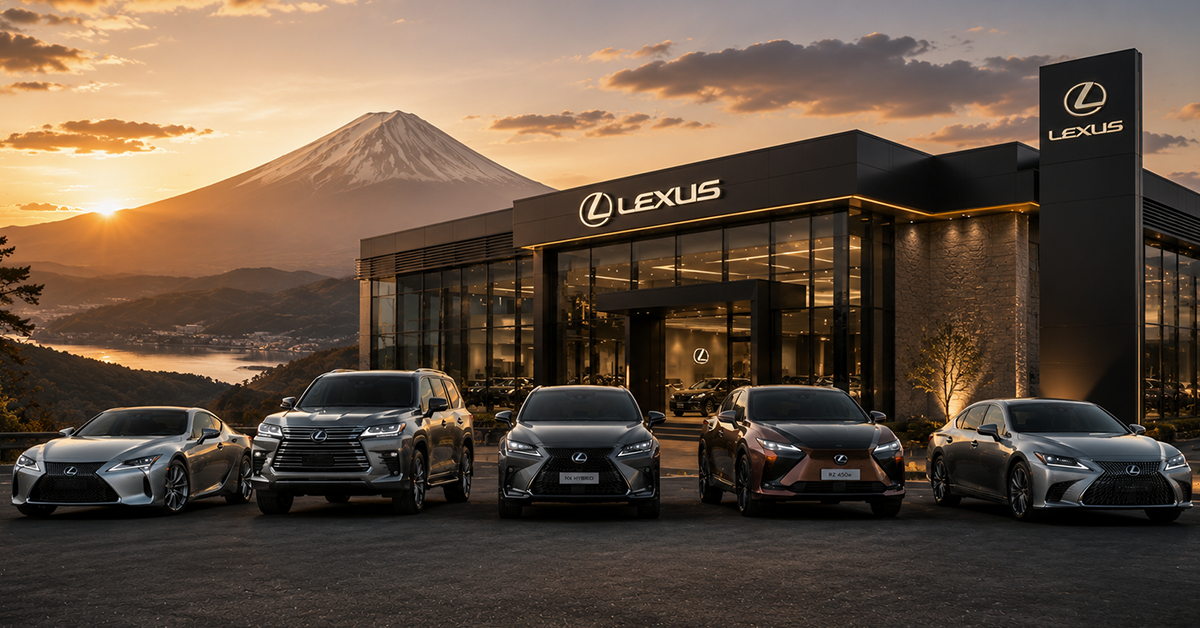
AI-generated concept illustration — Lexus brand overview. | Rev N Rise
Lexus is Toyota's luxury division and one of the most consistently excellent premium car brands in the world — renowned for outstanding build quality, ultra-quiet cabins, hybrid expertise and an ownership experience that regularly tops customer satisfaction surveys globally. Launched in 1989 with the ambition of outperforming the best European luxury cars on every objective measure, Lexus has spent 35 years proving that ambition was not overconfidence.
In 1983, Toyota chairman Eiji Toyoda issued a challenge to his engineers: create the best car in the world. The project — codenamed F1 — was kept secret for six years and involved over 1,400 engineers, 2,300 technicians and 220 designers working toward a single goal. The result was the Lexus LS 400 — unveiled at the 1989 North American International Auto Show in Detroit and launched in August of the same year.
The LS 400 was immediately recognised as extraordinary. It was quieter, smoother, more refined and better built than the Mercedes-Benz S-Class and BMW 7 Series it targeted — and it cost significantly less. Road & Track called it "the finest car in the world." Consumer Reports gave it a perfect score. The LS 400 established Lexus's reputation for obsessive quality in a single model launch — a reputation the brand has maintained and built upon for 35 years.
The Lexus RX 400h of 2005 — the world's first luxury hybrid SUV — demonstrated that Lexus could pioneer technology as well as refine it. The RX 400h preceded every European premium brand's hybrid SUV by years and established Lexus as the leader of luxury electrification long before it became fashionable. The Lexus LFA of 2010 — a $375,000 supercar with a naturally aspirated V10 producing 552 horsepower and revving to 9,000rpm — proved that Lexus could build a world-class performance car with a character unlike anything else available. Only 500 were made. The LFA's V10 exhaust note is widely considered the finest sound ever produced by a production car engine.
The Lexus LFA took ten years to develop and cost Toyota far more to build than the $375,000 asking price recovered. It used a carbon fibre reinforced polymer monocoque — at a time when CFRP was rare in production cars — and a 4.8-litre V10 engine developed specifically for the LFA that could not be made from aluminium because it revved too fast for aluminium to handle the thermal cycling. The engine was made from titanium and magnesium alloy. It revved to 9,000rpm and produced its power with such linear, instantaneous response that Lexus had to develop a digital instrument cluster — the needle of an analogue rev counter could not move fast enough to track the engine's speed changes.
The LFA was not a commercial success in the conventional sense — 500 cars over two years at $375,000 each does not cover a decade of development costs. But it established something more valuable: proof that Lexus could create emotional, visceral, genuinely extraordinary products when it chose to. A new LFA successor has been confirmed by Lexus as a fully electric hypercar — expected to debut in the late 2020s.
Lexus's defining quality is its consistency — the brand has topped reliability and customer satisfaction surveys in the United States, Australia, the United Kingdom and most global markets for most of its existence. While BMW, Mercedes-Benz and Audi produce cars that can be more emotionally exciting, more technologically adventurous or more performance-focused, none of them matches Lexus on the basics: build quality, reliability, dealer experience and long-term ownership satisfaction. The hybrid expertise that the RX 400h established in 2005 means Lexus has been selling electrified vehicles longer than any European luxury brand. And the LC 500 — with its naturally aspirated V8, rear-wheel drive and extraordinary design — proves that Lexus can create genuinely beautiful, emotionally resonant cars when it decides to try. The upcoming TZ three-row electric SUV and the new LFA electric hypercar will define whether Lexus can lead the electric luxury segment as decisively as it led the hybrid luxury segment.