 Brands
Maserati — History, Models and Everything You Need to Know
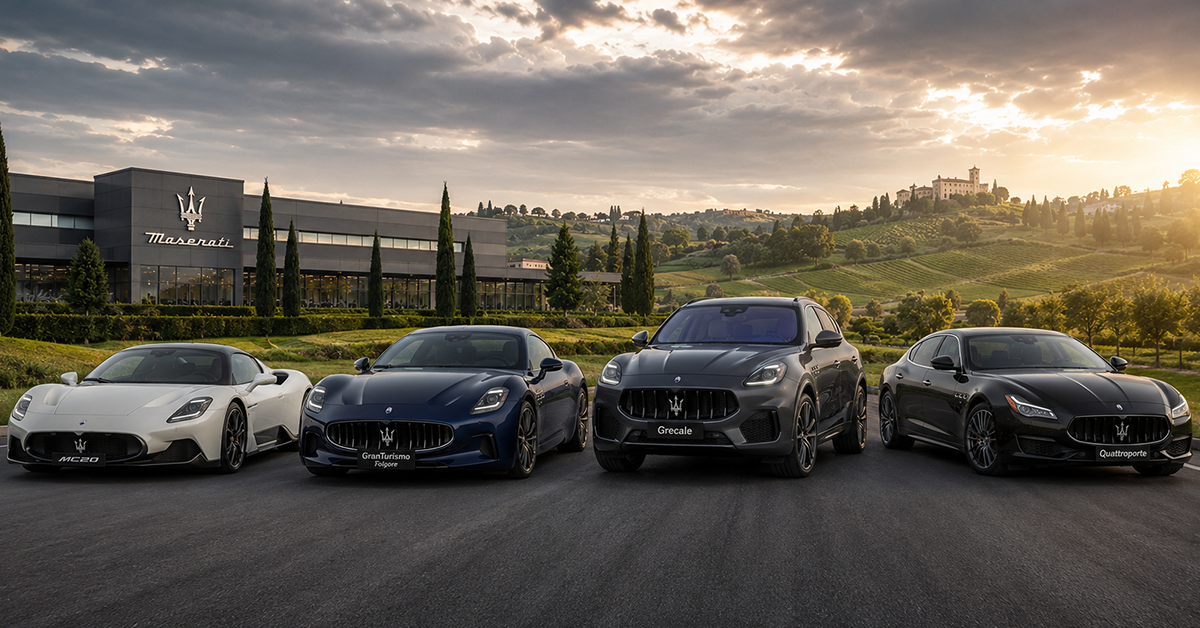
AI-generated concept illustration — Maserati brand overview. | Rev N Rise
Maserati is Italy's most musical car brand — a manufacturer whose engines have been celebrated for their distinctive sound as much as their performance for over a century. Founded by five brothers in Bologna in 1914 and based in Modena since the 1930s — the same small Italian city that gave the world Ferrari and Pagani — Maserati has built some of the most elegant grand tourers and sports cars in automotive history, and is now navigating a return to its in-house engineering roots with the MC20 supercar.
The five Maserati brothers — Alfieri, Bindo, Carlo, Ettore and Ernesto — founded Officine Alfieri Maserati on December 1 1914 in Bologna, initially as a workshop that tuned and modified Isotta Fraschini racing cars. The company built its first complete car — the Tipo 26 — in 1926, which won the Targa Florio on its competition debut. The trident logo — adopted that same year — was suggested by Mario Maserati, an artist brother who was not directly involved in the engineering side of the business, and was inspired by the statue of Neptune in Bologna's Piazza Maggiore.
Maserati moved to Modena in 1937 — the small Italian city that has since become globally synonymous with high-performance automotive engineering, also home to Ferrari and Pagani. Through the 1950s and 1960s Maserati built road cars of extraordinary elegance alongside a serious racing programme — Juan Manuel Fangio won the 1957 Formula 1 World Championship driving a Maserati 250F. The Maserati Ghibli, Bora and Khamsin of this era are among the most beautiful Italian grand tourers ever produced, with bodies designed by Giorgetto Giugiaro and Marcello Gandini.
Maserati's ownership history has been turbulent — it passed through Citroën, De Tomaso and various Italian state-backed rescues before Fiat acquired the brand in 1993. Under Fiat — and subsequently Fiat Chrysler Automobiles and now Stellantis — Maserati has been positioned as the group's ultra-luxury Italian flagship, sharing some engineering with Ferrari during the period when Ferrari was also part of the Fiat group (until 2016) and benefiting from that engineering proximity in models like the GranTurismo and Quattroporte.
The Nettuno V6 — introduced in the MC20 in 2020 — represents Maserati's first engine developed entirely in-house in several decades, after years of relying on Ferrari-built or Stellantis-shared powertrains. Named after Neptune, echoing the trident logo, the Nettuno uses Formula 1-derived pre-chamber combustion technology — a small secondary combustion chamber that ignites the fuel mixture more completely and efficiently than conventional spark plugs, improving both power output and emissions. The 3.0-litre twin-turbocharged V6 produces 630 horsepower — an extraordinary figure for its displacement — and represents Maserati's commitment to reclaiming genuine engineering independence rather than remaining purely a styling and branding exercise on shared platforms.
Maserati's competitive identity is built on Italian elegance and sound — its cars have always prioritised the emotional and sensory experience of driving over outright performance statistics. The Nettuno V6's distinctive exhaust note, the GranTurismo's flowing proportions and the brand's century of motorsport heritage give it a character that Stellantis's other Italian brand, Alfa Romeo, shares but Maserati positions at a more rarefied price point. The MC20's return to in-house engineering after years of shared platforms is the most significant signal that Maserati intends to compete genuinely with Ferrari and Lamborghini rather than simply occupying an adjacent luxury segment. The brand's challenge is sustaining that engineering investment at the relatively modest sales volumes that the ultra-luxury segment supports — a challenge that will define whether Maserati's renaissance under the Nettuno era proves durable.