 Brands
Aston Martin — History, Models and Everything You Need to Know
AI-generated concept illustration — Aston Martin brand overview. | Rev N Rise
Aston Martin is Britain's most glamorous car brand — the maker of James Bond's DB5, the Valkyrie hypercar developed with Formula 1 legend Adrian Newey and some of the most beautiful grand tourers ever built. Founded in 1913, Aston Martin has survived financial crises, multiple ownership changes and near-closure more times than almost any other car company — and emerged each time more desirable than before. There is no car brand whose story more closely mirrors the dramatic, improbable life of its most famous fictional customer.
Lionel Martin and Robert Bamford founded Bamford & Martin in London in 1913 — a company that sold Singer cars and later began building their own sporting vehicles. The name Aston Martin came from the Aston Hill climb in Buckinghamshire, where Lionel Martin raced successfully. The partnership became Aston Martin Motors in 1914. Early Aston Martins were hand-built sporting cars produced in tiny numbers — the company went bankrupt for the first time in 1925, a pattern that would recur throughout its history.
Aston Martin changed hands multiple times through the 1920s and 1930s before David Brown acquired both Aston Martin and Lagonda in 1947 for £20,500 — one of the most consequential automotive purchases in British history. Brown's initials — DB — became the naming convention for Aston Martin's most celebrated models. The DB2, DB4, DB5 and DB6 of the 1950s and 1960s established Aston Martin as the definitive British grand tourer — beautiful, fast, refined and achingly desirable. The DB5's appearance in Goldfinger in 1964 with Sean Connery as James Bond gave Aston Martin a cultural profile that no advertising budget could have purchased.
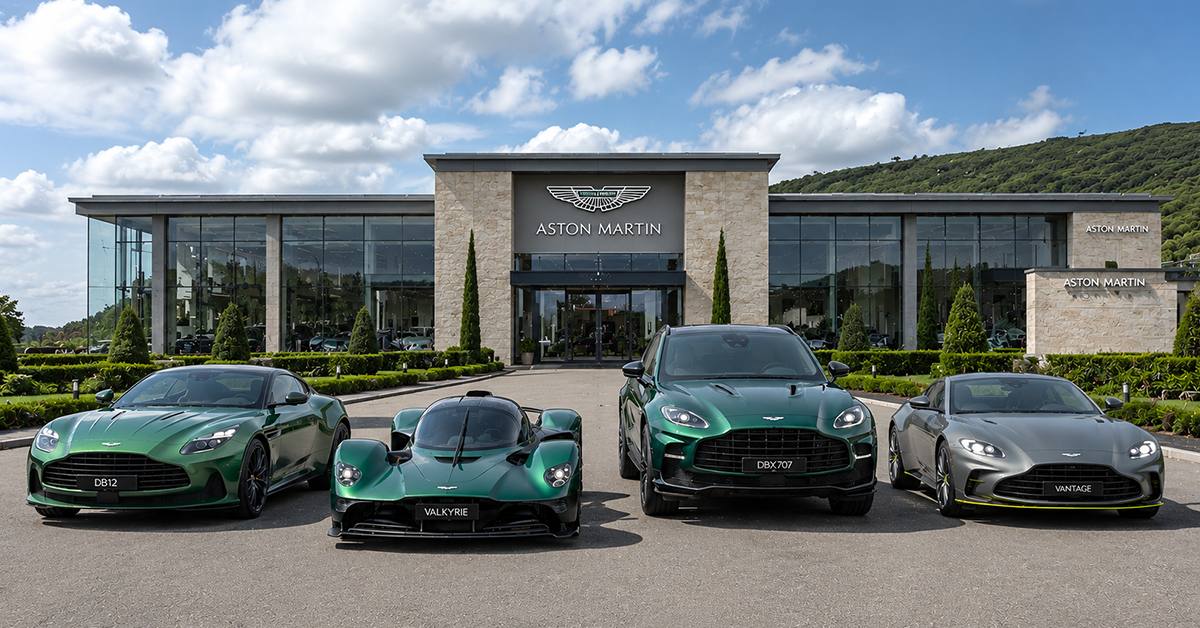
The brand passed through numerous owners — including Ford Motor Company from 1987 to 2007 — before a consortium led by Lawrence Stroll acquired control in 2020. Stroll restructured the company, brought in Mercedes-AMG as a technology and engine partner, purchased the Formula 1 team that was renamed Aston Martin Aramco in 2021 and began the most ambitious product renaissance in the brand's history. The DB12, Vantage and DBX707 represent a genuinely competitive new generation of Aston Martins.
The Aston Martin DB5 is the most famous car in cinema history — a silver grand tourer that appeared in Goldfinger in 1964 driven by Sean Connery as James Bond and has been associated with the character ever since. The DB5 was already a supremely beautiful car — a Carrozzeria Touring Superleggera body with a 4.0-litre straight-six engine producing 282 horsepower — but its Bond appearance transformed it from a luxury car into a cultural icon. The fictional gadgets — ejector seat, machine guns, revolving number plates — lodged in the collective imagination of an entire generation. The DB5 has appeared in more Bond films than any other car and its association with the franchise is now formally licensed — Aston Martin produced 25 DB5 Goldfinger Continuation cars in 2020 at £2.75 million each, fitted with the same gadgets from the original film. All 25 sold immediately.
The Aston Martin Valkyrie is the most technically ambitious road car in Aston Martin's history and arguably the most extreme road-legal hypercar ever produced. Developed in partnership with Red Bull Racing and designed by Adrian Newey — the most successful Formula 1 car designer of all time — the Valkyrie uses a naturally aspirated 6.5-litre Cosworth V12 that revs to 11,100rpm and produces 1,000 horsepower. Combined with a 160-horsepower hybrid system, total output is 1,160 horsepower. The car weighs approximately 1,000kg. The power-to-weight ratio exceeds that of most purpose-built racing cars. The downforce at speed is sufficient to theoretically drive on the ceiling. Only 150 road cars and 25 track-only AMR Pro versions were produced. The Valkyrie is the most direct translation of Formula 1 technology into a road vehicle that has ever been attempted by a production manufacturer.
Aston Martin's competitive position is built on three pillars — beauty, heritage and the Bond connection. No other car manufacturer has a cultural association as powerful, as globally recognised or as enduringly glamorous as Aston Martin's relationship with James Bond. That association is not a marketing campaign — it is a 60-year-old organic cultural phenomenon that has made Aston Martin the aspirational luxury car brand for multiple generations of buyers who grew up watching Bond films. The DB12 and new Vantage — with AMG V8 engines that are among the best-sounding and most characterful in the segment — demonstrate that the current product lineup can justify the brand's heritage rather than simply coasting on it. And the Valkyrie proves that Aston Martin's engineers can reach the absolute frontier of automotive technology when given the resources and the ambition to do so. The brand's financial stability under Lawrence Stroll's ownership — still fragile but more secure than at any point in the past two decades — is the essential foundation on which that ambition rests.