 Brands
McLaren — History, Models and Everything You Need to Know
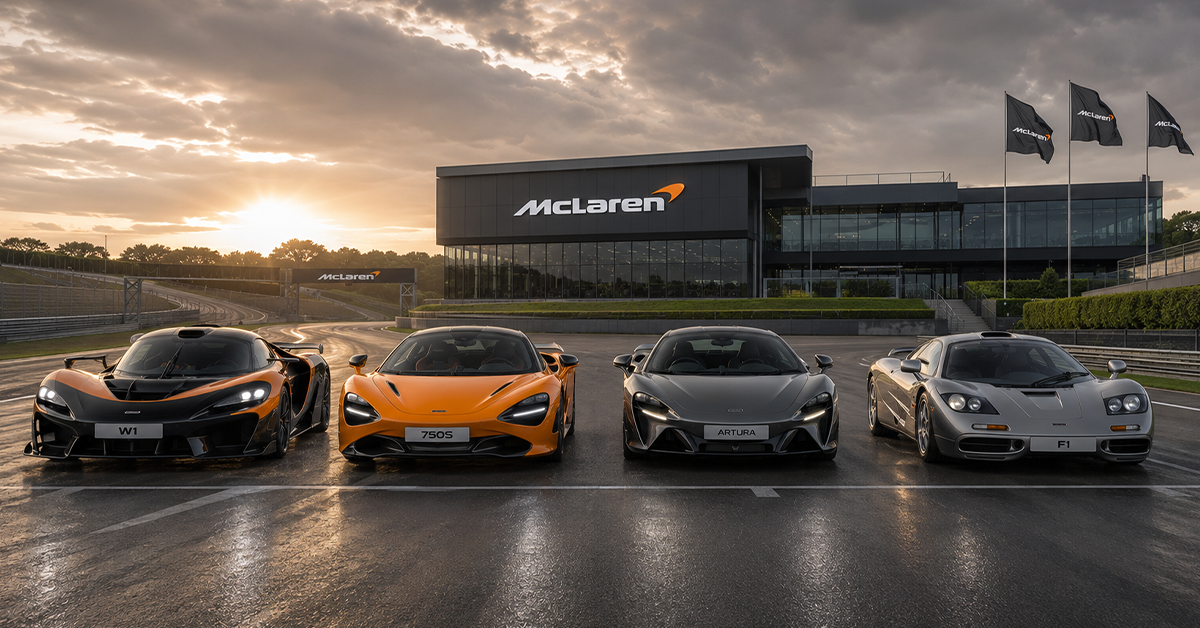
AI-generated concept illustration — McLaren brand overview. | Rev N Rise
McLaren is the supercar brand built by racers, for people who want a racing car they can drive to dinner. Founded as a Formula 1 team by New Zealander Bruce McLaren in 1963, the company has won eight F1 Constructors' Championships and produced the F1 — the car that held the world speed record for over a decade. Every road car McLaren has ever built carries the engineering DNA of a team that has spent six decades competing at the absolute pinnacle of motorsport.
Bruce McLaren — a New Zealand racing driver who had already won races for Cooper in Formula 1 — founded his own team, Bruce McLaren Motor Racing, in 1963. The team entered Formula 1 in 1966 and quickly established itself as a competitive force. Bruce McLaren died testing a Can-Am car at Goodwood in 1970, but the team he founded continued under the leadership of his colleagues and went on to become one of the most successful organisations in motorsport history.
McLaren's F1 success accelerated dramatically through the 1980s under team principal Ron Dennis — with Niki Lauda, Alain Prost and Ayrton Senna driving for the team during one of the most fiercely competitive periods in the sport's history. The legendary rivalry between Prost and Senna as McLaren teammates from 1988 to 1989 produced some of the most dramatic races and controversial moments in F1 history. McLaren has won 8 Constructors' Championships and 12 Drivers' Championships — second only to Ferrari among constructors.
McLaren Automotive — the road car division — emerged from this racing pedigree. The McLaren F1, launched in 1992 and designed by Gordon Murray, was the first true McLaren road car and one of the most significant supercars ever built. After a hiatus, McLaren Automotive relaunched as a sustained production car business with the MP4-12C in 2011, beginning an unbroken run of road car production that continues today.
The McLaren F1 held the record for the world's fastest production car for over a decade — reaching 240.1mph in 1998, a record that stood until the Bugatti Veyron arrived in 2005. Designed by Gordon Murray — who had previously designed championship-winning F1 cars for Brabham and McLaren — the F1 was an exercise in obsessive engineering purity. It featured a central driving position with two passenger seats slightly behind and to each side, giving the driver an unobstructed view and perfect symmetry. The engine bay was lined with gold foil — chosen specifically for its heat reflective properties, not for ostentation. The naturally aspirated BMW-developed V12 produced 627 horsepower in a car weighing just 1,138kg. Only 106 were built. Examples now sell for well over $20 million at auction — making it one of the most valuable cars in the world.
McLaren's defining characteristic is its uncompromising racing pedigree — more than almost any other road car manufacturer, McLaren's engineering decisions are filtered directly through Formula 1 thinking. Every McLaren road car uses a carbon fibre monocoque chassis — a technology McLaren pioneered in Formula 1 in 1981 and has used in every road car since the original F1. The W1 hypercar's active aerodynamics are derived directly from current Formula 1 technology, with Drag Reduction System-style components that adjust automatically for maximum cornering grip or minimum drag on straights. McLaren's recent ownership stability under Bahrain's Mumtalakat fund — after years of financial uncertainty that nearly forced the sale of the company — gives the brand the foundation it needs to continue investing in the engineering that has always been its core differentiator. For buyers who want their supercar to feel like a genuine extension of Formula 1 technology rather than simply a fast road car, McLaren remains the most credible choice in the market.