 Brands
McLaren W1 Review — The 1,258HP P1 Successor Is Worth Its $2.1 Million Price

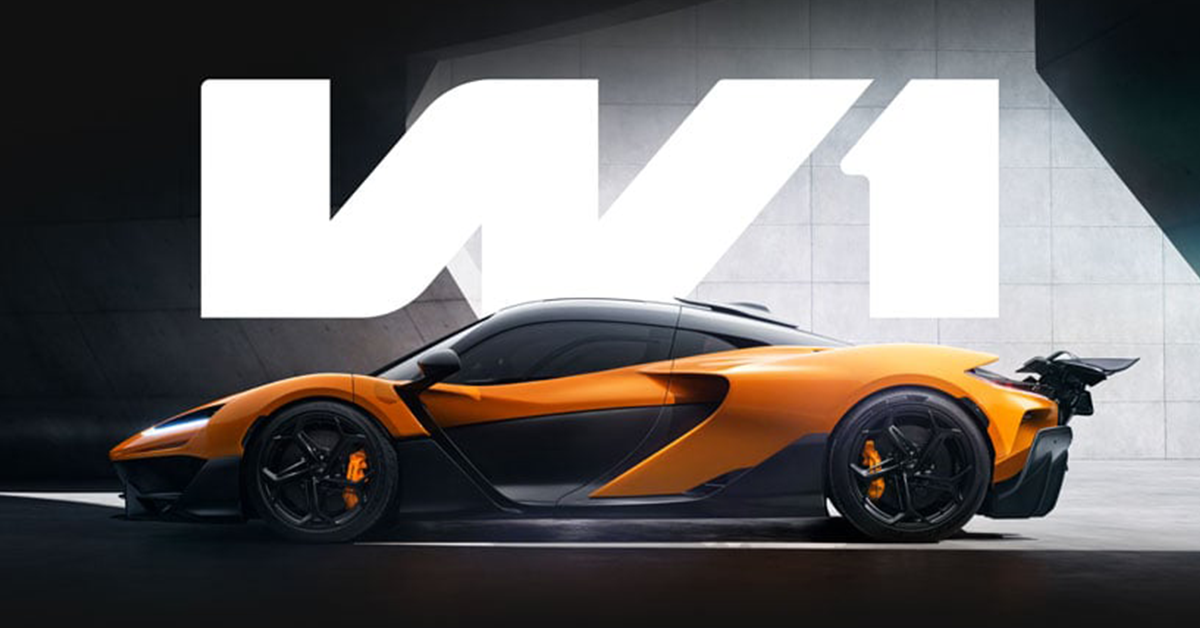
Official press image of the McLaren W1. | © McLaren Automotive
McLaren only gives three road cars the right to wear a "1" in their name. The F1 redefined what a supercar could be in 1992. The P1 reinvented the hybrid hypercar in 2012. Now, fourteen years later, the W1 arrives as the third member of that bloodline — 1,258 horsepower, a 2.7-second 0-60mph time, and a $2.1 million price that 399 buyers paid before most of the car's specifications were even public. This is whether the W1 actually earns its name.
The McLaren W1 is for the collector who wants the purest, most analogue-feeling hypercar of this generation — a car that sends every one of its 1,258 horsepower to the rear wheels alone, with no all-wheel-drive safety net. It is for the buyer who values Formula 1-derived engineering over outright lap times against rivals with more power and more grip. It is not for the buyer who wants the absolute lowest 0-60 number available — the all-wheel-drive Ferrari F80 and others will beat it off the line. But for anyone chasing the most connected, most theatrical driving experience in the current hypercar generation, the W1 is the one to have.
Not just any McLaren can be given the "1" title. The F1 and the P1 before it defined what a real supercar was for their respective generations, and McLaren has been characteristically patient about handing that name to a third car. The W1's reveal was deliberately timed to coincide with the 50th anniversary of McLaren's first Formula 1 Constructors' and Drivers' World Championship win in 1974 — a symbolic choice that says everything about how seriously McLaren takes this nameplate.
The timing also places the W1 at the head of what looks set to become a new "holy trinity" of hypercars, following in the footsteps of the McLaren P1, Ferrari LaFerrari and Porsche 918 Spyder from the previous generation. The W1 was the first of the new trio to break cover, with the Ferrari F80 following shortly after and Porsche's all-electric Mission X concept still in development. All 399 W1 allocations sold out almost immediately — a clear signal that, name aside, the car itself had already convinced the people who matter most.
At the heart of the W1 is an entirely new engine, internally designated the MHP-8 — a twin-turbocharged 4.0-litre flat-plane-crank V8 built from the ground up rather than adapted from an existing McLaren unit. On its own, it produces 928 horsepower, the highest output of any McLaren engine ever made and equivalent to 230 horsepower per litre. Port and direct injection work together to extract maximum output across the rev range, while a lightweight block, rigid valvetrain and plasma-spray-coated cylinder bores allow the engine to spin to a 9,200rpm redline, with the twin turbos spooling up from as low as 2,500rpm.
Supplementing the V8 is McLaren's new E-Module — a radial flux electric motor, motor control unit and a deliberately tiny 1.4kWh battery pack, adding a further 347 horsepower. Combined system output reaches 1,258 horsepower (1,275 PS) and 988 lb-ft of torque. The entire hybrid system weighs just 44 pounds, and McLaren has reduced total hybrid component weight by 88.2 pounds compared to the P1's equivalent hardware — a genuinely significant engineering achievement given how much more powerful the new system is.
Here is where the W1 separates itself from virtually every other hypercar currently being built with over 1,000 horsepower. All 1,258 horsepower goes to the rear wheels only, through an eight-speed dual-clutch transmission with an integrated electronic differential — no reverse gear exists mechanically, since the electric motor simply spins backwards to reverse the car. Every direct hypercar rival in this power bracket, including the Ferrari SF90 and Lamborghini Revuelto, uses all-wheel drive to manage this much torque.
McLaren's reasoning is twofold: weight saving, and a genuine belief that rear-wheel drive preserves a purer driving connection — the same philosophy that governs Formula 1 cars. The result is a dry weight of just 3,084 pounds (1,399kg), only 9 pounds heavier than the P1 despite the W1's far more powerful and complex hybrid system. For context, that makes the W1 171kg lighter than a Ferrari SF90 and 373kg lighter than a Lamborghini Revuelto — both of which also have more driven wheels to manage their power.
| Engine | 4.0L twin-turbo flat-plane V8 (MHP-8) + electric motor |
| Combined Output | 1,258 hp (1,275 PS) / 988 lb-ft |
| V8-Only Output | 928 hp |
| Electric Motor Output | 347 hp (255 kW) |
| Battery | 1.4 kWh — 80% charge in 22 minutes |
| EV-Only Range | ~1.6 miles |
| Drive | Rear-wheel drive only |
| Transmission | 8-speed dual-clutch, electronic reverse |
| 0-60 mph | 2.7 seconds |
| Top Speed | 217 mph (limited) |
| Dry Weight | 3,084 lbs (1,399 kg) |
| Power-to-Weight | 911 PS/tonne |
| Chassis | Carbon fiber Aerocell monocoque |
| Production Run | 399 units — sold out |
| US Starting Price | ~$2.1 million |
| Reveal Date | October 6, 2024 |
The W1 is a true ground-effect car, drawing directly on the same aerodynamic principles as McLaren's Formula 1 machinery. An active rear wing, controlled by electric motors, can raise, lower and rotate — functioning as a downforce generator, an air brake, and a DRS-style drag reduction system at the push of a button, just like in F1. In its most extreme Race Mode setting, the car drops by up to 37mm and the wing rises by 30cm, together generating 650kg of downforce at speed.
The bodywork itself is split into two visual halves — shrink-wrapped organic surfaces above a sharply technical, exposed aerodynamic underbody below, with Formula 1-inspired side pods channeling air around the carbon fiber Aerocell monocoque. The dramatic Anhedral doors, which open at a downward angle rather than swinging conventionally upward or outward, incorporate integrated aero blades that are functional rather than purely decorative. The rear diffuser is large enough that McLaren had to pitch the engine and gearbox upward by several degrees just to make room for it.
The W1's cabin is integrated directly into the Aerocell monocoque rather than being a separate assembly — the seating position is fixed, and instead the steering wheel, pedals and primary controls move to adapt to the driver, a McLaren signature approach also used on the P1 and Senna. This prioritizes the lightest, most rigid possible structure over conventional adjustable-seat convenience.
Material technology gets genuine attention too. The W1 debuts McLaren InnoKnit, a world-first lightweight, flexible material that can be woven directly into the cabin in custom textures and colours, including integration into speaker grilles for the Bowers & Wilkins audio system. For buyers who prefer tradition, leather and Alcantara remain available. An 8-inch touchscreen supports Apple CarPlay and Android Auto, and a small rear shelf adds 4.1 cubic feet of practical storage — a genuinely surprising amount for a car this extreme. McLaren Special Operations (MSO) offers near-unlimited bespoke customisation for buyers who want their W1 to be genuinely one-of-one.
The McLaren W1 is defined by real supercar principles and is the ultimate expression of a McLaren supercar. Born of our rich racing history and World Championship mindset, W1 pushes the boundaries of performance and is worthy of the '1' name.
— Michael Leiters, then-CEO, McLaren AutomotiveThe McLaren W1 earns its name through restraint as much as raw numbers. While every rival in this power bracket has moved to all-wheel drive to tame four-figure horsepower, McLaren chose the harder, purer path — rear-wheel drive only, just like the P1 before it and just like the Formula 1 cars this entire bloodline draws from. The new MHP-8 engine is a genuine ground-up achievement, the aerodynamics are authentically race-derived rather than styling exercises, and the weight discipline is remarkable given how much more capable this car is than its predecessor. The W1 isn't the fastest hypercar to 60mph in its class, and it never set out to be. It set out to be the most connected, most theatrical, most McLaren hypercar McLaren knows how to build — and on that measure, it succeeds completely.