 Brands
Ferrari F80 Review — 1,184HP, All-Wheel Drive and Ferrari's Boldest Hypercar Yet

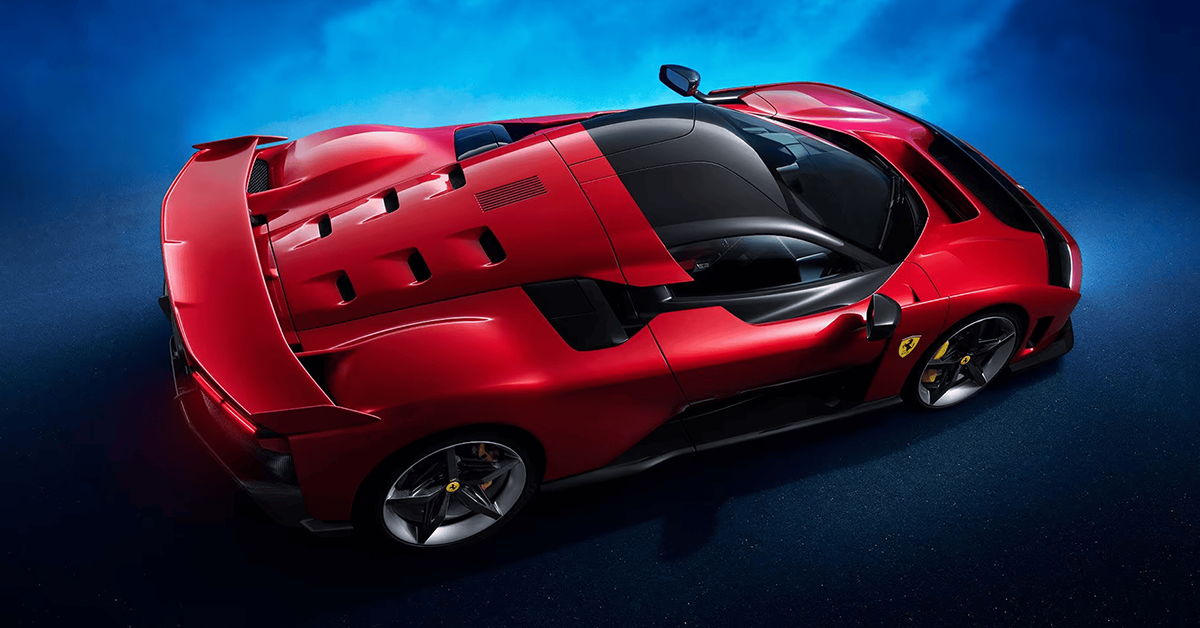
Official press image of the Ferrari F80. | © Ferrari S.p.A.
Ferrari just built the most powerful road car in its history, and it did so by cutting its iconic V12 in half. The F80 replaces the naturally-aspirated tradition of the LaFerrari with a twin-turbo hybrid V6 lifted directly from Ferrari's Le Mans-winning 499P race car, producing 1,184 horsepower and a $3.9 million price tag — and all 799 units sold before most buyers had even seen final specifications. This is whether Ferrari's most controversial engineering decision in decades actually pays off.
The Ferrari F80 is for the collector who wants the outright fastest, most powerful Ferrari ever built, backed by genuine Le Mans-winning engineering rather than just marketing language. It is for the buyer who values all-wheel-drive traction and the highest possible performance ceiling over raw mechanical purity. It is not for the traditionalist who feels a V6, however powerful, can never replace the emotional theatre of Ferrari's V12 halo cars — for that, the LaFerrari and Enzo remain the sentimental favourites. But for the buyer chasing the most technically advanced Ferrari ever to wear the badge, the F80 is exactly that.
Ferrari only hands its flagship halo-car status to a select few models. The F80 joins the 288 GTO, F40, F50, Enzo and LaFerrari as the sixth member of what Ferrari now calls its "Big Six" — and named to mark the company's 80th anniversary. CEO Benedetto Vigna has described the F80 as a car that, in the tradition of those predecessors, "maps out the road for the next decade" — language that signals Ferrari sees this not just as a halo product, but as the template for where its engineering goes next.
The reveal landed within weeks of McLaren's W1, immediately positioning the two as rivals at the head of a new "holy trinity" of hypercars, echoing the previous generation's LaFerrari, McLaren P1 and Porsche 918 Spyder. All 799 F80 allocations — double the W1's production run — were reportedly accounted for before the car was even fully revealed to the public, a similar story of overwhelming demand outpacing supply that has defined this entire new hypercar generation.
The single most controversial decision Ferrari made with the F80 was the engine. Rather than continuing the naturally-aspirated V12 tradition that defined the Enzo and LaFerrari, the F80 uses a 3.0-litre twin-turbocharged V6 — internally designated F163CF — derived directly from the 120-degree hot-V architecture that powers Ferrari's 499P Le Mans Hypercar, a car that has won Le Mans outright multiple times. On its own, the V6 produces 900 horsepower, an extraordinary 300 horsepower per litre, while three electric motors add a further 296 horsepower combined.
Combined system output reaches 1,184 horsepower and 805 lb-ft of torque — making the F80 the most powerful road-going Ferrari ever built, surpassing even the LaFerrari. Two of the three electric motors sit on the front axle, forming Ferrari's first-ever e-4WD all-wheel-drive system on a flagship halo car, while the third motor and MGU-K sit at the rear alongside the V6. The front motors also enable genuine torque vectoring and can return up to 210kW to the front axle through regenerative braking.
This is the F80's other major departure from Ferrari's halo-car history. Where the LaFerrari, and most analogue Ferrari supercars before it, sent power exclusively to the rear wheels, the F80's e-4WD system represents Ferrari's first attempt at putting all 1,184 horsepower down through all four corners on a flagship car. This is also the most significant point of divergence from its closest rival, the McLaren W1, which deliberately stays rear-wheel-drive only.
The transmission is an eight-speed dual-clutch unit, specially recalibrated to handle a 20 percent increase in combustion chamber pressure compared to the related 296 road car. Electric turbochargers — with a motor mounted directly on the shaft between turbine and compressor — virtually eliminate the lag traditionally associated with turbocharged engines, while a new Boost Optimization system can learn a circuit after a single reconnaissance lap and automatically deploy additional electric boost in specific zones, such as a long straight, where it will have the greatest effect.
| Engine | 3.0L twin-turbo V6 (F163CF) + 3 electric motors |
| Combined Output | 1,184 hp / 805 lb-ft |
| V6-Only Output | 900 hp (300 hp/litre) |
| Electric Motor Output | 296 hp combined (3 motors) |
| Drive | e-4WD — first AWD Ferrari halo car |
| Transmission | 8-speed dual-clutch |
| 0-62 mph | 2.15 seconds |
| 0-125 mph | 5.75 seconds |
| Top Speed | 217.5 mph (limited) |
| Dry Weight | 3,362 lbs |
| Max Downforce | 1,050 kg at 155 mph |
| Suspension | 48V active suspension |
| Chassis | Multi-material carbon fibre / aluminium / titanium |
| Production Run | 799 units — sold out |
| US Starting Price | ~$3.9 million |
| Reveal Date | October 17, 2024 |
The F80's aerodynamic ambitions are matched by very few road cars at any price. A carbon-fibre front bonnet features an S-Duct integrated into a triplane wing configuration directly inspired by the 499P race car, while underneath, the rear diffuser stretches an enormous 180cm in length — so large that Ferrari had to rotate the entire engine-and-gearbox assembly by 1.3 degrees just to make physical room for it. The result is up to 1,050kg of downforce at 155mph.
A 48V active suspension system, completely re-engineered from the version used on the Purosangue SUV, continuously manages ride height and body control to keep that aerodynamic package working as intended at all times. The active rear wing can shift dramatically between positions, fundamentally altering both the car's downforce levels and its visual silhouette depending on whether it's set up for outright style or maximum lap-time performance.
Ferrari describes the F80's cabin layout as a "1+" configuration — the driver's seat is positioned forward of and finished in a different colour from the passenger seat, creating an arrangement that prioritises the driver while still comfortably accommodating a passenger within an efficiently narrow cabin width. Ferrari says the compact, single-seater-inspired layout was deliberately designed to evoke the feeling of sitting in an enclosed Formula 1 cockpit.
A new, slightly smaller steering wheel features flattened top and bottom rims and a reduced boss for improved forward visibility, along with a return to physical buttons on both spokes rather than the haptic touch-sensitive controls used on Ferrari's other recent models — a change Ferrari says improves usability specifically because physical buttons can be identified by touch alone, without looking down, during high-speed driving.
It was the year of the F80, our new Supercar which, following in the wake of models like the GTO, F40, F50, Enzo, and the LaFerrari, maps out the road for the next decade.
— Benedetto Vigna, CEO, FerrariThe Ferrari F80 takes the bigger engineering risk of this generation's hypercar trio, and it largely pays off. Cutting the V12 down to a hybrid V6 will upset purists, but the powertrain itself is genuinely extraordinary — 300 horsepower per litre from an engine with real Le Mans-winning pedigree is not a marketing exercise, it's demonstrated motorsport technology making its way directly into a road car. The all-wheel-drive system gives the F80 a different, more attainable kind of speed than the rear-drive-only McLaren W1, even if it sacrifices some of that car's mechanical purity in the process. At $3.9 million it's $1.8 million more expensive than the W1, and reasonable people will disagree about whether that premium is justified by the extra power and traction. What's not in question is that Ferrari has built its most technically advanced road car ever, and done so while staying genuinely faithful to what makes its halo cars matter in the first place.