 Brands
Ferrari Brings Back the Manual — 819hp V12, 1,499 Units, No Paddles

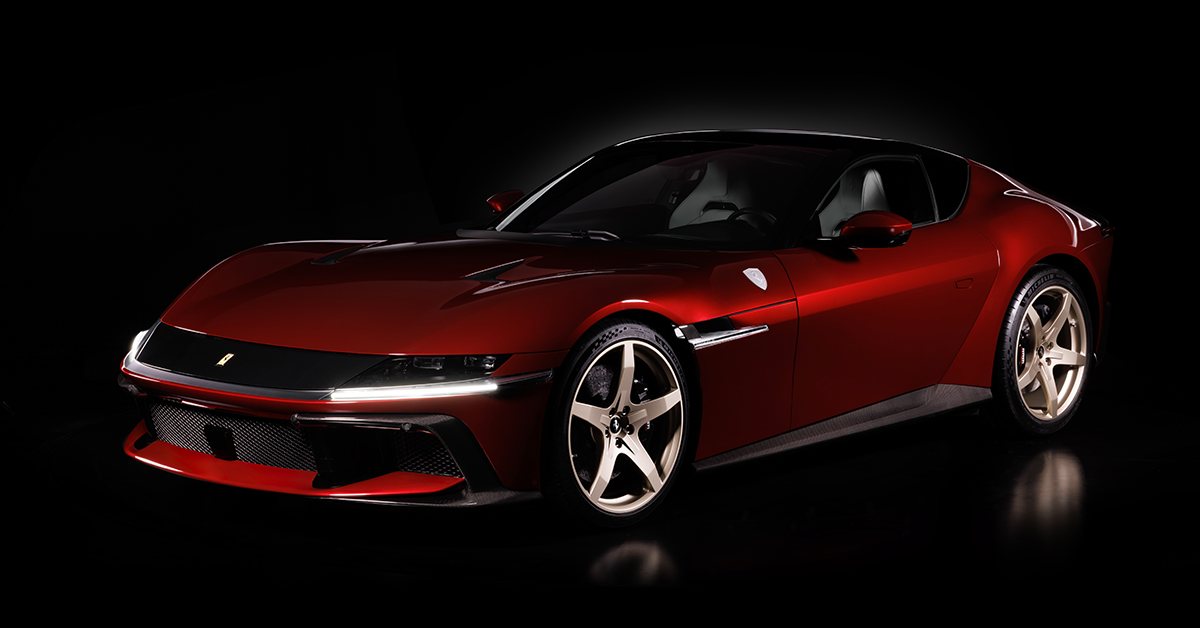
Official press image of the Ferrari 12Cilindri Manuale. | © Ferrari S.p.A.
Ferrari hasn’t offered a manual gearbox in almost 15 years. Yesterday, that changed. The 12Cilindri Manuale is a limited-edition special series of Ferrari’s flagship V12 grand tourer, built around a genuinely brilliant engineering idea borrowed — with full acknowledgement — from a small Swedish hypercar company, and limited to precisely 1,499 units as a deliberate nod to the displacement of the very first Ferrari V12 engine, built in 1947. The paddles are gone. There is a clutch pedal. There is a gated gear lever. And no, it is not mechanically connected to anything — and that is actually the point.
The honest explanation first, because this deserves one. The Ferrari 12Cilindri Manuale does not have a traditional manual gearbox in the mechanical sense — the kind where a physical lever moves through a gate and mechanically engages gears via a linkage. What it has is the Manuale By-Wire system, an entirely new Ferrari-developed technology that reconfigures the standard 12Cilindri’s eight-speed dual-clutch transmission to behave like a six-speed gated manual. The gear lever you move through the gate, the clutch pedal you press — neither is physically connected to the transmission. Both convert your inputs into digital signals that electronically operate the DCT.
The concept traces directly to a system first used by Koenigsegg in the CC850 hypercar, which performed exactly the same trick with a different underlying transmission. Ferrari has been fully open about this inspiration. What Maranello did differently was engineer the entire system in-house, specifically calibrated to the character and rev range of its naturally aspirated 6.5-litre V12 — a unit that revs to 9,250rpm and delivers its power in a way that an electronically mediated clutch and shifter can genuinely exploit for feel and engagement in a way that a turbocharged engine simply cannot.
In the 12Cilindri Manuale, the eight-speed DCT is still physically present and doing all the work. What changes is the interface through which you command it. The driver selects one of six forward gears using the gated H-pattern lever and a clutch pedal — the system uses the first six ratios of the eight-speed DCT for manual mode, with the seventh and eighth gears reserved for automatic high-speed cruising. When you want to go faster, you can switch to Manuale mode via a button on the steering wheel and the car becomes, in all meaningful experiential terms, a gated manual V12 Ferrari.
The centre console has been completely redesigned to accommodate the gear gate — a steel surround embellished with anodised aluminium, housing a round aluminium gear knob backlit with LEDs that indicate the current gear position, with six illuminated dots arranged around it referencing the six forward gears. Paddle shifters are gone entirely from the steering column. A clutch pedal sits in the footwell. The seats carry six vertical grooves in the trim — a deliberate, subtle reference to the number of manual gears. Maranello describes this as a contemporary interpretation of the classic Ferrari gated manual rather than a replica of one, and that distinction is worth keeping in mind.
Under the long bonnet sits Ferrari’s 6.5-litre naturally aspirated V12 — unchanged from the standard 12Cilindri in both specification and character. It produces 819 horsepower at 9,250rpm and 500 lb-ft of torque at 7,250rpm. The 0–62mph time is 3.0 seconds, top speed is 211mph, and the entire car weighs just 5kg (11 lbs) more than the standard 12Cilindri — a remarkably small penalty for the additional components required by the Manuale By-Wire system.
Pricing has not been confirmed by Ferrari, though the standard 12Cilindri starts at approximately $423,000 in the United States. The Manuale will be meaningfully more expensive than that — the combination of limited production, the engineering development cost of the new transmission interface, and the inevitable collector premium for a manual Ferrari means the price will be significantly higher. Ferrari has not disclosed a figure.
| Full Name | Ferrari 12Cilindri Manuale |
| Body Style | Coupe only — no Spider variant |
| Engine | 6.5L naturally aspirated V12 |
| Power | 819 hp @ 9,250 rpm |
| Torque | 500 lb-ft @ 7,250 rpm |
| Transmission | 8-speed DCT with Manuale By-Wire (6 manual gears + 2 auto) |
| Clutch | Clutch-By-Wire pedal — electronically actuated |
| Gear Lever | Open-gate H-pattern — steel gate, anodised aluminium, LED gear position indicator |
| Paddle Shifters | Removed entirely |
| 0–62mph | 3.0 seconds |
| Top Speed | 211 mph |
| Weight Penalty vs Standard | +5 kg (+11 lbs) |
| Production Limit | 1,499 units |
| Unit Number Reference | 1,499cc — displacement of first Ferrari V12, 1947 |
| Drive | Rear-wheel drive |
| Standard 12Cilindri Price | ~$423,000 (US) |
| Manuale Price | Not confirmed — significantly higher |
| Last Ferrari Manual Before This | 2012 — 599 GTB and California |
| Announced | July 3, 2026 |
| Technology Inspiration | Koenigsegg CC850 Engage Shift System |
It is not just about moving from one gear to another. We wanted to give our customers the complete experience of driving a Ferrari the way Ferrari was driven for decades — with their hands, their feet and their full attention.
— Gianmaria Fulgenzi, Product Development Chief, FerrariThe timing of the 12Cilindri Manuale’s debut is not accidental. Ferrari launched its first electric car — the Luce — earlier this year to a reception that was, in Ferrari’s own acknowledged terms, mixed. A section of its most loyal customer base remains deeply attached to the combustion engine, and specifically to the tactile engagement of a manual gearbox in a front-engined V12 grand tourer — the configuration the brand has been building since the 1950s. The 12Cilindri Manuale is a direct, deliberate response to that customer feedback, and Ferrari’s decision to limit it to 1,499 units is equally deliberate: it protects the exclusivity of the model while ensuring that anyone who truly wants one has a real opportunity to secure an allocation before the production run closes.
The broader context matters too. Several other manufacturers — Hyundai, Ford, Subaru and Porsche among them — have filed patents for systems similar to the Manuale By-Wire technology. Ferrari is not the only company watching the Koenigsegg CC850’s approach with interest, and the 12Cilindri Manuale’s debut is likely to accelerate that broader industry conversation significantly. Whether by-wire manual simulation is genuinely satisfying in practice, or whether it represents the automotive equivalent of decaffeinated coffee, will ultimately be answered by the 1,499 customers who receive their cars.
The 12Cilindri Manuale is one of the most genuinely interesting Ferraris in years — not because of its power output, which is unchanged from the standard car, but because of the philosophical argument it makes. Ferrari is saying, explicitly, that driver engagement and tactile involvement matter enough to engineer a completely new transmission interface just to deliver them — even when that interface is technically a simulation of what it represents. Whether you consider Manuale By-Wire a brilliant workaround or a digital facsimile of the real thing depends entirely on what you think a manual gearbox is actually for. If it’s the mechanical connection, this isn’t it. If it’s the experience of shifting with your hands and feet, this very much is. Ferrari is betting that most of its customers will side with experience over engineering purity. At 1,499 units referencing 1947, with a naturally aspirated V12 revving to 9,250rpm and no paddles on the wheel, it is an argument that is very difficult to dismiss.