 Brands
Alpine A110 FUTURE — First Look at the Electric Sports Car That Replaces a Legend

Official press image of the Alpine A110 FUTURE development mule. | © Alpine Automobiles
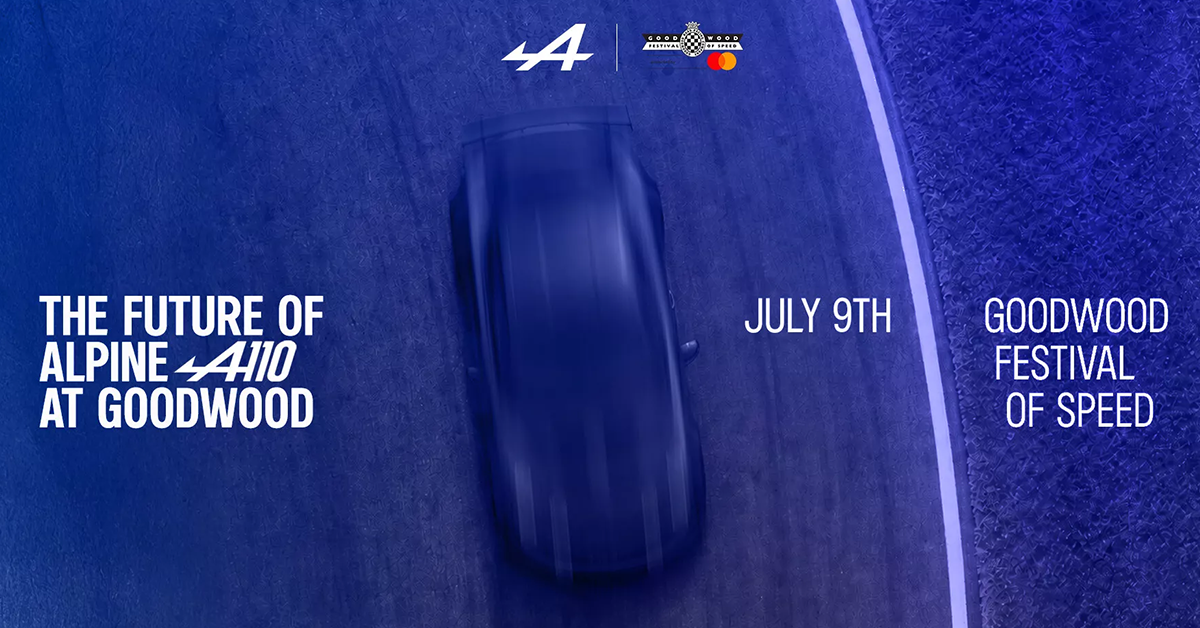
The last petrol-powered Alpine A110 — unit number 28,701 — rolled off the production line in Dieppe last week. Six days later, Alpine revealed what comes next. The A110 FUTURE is a development mule for the all-electric third-generation A110, and it will make its first public appearance at this year’s Goodwood Festival of Speed, running the famous hillclimb every single day from July 9 to 12. This is not a concept car. It is a working prototype carrying the actual platform, motors, batteries and electronics that will underpin the production car expected later this year or in 2027.
Alpine has named the prototype the A110 FUTURE — a deliberate statement about where the company is heading rather than where it has been. The mule wears heavily modified bodywork based on the outgoing second-generation A110, with pronounced wide-arch extensions front and rear hinting at the new car’s significantly wider track. The production A110’s final design remains hidden — Alpine is not showing that today — but underneath the disguise sits the Alpine Performance Platform (APP), the entirely new aluminium architecture that will underpin the third-generation car and every Alpine sports model that follows it.
What makes the A110 FUTURE’s Goodwood appearance genuinely significant is the context. It is rare for a manufacturer to bring a development mule — rather than a finished concept or production-ready reveal — to a major public event. Alpine’s decision to run a working prototype up the Goodwood hillclimb every day for four consecutive days is an explicit signal that development is well advanced and that the company is confident enough in what it has built to let the public hear, see and judge it in motion before the production car is revealed.
The APP is not a modified version of any existing Renault Group architecture. Alpine developed it from a clean sheet specifically to solve the fundamental problem with electric sports cars: they tend to be heavy, tall-floored, and dynamically compromised by the physics of packing large battery packs into a compact body. Alpine’s solution is a split-battery design — two separate packs rather than one large central unit — with one battery positioned ahead of the safety cell and one behind the cabin, approximately where the petrol engine sits in today’s A110.
The result is a 40:60 front-to-rear weight distribution — almost exactly matching the current mid-engine A110’s balance, and the characteristic that has made it one of the best-handling cars of its generation. Keeping that weight distribution while switching to electric power is the central engineering achievement Alpine is claiming, and it is the detail that most directly addresses the concern that an EV A110 will feel nothing like the car it replaces.
The platform uses an 800-volt electrical architecture — the same voltage level adopted by Porsche’s Taycan and the Hyundai E-GMP platform — enabling rapid DC charging and reducing wiring weight compared to lower-voltage systems. Cell-to-pack technology integrates energy cells directly into the structural battery pack, eliminating conventional module casings to save weight and improve packaging.
The third generation of the Alpine A110 will be the world’s first true EV sports car — underpinned by the brand-new Alpine Performance Platform, which allows it to remain true to Alpine’s DNA while outperforming the best of today’s combustion sports cars.
— Alpine Automobiles, official A110 FUTURE announcement, July 3, 2026The drivetrain is rear-wheel drive, using a 3-in-1 e-axle that packages dual electric motors with a silicon carbide inverter into a single unit at the rear. Active torque vectoring distributes torque between the rear wheels every 10 milliseconds — a response speed no mechanical limited-slip differential can match. The entire system is coordinated by a unified electronic brain Alpine calls the Alpine Dynamic Model (ADM), which simultaneously manages the battery, motors, regenerative braking, steering and any active aerodynamic elements in real time. Alpine says this integrated approach — rather than the separate control modules typically used — is what will allow the electric A110 to feel connected and responsive in the way the petrol car does, despite being significantly heavier.
On weight: Alpine CEO Philippe Krief has confirmed a target kerb weight of approximately 1,500 kilograms. The outgoing petrol A110 weighs around 1,100 kilograms — a 400-kilogram increase that is essentially unavoidable with current battery technology at the range targets Alpine is pursuing. The company’s answer is the active torque vectoring system, which Krief says can compensate for the additional mass by generating agility through electronic precision rather than physical lightness. Whether that argument holds up on a challenging road will be the real test once the production car arrives.
| Car Name | Alpine A110 FUTURE (development mule) |
| Generation | Third-generation A110 — first all-electric version |
| Platform | Alpine Performance Platform (APP) — all-new aluminium architecture |
| Battery Layout | Two separate packs — front and rear axle positions |
| Weight Distribution | 40:60 front-to-rear (matches current petrol A110) |
| Electrical Architecture | 800V |
| Battery Technology | Cell-to-pack (no conventional modules) |
| Drive | Rear-wheel drive — 3-in-1 e-axle |
| Motors | Dual electric motors with silicon carbide inverter |
| Torque Vectoring | Active — updates every 10 milliseconds |
| Electronic Brain | Alpine Dynamic Model (ADM) — unified coordinator |
| Power Output | Not confirmed — expected to exceed 464 bhp |
| Target Range | 340+ miles |
| Target Weight | ~1,500 kg (vs current A110’s ~1,100 kg) |
| Combustion Option | Platform is compatible — not ruled out |
| Nürburgring Target | 3 laps without battery derating |
| Mule Bodywork | Modified current A110 panels with wide arch extensions |
| Goodwood Appearance | Runs hillclimb daily, July 9–12 |
| F1 Drivers at Goodwood | Pierre Gasly, Franco Colapinto + 3 academy drivers |
| Production Car Reveal | Expected late 2026 or 2027 |
| Last Petrol A110 Built | Unit 28,701 — Dieppe factory, last week |
The timing of the A110 FUTURE’s debut is pointed. Porsche has discontinued the combustion-powered 718 Cayman and Boxster and is still publicly wrestling with what replaces them — the company’s executives have given conflicting signals about whether the successor will be fully electric, hybrid, or combustion. Alpine has no such ambiguity: the third-generation A110 is electric, it is coming this year or next, and it is going to run up the Goodwood hillclimb six days from now to prove the hardware works.
Alpine has also confirmed that the APP platform is not exclusively for EVs. Krief stated that the rear battery pack sits approximately where the petrol engine does in today’s car, which “presents an opportunity” to accommodate a combustion powertrain if needed. He was careful to add that this flexibility was not achieved at any cost to the electric car’s performance — but the door is open, and the company has explicitly not ruled out a petrol variant. For buyers unconvinced by EV sports cars, that is a meaningful statement to make before the production reveal.
The A110 FUTURE is exactly the right move from Alpine at exactly the right moment. Running a working prototype up the Goodwood hillclimb — not parking a concept on a stand — sends a clear signal about development confidence, and the engineering detail behind the Alpine Performance Platform is genuinely impressive: split-battery layout preserving the 40:60 weight distribution, 10-millisecond torque vectoring, 800V charging, and a unified electronic coordinator tying it all together. The 400-kilogram weight increase over the petrol car is real and unavoidable, and whether the active torque vectoring system can fully compensate for that on a challenging mountain road is the question that will define the third-generation A110’s reputation. But the platform thinking is sound, the intent is clear, and the timing — one week after the last petrol A110 left the factory — couldn’t be more deliberately symbolic. The legend isn’t ending. It’s changing shape.