 Brands
Rolls-Royce Phantom vs Bentley Flying Spur — Which Ultra-Luxury Sedan Wins?

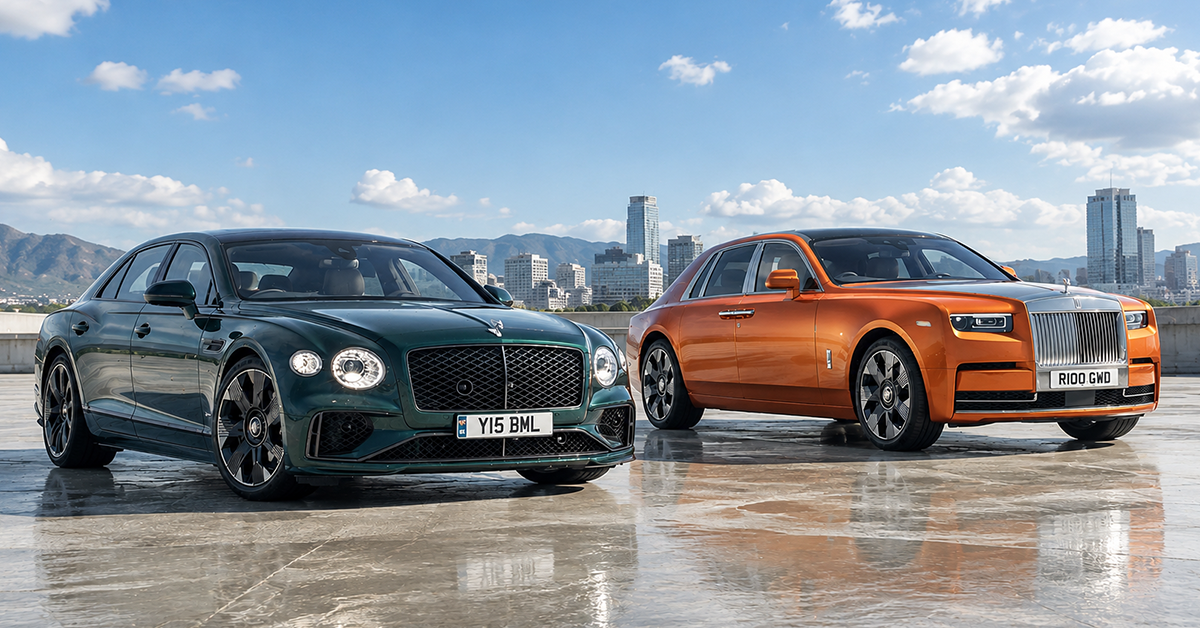
AI-generated concept illustration of the Rolls-Royce Phantom and Bentley Flying Spur — not official images. | Rev N Rise
The Rolls-Royce Phantom wins on total cabin isolation, prestige and bespoke craftsmanship — nothing else in the world offers the Gallery dashboard or the “Magic Carpet Ride.” The Bentley Flying Spur wins decisively on value and genuine driving engagement — it costs nearly $235,000 less while being significantly faster and offering real hybrid efficiency. For most buyers who want to actually drive their ultra-luxury sedan rather than simply be driven in it, the Flying Spur is the smarter purchase.
Two of the most storied names in British luxury motoring, separated by nearly a quarter of a million dollars and two fundamentally different philosophies about what an ultra-luxury sedan should actually do. The Rolls-Royce Phantom has spent a century perfecting the art of making the outside world disappear. The Bentley Flying Spur has spent the same century arguing that a car this opulent can still be genuinely enjoyable to drive. Having studied every number behind both, this is the most complete comparison of the two available anywhere.
| Specification | Phantom | Flying Spur |
|---|---|---|
| Starting Price | $527,750 | $292,800 Winner |
| Engine | 6.75L twin-turbo V12 | 4.0L twin-turbo PHEV V8 |
| Power | 571 hp | Up to 771 hp Winner |
| Torque | 664 lb-ft | Up to ~750 lb-ft (combined) |
| 0–60 mph | ~5.3 sec | 3.3–3.8 sec Winner |
| Top Speed | 155 mph (limited) | ~177 mph (Speed trim) |
| Drive | Rear-wheel drive | All-wheel drive, all-wheel steering Winner |
| Electric-Only Range | None | ~30 miles Winner |
| Fuel Economy (combined) | 14 mpg | Significantly higher (PHEV) Winner |
| Personalisation Programme | Bespoke (Goodwood) Winner | Mulliner |
| Signature Feature | Gallery dashboard Winner | Herringbone veneers, dual audio options |
| Extended Wheelbase Option | Yes (+8.6in rear legroom) | No |
This is the widest gap in the entire comparison. The Rolls-Royce Phantom starts at $527,750, while the Bentley Flying Spur starts at just $292,800 — a difference of roughly $234,950, meaning the Flying Spur costs barely 55 percent of the Phantom’s price. For that considerably lower outlay, the Flying Spur in Speed trim also delivers 200 more horsepower and is a full two seconds quicker to 60mph. On pure numbers, the value case for the Flying Spur is difficult to argue against.
The Bentley Flying Spur in Speed trim produces 771 horsepower against the Phantom’s 571 horsepower — a 200hp gap that translates directly into acceleration figures. The Flying Spur reaches 60mph in as little as 3.3 seconds, while the Phantom takes approximately 5.3 seconds. The Flying Spur’s standard all-wheel steering and 48-volt active anti-roll suspension also give it genuine agility through corners that the rear-wheel-drive-only Phantom, engineered specifically to disguise speed and motion rather than encourage it, was never designed to match.
This is not really a fair fight, because it was never meant to be one. The Phantom’s entire engineering philosophy is built around removing the sensation of speed, not chasing it. The Flying Spur was built for the opposite purpose.
Here the Phantom reasserts its position at the very top of the hierarchy. Rolls-Royce spent over 10,000 hours specifically isolating road, wind and mechanical noise from the Phantom’s cabin, and the resulting silence has no genuine equal — not even in the Flying Spur, which is itself an exceptionally quiet and well-isolated car by any normal standard. The Phantom’s Gallery dashboard — a continuous glass panel in which owners can commission genuinely bespoke artwork — remains completely without equivalent anywhere in the automotive industry, Bentley’s Mulliner programme included.
The Flying Spur counters with its own genuine strengths: leather sourced from high-altitude European herds specifically chosen for fewer blemishes, a choice between reference-grade Bang & Olufsen or Naim audio systems, and Mulliner personalisation offering over 80 extended paint finishes. It is a genuinely excellent luxury cabin. It is simply not competing in the same category as the Phantom’s bespoke ceiling.
The Bentley Flying Spur’s plug-in hybrid powertrain offers approximately 30 miles of electric-only range, allowing genuinely silent, zero-emission driving for typical urban commuting. The Rolls-Royce Phantom offers no hybrid or electric assistance whatsoever — its 14mpg combined fuel economy reflects a traditional V12 with no concessions made toward efficiency. For owners who drive regularly rather than being exclusively chauffeured, the Flying Spur’s hybrid system represents a meaningful real-world advantage that the Phantom simply does not offer, and currently has no answer for — Rolls-Royce’s only electrified model, the Spectre, sits in a separate product line entirely.
| Category | Phantom | Flying Spur |
|---|---|---|
| Price | — | ✓ Winner |
| Performance | — | ✓ Winner |
| Cabin Isolation & Craft | ✓ Winner | — |
| Efficiency | — | ✓ Winner |
| Bespoke Personalisation | ✓ Winner | — |
| Prestige & Presence | ✓ Winner | — |
| Overall | 3 Wins | 3 Wins |
On prestige and isolation: Rolls-Royce Phantom. The Gallery dashboard, the unmatched cabin silence, and a century of bespoke coachbuilding tradition remain genuinely without equal anywhere in the automotive industry. If total serenity and the highest possible bespoke ceiling define your priorities, nothing else comes close.
On performance and value: Bentley Flying Spur. Up to 771 horsepower, genuine hybrid efficiency, and all-wheel steering agility, all at nearly $235,000 less than the Phantom. If you actually want to drive your ultra-luxury sedan rather than simply be driven in it, the Flying Spur makes a genuinely compelling case.
The short answer: Buy the Phantom if you are chauffeured and prestige is paramount. Buy the Flying Spur if you drive yourself and want nearly the same rear-seat luxury at a meaningfully more sensible price.