 Brands
Bentley Flying Spur vs Mercedes-Maybach S-Class — Which Ultra-Luxury Sedan Wins?

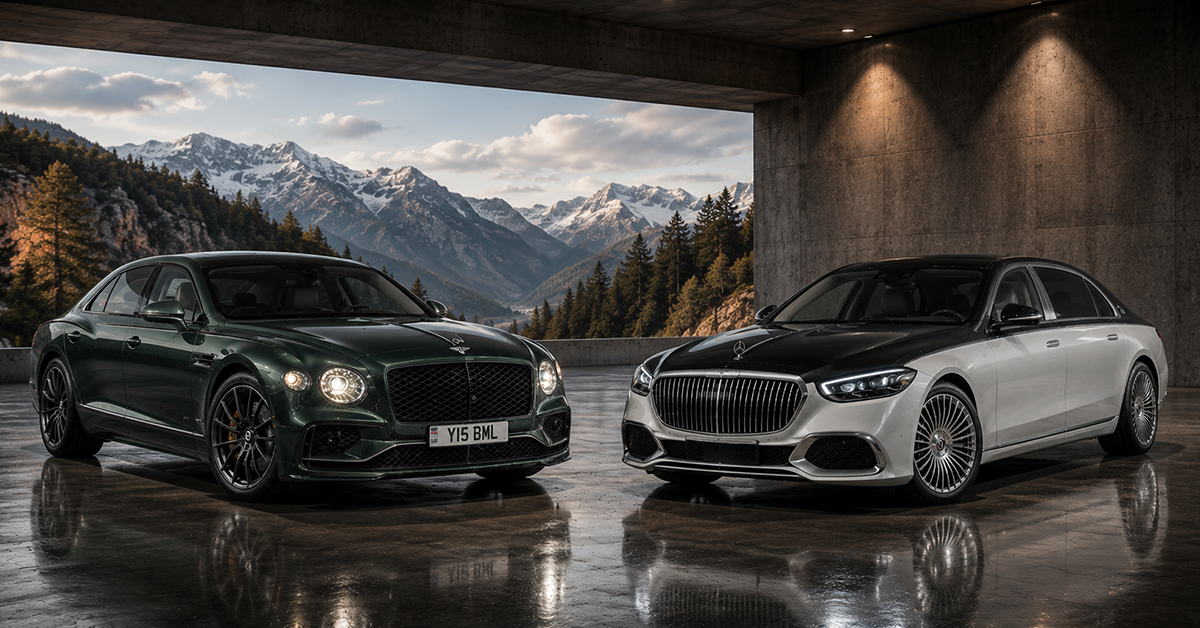
AI-generated concept illustration of the Bentley Flying Spur and Mercedes-Maybach S-Class — not official images. | Rev N Rise
The Bentley Flying Spur wins on performance, driving engagement and true handcrafted personalisation through Mulliner — up to 771 horsepower, all-wheel steering and genuine agility for a four-door this size. The Mercedes-Maybach S-Class wins decisively on value, undercutting the Flying Spur by up to $84,400 while still delivering a genuinely comparable rear-seat luxury experience and one of the last hand-assembled V12 engines available anywhere. For most buyers, the closeness of this comparison makes it the tightest fight in the entire ultra-luxury sedan segment.
This is arguably the closest fight in the entire ultra-luxury sedan segment — two genuinely excellent cars from two of the most respected names in German-and-British luxury motoring, separated by a price gap that is real but far smaller than either car's rivalry with Rolls-Royce. The Bentley Flying Spur builds its case on genuine driving engagement and true handcrafted materials. The Mercedes-Maybach S-Class builds its case on delivering nearly the same experience for meaningfully less money. Having studied every number behind both, this is the most complete comparison of the two available anywhere.
| Specification | Flying Spur | Maybach S 680 |
|---|---|---|
| Starting Price | $292,800 | $245,650 Winner |
| Engine | 4.0L twin-turbo PHEV V8 | 6.0L hand-assembled twin-turbo V12 |
| Power | Up to 771 hp Winner | 621 hp |
| 0–60 mph | 3.3–3.8 sec Winner | 4.5 sec |
| Top Speed | ~177 mph (Speed trim) Winner | ~130 mph (limited) |
| Drive | AWD, all-wheel steering Winner | 4MATIC AWD, rear-axle steering |
| Electric-Only Range | ~30 miles Winner | None |
| Personalisation Programme | Mulliner Winner | Manufaktur Made to Measure |
| Audio Options | Bang & Olufsen or Naim reference-grade | Standard premium system |
| Cheaper Alternate Trim | Not offered below $292,800 | S 580 V8 saves further $37,250 Winner |
| Platform | Not shared with lesser VW Group models Winner | Shared with standard S-Class |
The Bentley Flying Spur starts at $292,800. The Mercedes-Maybach S 580 starts at $208,400 — a difference of approximately $84,400. Even comparing the range-topping Maybach S 680 V12 at $245,650 against the entry-level Flying Spur, the Maybach is still roughly $47,150 cheaper. This is a considerably narrower gap than either car's comparison against the Rolls-Royce Phantom — which is precisely what makes this such a genuinely close contest. Neither car is the “budget” option in any real sense; the question here is which specific strengths matter more to you, not which car is dramatically cheaper.
The Bentley Flying Spur in Speed trim produces 771 horsepower against the Maybach S 680’s 621 horsepower — a genuine 150hp gap. The Flying Spur reaches 60mph in as little as 3.3 seconds, a full 1.2 seconds quicker than the Maybach’s 4.5-second time. Both cars offer all-wheel drive and rear-axle steering for improved manoeuvrability, but the Flying Spur’s standard 48-volt active anti-roll suspension gives it a genuinely sharper, more engaging character through corners than the Maybach’s more comfort-oriented tuning, which prioritises isolation over outright dynamic ability.
The Flying Spur also offers something the Maybach S 680 does not — a genuine plug-in hybrid powertrain with approximately 30 miles of electric-only range, meaning it out-performs the Maybach while also being considerably more efficient day-to-day. The Maybach’s only route to comparable efficiency is choosing the S 580’s mild-hybrid V8 instead — a real trade-off, since that requires stepping down from the more characterful V12.
Bentley’s Mulliner personalisation programme offers over 80 extended paint finishes, leather sourced from herds specifically chosen for minimal blemishes, and hand-selected veneers — genuine bespoke depth that goes beyond what most buyers will ever fully use. The Flying Spur also offers a choice between reference-grade Bang & Olufsen or Naim audio systems, both rarely matched even at this price point.
The Maybach counters with genuine design theatre of its own — an illuminated 20-percent-larger grille, rose-gold headlight accents, and forged wheels with a floating Mercedes star that stays upright as the wheel spins. Mercedes’ expanding Manufaktur Made to Measure programme, now including leather-free luxurious upholstery options, is closing the personalisation gap with Bentley meaningfully year over year, even if it does not yet fully match Mulliner’s depth.
| Category | Flying Spur | Maybach |
|---|---|---|
| Price | — | ✓ Winner |
| Performance | ✓ Winner | — |
| Efficiency | ✓ Winner | — |
| Personalisation Depth | ✓ Winner | — |
| Design Theatre | — | ✓ Winner |
| Value for Money | — | ✓ Winner |
| Overall | 3 Wins | 3 Wins |
On performance and driving engagement: Bentley Flying Spur. Up to 771 horsepower, genuine hybrid efficiency, all-wheel steering agility, and Mulliner personalisation depth that goes beyond what the Maybach currently offers. If you want your ultra-luxury sedan to feel genuinely alive from behind the wheel, the Flying Spur delivers a meaningfully sharper experience.
On value and rational spending: Mercedes-Maybach S-Class. A genuinely comparable rear-seat experience, one of the last hand-assembled V12 engines in production, and a starting price up to $84,400 lower. The gap between these two cars is the narrowest in the entire ultra-luxury segment, which makes the Maybach's value case even more compelling.
The short answer: Buy the Flying Spur if performance, driving engagement and depth of personalisation are worth the premium. Buy the Maybach if you want nearly the same luxury experience while keeping considerably more money in your pocket.