 Brands
Toyota Hilux — The Truck Top Gear Couldn't Kill
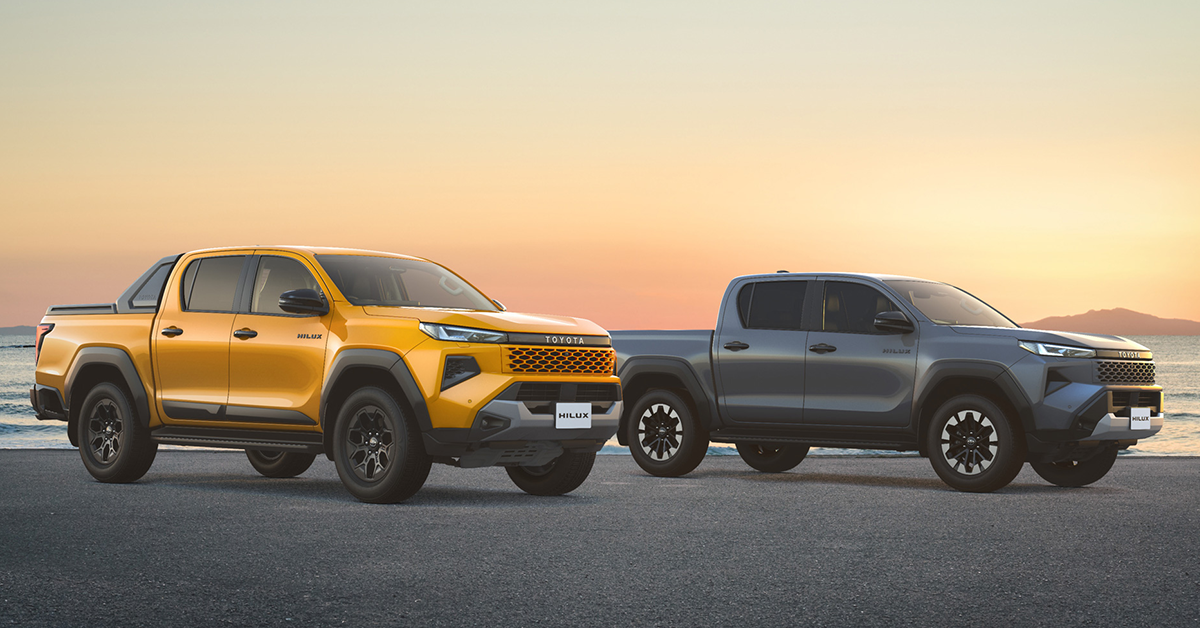
Official press image of the Toyota Hilux. | © Toyota Motor Corporation
In 2003, a British television crew set out to prove that no vehicle is truly indestructible. They drove a 20-year-old Toyota Hilux down a flight of concrete stairs, into the side of a building, head-on into a tree, out into the sea, and set it on fire — then, for good measure, dropped a caravan on it and demolished a tower block on top of it. The truck kept running after nearly every single test. Two decades later, that single episode of Top Gear has probably done more for the Hilux’s global reputation than any advertising campaign Toyota has ever produced.
The Hilux’s origin traces back to 1966, when Toyota established a partnership with Hino Motors. At the time, both companies produced competing bonnet-type light trucks — Toyota’s Lite Stout and Hino’s Briska. Rather than continue running two overlapping products, Toyota and Hino agreed to merge both models into a single new light truck, built at Hino’s Hamura plant. The result, launched in March 1968, was the first-generation Hilux (N10) — using running gear borrowed from the Toyoace cab-over-engine light truck, and adopting the body-on-frame construction that remains the Hilux’s structural foundation to this very day, nearly six decades later.
The name itself is a portmanteau of “high” and “luxury” — a genuinely aspirational choice for what began as a straightforward 1.5-litre, 70-horsepower work truck. Toyota clearly had ambitions beyond a purely utilitarian vehicle from the outset, and across subsequent generations gradually introduced upmarket trim levels, better seat materials, automatic transmissions and disc brakes — features borrowed from the passenger car world and applied to a segment that had, until then, rarely bothered with them.
The second and third generations, spanning 1972 to 1983, refined the original formula without fundamentally altering it — still small, low-riding pickups built primarily around reliability and low running costs. The most significant change came with the introduction of the double-cab body style in 1981, expanding the Hilux’s appeal beyond pure work-truck buyers toward genuine family and lifestyle use. Part-time four-wheel drive arrived with the third generation, engaged through a second lever mounted beside the standard gear shifter — a genuinely significant capability upgrade that began the Hilux’s transformation from urban delivery vehicle to serious off-road tool.
The fifth generation marked the point where the Hilux genuinely grew up. Four-wheel drive became a standard configuration option rather than a specialist add-on, styling became noticeably more refined, and the truck gained a reputation for comfort and everyday liveability alongside its established toughness. Diesel engine options expanded significantly as that fuel type gained broader market acceptance, and Toyota added a 3.0-litre V6 petrol option alongside a new four-speed automatic transmission — genuinely substantial technical upgrades for a segment still largely defined by basic mechanicals elsewhere in the industry. It was a late example of this generation, built in 1988, that would go on to become the most famous Hilux in television history.
In 2003, BBC’s Top Gear purchased a fourth-generation Hilux diesel from a farmyard, carrying 190,000 miles on its odometer and visible corrosion on its bodywork. Presenters Jeremy Clarkson, Richard Hammond and James May then subjected it to a deliberately escalating series of abuse tests, broadcast across two episodes: driving it down a flight of concrete stairs, sideswiping the corner of a building hard enough to dislodge bricks, a head-on collision with a tree, submerging it in rising tidal water, deliberately setting the cabin on fire, dropping a static caravan onto its roof from height, and finally placing it atop a tower block that was then demolished with the truck still on it.
The truck required only basic tool repairs between most of these tests, and continued running through nearly the entire sequence. The episode became one of the most-watched segments in Top Gear’s history and permanently cemented the phrase “indestructible Hilux” in automotive culture worldwide — a reputation Toyota has, quite reasonably, never discouraged in its own marketing since.
The current Hilux went on sale in key global markets including Australia on 9 December 2025, bringing a refreshed exterior, redesigned cabin and a streamlined single-diesel-engine lineup. Exterior design work was handled by Toyota Design Australia, delivering a new front and rear treatment — slimmer LED headlights, a revised grille and sharper body lines — while retaining the same doors and cabin structure as its immediate predecessor. Notably, the new Hilux continues to use the same ladder-frame chassis as before rather than adopting the newer TNGA-F platform found underneath the LandCruiser Prado and LandCruiser 300 Series, keeping its overall dimensions close to the outgoing model.
In Australia, the 2026 range starts at approximately AU$33,990 before on-road costs for the base WorkMate 4x2 manual — a notable increase from the previous 2.7-litre petrol model’s roughly AU$27,730 starting point. Higher trims, including the returning Rogue and Rugged X variants, add features like a $2,500 optional premium interior package with leather upholstery, an eight-way power-adjustable driver’s seat and a nine-speaker JBL audio system. New exterior colour options for 2026 include Ash Slate, alongside Frosted White, Feverish Red and Sunglow on SR5-and-above trims.
Sitting at the top of the current range is the Hilux GR Sport, developed under Toyota’s Gazoo Racing performance division — the same division responsible for the GR Yaris, GR Corolla and GR86. The GR Sport uses a 2.8-litre turbo-diesel inline-four producing approximately 221 horsepower and 550 Nm of torque, a modest but genuine bump over standard diesel trims, paired with sport-tuned suspension and bold GR-specific styling: a prominent honeycomb grille, flared fenders, blacked-out accents, bash plates and side steps. Australian pricing for the GR Sport 4x4 starts at approximately AU$74,310 before on-road costs. Whether Toyota develops a genuinely higher-performance variant to directly challenge the Ford Ranger Raptor has not been confirmed as of this writing.