 Brands
Toyota — History, Models and Everything You Need to Know
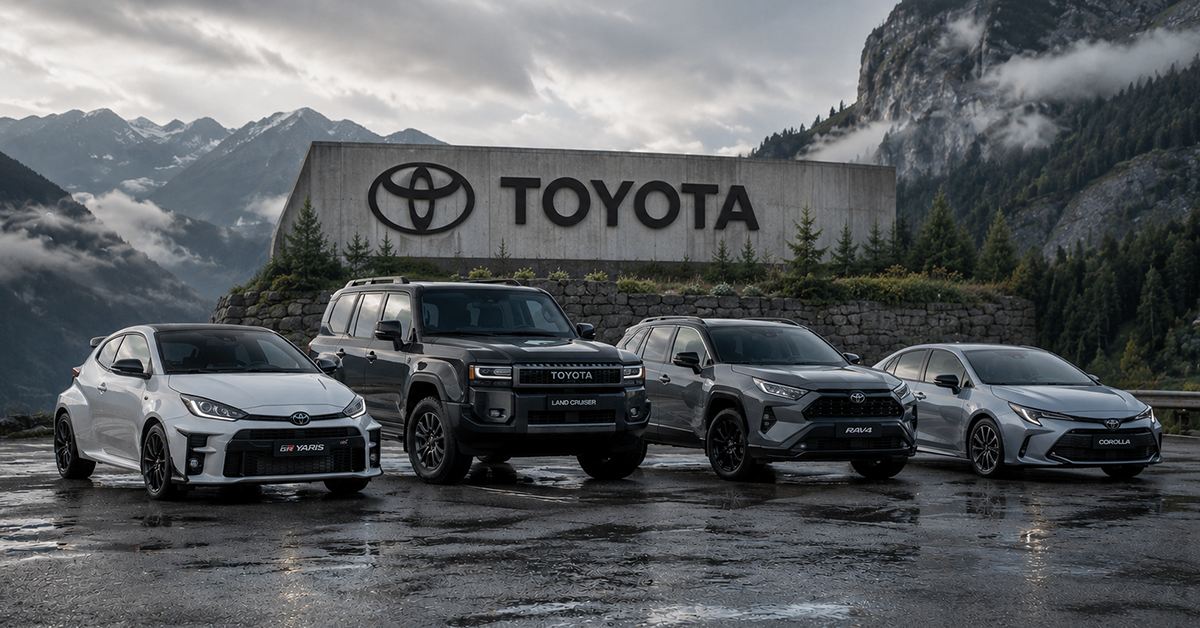
AI-generated concept illustration — Toyota brand overview. | Rev N Rise
Toyota is the world's largest automaker by sales volume — a distinction it has held for most of the past two decades. Founded in Japan in 1937, Toyota has grown from a small domestic manufacturer into a global company that sells more than 10 million vehicles every year across more than 170 countries. It invented mass-market hybrid technology, produces some of the most reliable cars ever built and created the manufacturing philosophy that transformed how every company on earth builds products.
Toyota's origins lie not in the automotive industry but in textiles. Sakichi Toyoda built one of Japan's most successful automatic loom businesses in the late 19th and early 20th centuries. His son, Kiichiro Toyoda, used the proceeds from selling the loom patents to fund a new venture — Toyota Motor Corporation, formally established on August 28 1937. The company name was changed from Toyoda to Toyota because the latter required eight strokes to write in Japanese — a lucky number — and sounded cleaner in spoken Japanese.
Toyota's early vehicles were heavily influenced by American and European designs, but by the 1950s the company was developing its own engineering identity. The Land Cruiser — first produced in 1951 — became one of the most important vehicles in Toyota's history, establishing its reputation for durability in the harshest conditions on earth. Governments, militaries, aid organisations and overlanders around the world chose the Land Cruiser above everything else available because it simply did not break down. That reputation became the foundation on which Toyota built its global brand.
The Corolla arrived in 1966 and changed Toyota's trajectory permanently. Practical, affordable, reliable and available in right-hand and left-hand drive for global markets, it became the best-selling car in the world — a title it held for decades and a record it still owns with over 50 million units sold. The Camry followed in 1982 and became America's best-selling passenger car for multiple consecutive decades. In 1997 Toyota launched the Prius — the world's first mass-produced hybrid car — and changed the automotive industry in a way no company since Henry Ford had managed to do. Every hybrid sold by every manufacturer today owes something to what Toyota proved in 1997: that hybrid technology could work, could be reliable and could be affordable.
Toyota's growth through the 2000s was extraordinary. It briefly became the world's largest automaker by sales in 2008, overtaking General Motors for the first time in history. A series of large-scale recalls in 2009 and 2010 tested the company severely, but Toyota's response — a thorough review of quality processes and a recommitment to the Toyota Production System — restored its standing. Today Toyota is not just the largest automaker but consistently the most profitable mainstream car manufacturer in the world.
The Toyota Production System — developed through the 1950s and 1960s primarily by Taiichi Ohno — is arguably Toyota's most significant contribution to the modern world. Built around two principles — just-in-time manufacturing and jidoka (automation with a human touch) — it eliminated waste at every stage of production, reduced costs, improved quality and created a system so efficient that it was adopted by manufacturers across every industry worldwide. The Toyota Production System is the origin of what the world now calls lean manufacturing — a philosophy that has improved efficiency in hospitals, logistics networks, software development and services as much as in automotive factories.
Toyota's 2026 model lineup covers nearly every segment of the global market — from city cars to full-size pickup trucks, from hybrid family saloons to race-derived hot hatches. The breadth of the range is matched by the depth of electrification — Toyota sells more hybrid and electrified vehicles than any other manufacturer on earth.
Toyota's Gazoo Racing performance division — established formally in 2015 — has transformed the brand's performance credentials in less than a decade. GR's involvement in the World Rally Championship produced the GR Yaris — a three-door homologation special with a 1.6-litre three-cylinder turbo producing 272 horsepower in a car weighing under 1,300 kilograms. It is widely considered one of the most driver-focused hot hatches ever built at any price. The GR86 — developed with Subaru — revived the naturally aspirated rear-wheel-drive sports car in a segment that many manufacturers had abandoned. The GR Corolla brought Yaris-level performance to a more practical body. And Toyota's Le Mans programme — which returned to top-level endurance racing in 2012 and won overall at Le Mans every year from 2018 — feeds real race technology directly back into the road car development process.
Three qualities set Toyota apart from every other mainstream car manufacturer. First, reliability — Toyota consistently tops independent reliability surveys and owner satisfaction studies globally. Models like the Land Cruiser and Hilux regularly run for hundreds of thousands of kilometres with minimal mechanical intervention. In markets where reliability is literally a matter of life and death — remote Australia, sub-Saharan Africa, the Middle East — Toyota is not just the preference but the only choice. Second, the Toyota Production System — a lean manufacturing methodology so influential that it has reshaped not just the automotive industry but manufacturing, logistics and service industries worldwide. Third, hybrid leadership — Toyota was building hybrid cars profitably before any competitor considered it commercially viable, and today sells more electrified vehicles than any other brand. The Prius alone has saved an estimated 100 million tonnes of CO2 emissions since its 1997 launch.
Toyota's weakness — if it has one — is the pace of its full electrification transition. The company bet heavily on hydrogen fuel cell technology and hybrid systems, and has moved more cautiously toward full battery-electric vehicles than rivals like Hyundai, Volkswagen and Tesla. The bZ4X is a competent but not class-leading electric SUV. Toyota has acknowledged the need to accelerate and has committed to launching ten new dedicated electric models by 2026 — a timeline that will determine whether the brand that invented mass-market electrification can lead the next chapter of it.