 Brands
Toyota Tacoma — America's Best-Selling Midsize Truck
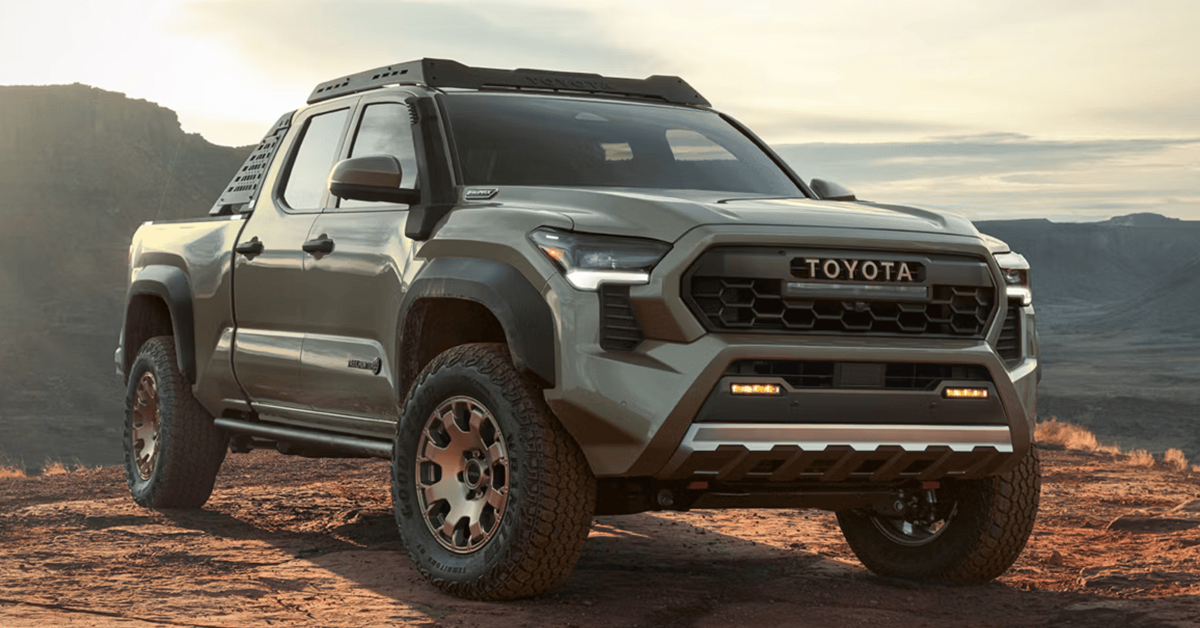
Official press image of the Toyota Tacoma. | © Toyota Motor Corporation
For over two decades, the Toyota Tacoma has held a title few nameplates in any segment can genuinely claim: America’s best-selling midsize pickup truck, year after year, without meaningful interruption. It began life as a deliberate American reinvention of a global Toyota truck the company had sold for decades under a different badge, and it has spent 30 years quietly building one of the strongest reputations for reliability and resale value in the entire US automotive market.
Before the Tacoma existed, American buyers bought Toyota’s global pickup under a considerably less memorable name: the Toyota Pickup, sold in the US market from 1976, and later simply the Toyota Truck from 1984 — both of which were, mechanically, rebadged left-hand-drive versions of the Toyota Hilux sold internationally. By the late 1980s and early 1990s, Toyota had noticed a genuinely American pattern in how these trucks were actually being used: rather than serving primarily commercial, agricultural and off-road purposes as they did in most of the world, American and Canadian buyers were increasingly choosing compact and midsize pickups as personal vehicles, prioritising ride quality and comfort over maximum payload capacity.
Toyota responded by developing an entirely dedicated model for the North American market. Development began in 1989, the same year the Hilux itself entered its fifth generation internationally, and the first-generation Tacoma launched in February 1995, built at Toyota’s plant in Fremont, California. The name itself was drawn from the Coast Salish word for Mount Rainier in Washington state — a deliberate signal that this was now a genuinely American product, engineered specifically around US and Canadian buyer priorities rather than a global truck adapted for local sale.
The first-generation Tacoma (1995–2004) remained a genuinely compact truck, offered across regular cab, Access Cab and Double Cab body styles, with engine choices spanning a 2.4-litre four-cylinder and later a 3.4-litre V6. It retained clear Hilux mechanical DNA while introducing driver-assistance technology that was genuinely advanced for a compact truck at the time, including standard daytime running lights, ABS and stability control on higher trims. An aftermarket TRD supercharger kit developed for the first-generation V6 became a genuinely significant enthusiast modification during this era, adding a seventh fuel injector and a revised ECU to unlock meaningfully more power.
The second generation, unveiled at the 2004 Chicago Auto Show under chief engineer Chikuo Kubota, represented a genuine step change — larger, more powerful, and firmly repositioned as a midsize rather than compact truck. Engine options expanded to a 2.7-litre four-cylinder producing 159 horsepower and a 4.0-litre V6 producing 236 horsepower, paired with a genuinely broad spread of transmission choices — four-speed automatic, five-speed automatic, five-speed manual and six-speed manual — across up to 18 total cab, bed and drivetrain configurations. The third generation, introduced for 2016 and developed by Toyota’s engineering team based in Michigan, refined that formula further without abandoning it, running through the 2023 model year.
The current, fourth-generation Tacoma, introduced for the 2024 model year, represents the most significant mechanical departure in the nameplate’s history. It moved to Toyota’s TNGA-F global truck platform — the same underlying architecture shared with the full-size Tundra, Land Cruiser and Sequoia — bringing genuinely improved structural rigidity and, for the first time on most trims, a coil-spring rear suspension that meaningfully improved on-road ride quality and handling without sacrificing the Tacoma’s established off-road credibility.
The previous generation’s naturally aspirated V6 disappeared entirely, replaced across the board by a turbocharged 2.4-litre four-cylinder offered in multiple states of tune. The base i-FORCE gas engine produces 228, 270 or 278 horsepower depending on trim, while the range-topping i-FORCE MAX hybrid powertrain combines the same turbocharged four-cylinder with an electric motor for 326 horsepower and 465 lb-ft of torque — standard on the Trailhunter and TRD Pro, and optionally available on TRD Sport, TRD Off-Road and Limited trims. Toyota states plainly that only the Ford Ranger Raptor currently produces more horsepower in the entire midsize truck segment.
Toyota confirmed the 2026 Tacoma’s official pricing and updates through its own USA Newsroom, starting at $32,145 before delivery and handling fees, entering dealerships in winter 2025–2026. Genuine updates for the model year include a new black front logo on the TRD Off-Road, TRD Sport and TRD Pre-Runner trims, new 18-inch TRD wheels paired with 32-inch Goodyear All-Terrain tyres as part of the TRD Off-Road i-FORCE Premium Package, and a standard tow hitch now fitted to SR XtraCab models. Two new exterior colours join the range: Heritage Blue across the lineup, and the striking Wave Maker shade exclusive to the TRD Pro, expected to reach dealerships in March 2026.
Pricing for the hybrid range spans from approximately $48,530 to $48,830 for the i-FORCE MAX Double Cab, rising to $65,945 to $66,245 for the range-topping TRD Pro i-FORCE MAX. Real-world fuel economy varies considerably by configuration — rear-drive gas models return approximately 22 to 23 mpg combined, while the hybrid i-FORCE MAX settles around 23 mpg combined across most trims, figures that represent genuine best-in-class efficiency for the segment given the complete absence of diesel competitors.