 Brands
Toyota Tundra — The Truck Ford Sued Into a New Name
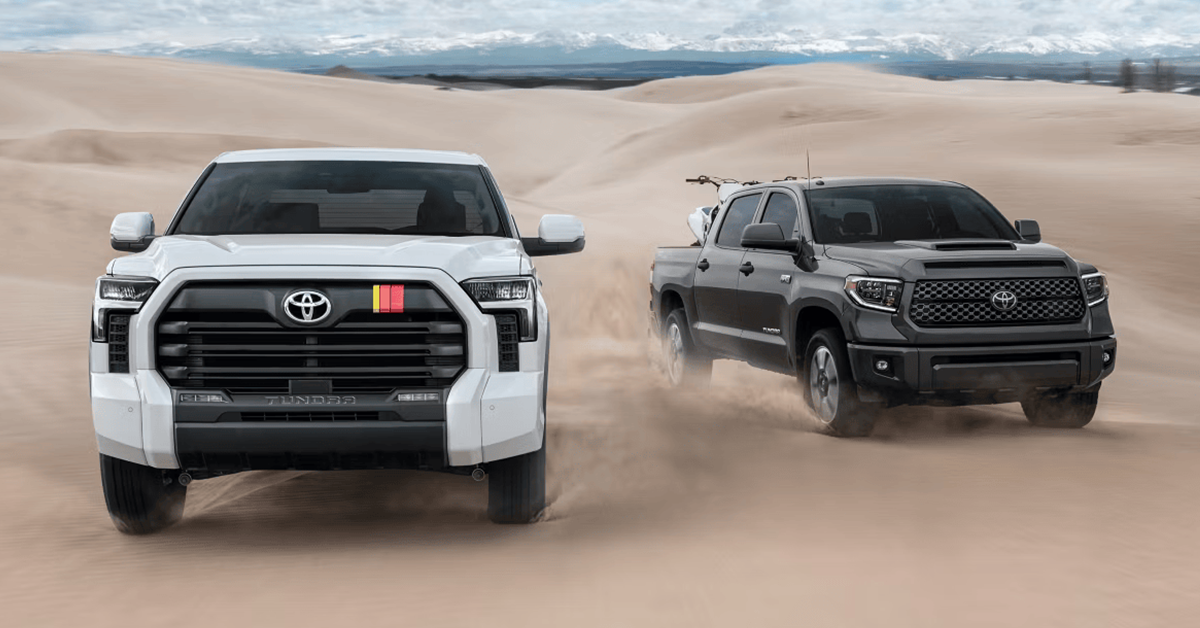
Official press image of the Toyota Tundra. | © Toyota Motor Corporation
Before it was called the Tundra, Toyota’s first genuine full-size truck was internally known by a different designation entirely: T150. Ford, understandably protective of its own F-150 — America’s best-selling vehicle for decades — objected loudly enough, and with enough legal weight behind it, that Toyota changed the name before the truck ever reached a dealership. What emerged instead was the Tundra, a nameplate that has since spent 26 years building a genuine, if perpetually second-place, reputation in America’s most fiercely contested vehicle segment.
Toyota’s full-size truck story does not begin with the Tundra — it begins with the T100, sold from 1993 to 1998. Toyota had already established itself firmly in the compact truck segment through the Tacoma’s predecessors, but American dealers had spent years requesting something larger, driven by high numbers of compact-truck owners eventually trading up to full-size domestic pickups instead of staying loyal to Toyota. The T100 was Toyota’s answer — genuinely larger than a compact truck, with an eight-foot bed and up to 5,200 pounds of towing capacity, and it won J.D. Power’s Best Full-Size Pickup award in its debut year alongside recognition from Popular Science.
But the T100 fell into an awkward middle ground. It offered no extended cab, no V8 engine option, and its largest available engine was simply the same 3.4-litre V6 already found in the smaller Tacoma. Positioned between true compact and true full-size, it never achieved the sales volume Toyota needed, and by 1998 the company had already begun developing a genuine successor.
Toyota unveiled its full-size truck concept at the 1998 Chicago Auto Show, running under the internal designation T150 — a name that immediately drew objection from Ford and much of the automotive press, given its obvious closeness to the market-dominant Ford F-150. Following legal pressure from Ford, Toyota renamed the production truck Tundra ahead of its public launch in May 1999 as a 2000 model. In a detail automotive historians still enjoy repeating, Toyota later returned the favour: when Ford launched the Lincoln LS, Toyota sued over that name’s similarity to the Lexus LS — a genuinely fair point, given how closely the two badges read.
The first-generation Tundra represented a genuine milestone: it was the first full-size pickup from a Japanese manufacturer to be built in North America, assembled initially at Toyota Motor Manufacturing Indiana in Princeton. It earned Motor Trend’s Truck of the Year award in its debut year and again in 2008, and received a North American Truck of the Year nomination — genuine recognition in a segment where import brands had historically struggled to gain real traction against Ford, Chevrolet and Ram.
The Tundra’s early years still carried some of the T100’s undersized reputation — genuinely larger than its predecessor, but still not quite matching domestic full-size trucks in outright scale. A 4.7-litre V8 arrived to address that criticism directly, later updated in 2005 to produce 271 horsepower and 313 lb-ft of torque, with a 5.7-litre V8 eventually joining the range for buyers wanting genuine domestic-rivalling output. The second generation pushed the Tundra’s dimensions and capability further still, cementing its position as a genuine full-size competitor rather than an import curiosity.
The current, third generation launched for the 2022 model year, rebuilt from the ground up and marking the Tundra’s most significant reinvention yet. For the first time, the Tundra adopted independent rear suspension, replacing the traditional leaf-spring setup most full-size trucks still use, delivering a meaningfully smoother ride without sacrificing genuine capability. Every third-generation Tundra uses a twin-turbocharged V6 paired with a 10-speed automatic transmission — the previous generation’s naturally aspirated V8 disappeared entirely, a genuinely bold move that aligned Toyota with the broader industry shift toward smaller, turbocharged engines delivering equal or greater output. This generation is built exclusively at Toyota Motor Manufacturing Texas in San Antonio, making it the only full-size pickup truck manufactured in the state of Texas.
Every 2026 Tundra uses the same fundamental 3.4-litre twin-turbo V6 architecture, but output varies meaningfully by trim. The base SR produces 348 horsepower and 405 lb-ft of torque, while SR5 through the range-topping Capstone and 1794 Edition trims step up to 389 horsepower and 479 lb-ft. Sitting above both is the i-FORCE MAX hybrid, combining the twin-turbo V6 with a motor generator integrated directly into the transmission bell housing between the engine and the 10-speed automatic. Toyota confirms official output at 437 net combined horsepower at 5,200rpm and 583 lb-ft of torque arriving at a genuinely low 2,400rpm — figures that make the i-FORCE MAX the most powerful engine in Toyota’s entire pickup lineup, available with maximum towing capacity reaching 12,000 pounds depending on configuration.
2026 updates confirmed through Toyota’s own USA Newsroom include a revamped Capstone interior with Shale Premium Textured leather-trimmed seats, a larger 32.2-gallon fuel tank standard across all trims (up from 22.5 gallons on previous lower trims), a new Tundra XSP Heritage package with colour-keyed fender flares and a Heritage-styled grille, and a new Wave Maker exterior colour exclusive to the TRD Pro. 2026 pricing spans from approximately $43,455 for the base SR, through roughly $60,655 for the i-FORCE MAX hybrid, up to approximately $74,660 for the fully-loaded TRD Pro i-FORCE MAX.