 Brands
Toyota Alphard — Japan's VIP Minivan the West Rarely Sees
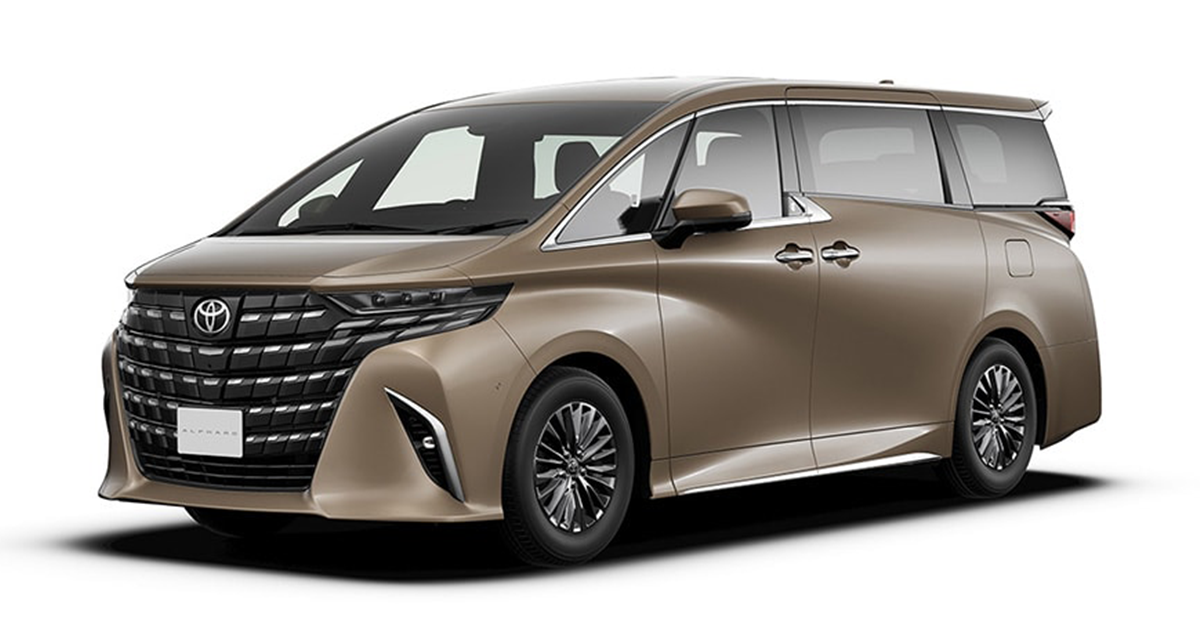
Official press image of the Toyota Alphard. | © Toyota Motor Corporation
In most of the world, a minivan is a practical, largely unglamorous appliance — something you buy for the school run and forget about until the next oil change. In Japan, one minivan occupies an entirely different category. The Toyota Alphard has spent over two decades quietly becoming a genuine status symbol, the vehicle of choice for corporate executives, wedding parties and VIP airport transfers, commanding prices that rival luxury sedans while officially remaining, on paper, a minivan. It is also a vehicle most Western car buyers will never see in person, because Toyota has deliberately kept it almost entirely out of Europe and North America.
Toyota launched the Alphard in May 2002, and the name itself signals exactly how the company positioned it — Alphard is the brightest star in the constellation Hydra, a deliberate choice meant to convey standout prestige rather than mere family practicality. The Alphard did not launch into an empty gap in Toyota’s lineup; it launched specifically to replace four separate existing minivan lines, including the Granvia and Regius, consolidating Toyota’s upper minivan segment into a single, genuine flagship model. Built on a front-wheel-drive platform derived from the Toyota Estima (Previa), but wrapped in a considerably larger body, the original Alphard offered seating in either a seven-passenger 2-2-3 configuration or an eight-passenger 2-3-3 layout, with a choice between a 3.0-litre V6 producing 220ps or a 2.4-litre four-cylinder producing 159ps, available with front-wheel or full-time four-wheel drive.
Because the Alphard shared its underlying platform with the Previa, Toyota could relatively easily configure it for left-hand-drive markets, and the model found genuine demand in Russia and other former Soviet states. Europe, however, was deliberately excluded — not because the Alphard failed to meet European regulations alone, but because Toyota specifically did not want the considerably more premium Alphard cannibalising sales of the Previa, which Toyota was still actively selling in that market at the time. It is a genuinely rare example of a manufacturer intentionally withholding a superior product from a market to protect an existing one.
The Alphard adopted Toyota’s Hybrid Synergy Drive technology remarkably early, introducing a hybrid variant just a year after the standard model launched, in July 2003 — a genuinely forward-looking move for a large minivan at a time when hybrid technology remained largely associated with the Prius alone. From its earliest years, the Alphard also established the dual identity that still defines it today: marketed simultaneously as a genuinely capable family vehicle and as a VIP charter car, purpose-built for chauffeured executive transport, wedding processions and airport service — a positioning most Western minivans have never attempted. A more upmarket, four-seat “Royal Lounge” variant of the Alphard G arrived in 2006, foreshadowing the ultra-luxury rear-seat specifications that would eventually define the nameplate’s top trims.
When Toyota launched the second-generation Alphard in 2008, it simultaneously introduced an entirely new sibling model: the Toyota Vellfire, developed specifically for buyers who wanted a bolder, more individualistic alternative to the Alphard’s more restrained styling. The two models have shared underlying mechanicals and platforms across every generation since, differentiated primarily through exterior design, badging and market positioning — the Alphard leaning toward understated prestige, the Vellfire toward a more aggressive, sportier road presence. Interestingly, through the first three generations, neither the Alphard nor the Vellfire wore Toyota’s standard emblem on the front of the car at all, instead carrying their own unique badges — a genuinely unusual branding decision that reinforced their positioning as standalone flagship products rather than conventional Toyota-badged minivans.
The third-generation Alphard, launched in 2015, brought a genuinely significant chassis upgrade: a new double-wishbone rear suspension, specifically engineered to deliver what Toyota itself describes as “exquisite ride comfort” — the kind of language usually reserved for luxury sedans, not minivans. This generation also introduced the Executive Lounge grade, a genuine top-tier trim that would go on to define the Alphard’s ultra-luxury identity for the following decade. Toyota has been explicit about the strategic intent behind this shift: by pursuing progressively greater luxury with each generation, the company deliberately transformed the Alphard and Vellfire from conventional minivans into what Toyota itself now calls “ultra-spacious luxury saloons” — a genuine repositioning of the entire product category, not merely an equipment upgrade.
The current, fourth-generation Alphard and Vellfire, fully redesigned in June 2023, moved onto an optimised version of Toyota’s TNGA platform (GA-K), specifically adapted for minivan use with straight rocker reinforcements for improved structural rigidity. Toyota’s development team approached this generation with a genuinely deliberate design brief: create a space where every passenger, from driver to rear-seat occupant, could share consideration and appreciation — company language that reflects just how seriously Toyota treats the Alphard’s dual role as both family vehicle and premium mobile office for important business travel. Rear-seat comfort was prioritised specifically enough that Toyota fundamentally overhauled seat design and implemented thorough vibration and noise isolation measures, positioning the Alphard as suitable for use as a genuine super-luxury mobile office.
The standard hybrid powertrain uses a 2.5-litre inline-four DOHC engine (A25A-FXS) delivering a maximum system output of 184kW (250ps), with fuel efficiency improved over the outgoing generation and a new 2WD grade introduced for HEV models specifically to broaden the lineup’s appeal and price accessibility. In December 2024, Toyota expanded the range further still, launching Japan’s first plug-in hybrid minivan — the Alphard and Vellfire PHEV, combining the familiar 2.5-litre engine with Toyota’s E-Four system for a combined 302 horsepower, and an EV-only range of approximately 73km (45 miles) under WLTC testing. The PHEV’s battery pack sits under the floor, lowering the centre of gravity by 35mm compared to the standard hybrid, and can fast-charge to 80 percent in roughly 38 minutes.
Alongside the PHEV launch, Toyota introduced the Spacious Lounge trim — based on the range-topping Executive Lounge, available in both HEV and PHEV form, and configured as a genuine four-seat, six-occupant executive layout with independent captain’s chairs in the rear, deliberately positioned close to the experience offered by the Lexus LM. That comparison is not accidental: the Lexus LM, sold since 2020, is effectively a more luxuriously appointed, Lexus-badged version of the Alphard, sharing its underlying platform and mechanical architecture. The Alphard Spacious Lounge stops short of the Lexus LM500h Executive’s fixed rear partition and 48-inch display, but still offers curtains separating front and rear occupants, side-mounted air vents for rear passengers, headrest-integrated speakers, a refrigerator, phone chargers and selectable interior fragrances — genuinely more akin to a private jet cabin than a conventional minivan interior.
Current Japanese pricing for the Alphard spans approximately ¥5.1 million to ¥10.65 million (roughly $32,600 to $68,100), depending on powertrain and trim, with the Vellfire running from approximately ¥6.7 million to ¥10.85 million ($42,800 to $69,300). The Alphard remains unavailable new in the United States and most of Europe, though grey-market imports and Japanese used-export channels have made it accessible to enthusiast buyers in markets including Russia, Southeast Asia and, more recently, South Korea, which began officially importing the Alphard in 2023 after years of only limited diplomatic and private imports.