 Brands
Volkswagen Beetle — 21.5 Million Cars and a Retro Reboot

Official press image of the original Volkswagen Beetle and the New Beetle. | © Volkswagen AG
The Volkswagen Beetle was built for 65 years, with 21,529,464 original cars made before production ended in 2003, followed by the New Beetle and a final generation that ended in 2019. Here is the full Beetle story, with history, engines, specs, variants and what happened to each generation.

Official press image of the Volkswagen Beetle models from 1938 to 1975. | © Volkswagen AG
The Volkswagen Beetle is one of the most recognisable cars ever built, and its story starts well before Volkswagen was a household name. The original car, known inside the company as the Type 1 and in Germany as the Käfer, was based on a design by Professor Ferdinand Porsche. Its roots go back to the mid-1930s, when Porsche worked on a small, affordable car for ordinary families. It was first called the KdF-Wagen, and the name Volkswagen, meaning “people’s car”, was the one Porsche himself preferred. A production-ready version was shown at the 1939 Berlin Motor Show, and it was the rounded shape that later earned the car its Beetle nickname.
| Designer | Based on a design by Ferdinand Porsche |
| Original name | KdF-Wagen, later Volkswagen |
| Production-ready version shown | 1939 Berlin Motor Show |
| Wartime halt | Production stopped in August 1944 |
| Post-war start | Wolfsburg under British control, 55 cars by end of 1945 |
| Kit assembly (CKD) exports | Began in 1950 |
| Brazil exports | From 23 March 1953 |
| Mexico production | Puebla from 1967 |
| German production ended | 1978 (Wolfsburg) |
| Last Cabriolet | Built by Karmann in Osnabrück in 1980 |
| Last original Beetle | Puebla, 30 July 2003 |
The war interrupted everything. Before 1945 only a very small number of cars were built, with production in the new town that later became Wolfsburg halted in August 1944 as air raids threatened the factory. After the war the plant came under British control, and the decision to restart car production is the reason the Beetle exists as a mass-market product at all. The first cars were assembled in the months after the first post-war Christmas, and by the end of 1945 only 55 vehicles had been produced. Materials were short, tools were improvised and the early months were a struggle, but Volkswagen began to democratise mobility from 1946 onwards.
Through the late 1940s and 1950s the Beetle grew from a rescue project into the engine of West Germany’s recovery. The recipe was simple. It was a small, robust, cheap car with an air-cooled engine at the back, a flat floor, simple controls and a body shape that changed very little from year to year. Because it had no water-cooling system to fail and few complicated parts, it was easy to repair, and that is one of the reasons it spread so widely. In 1950 Volkswagen began exporting the car in kit form, and the Beetle became the first vehicle assembled from completely knocked down parts supplied in a box, which allowed assembly plants to open abroad.
The car then travelled. Official exports to Brazil began on 23 March 1953, and Brazilian production, where the car was known as the Fusca, followed in the years after. Production in Mexico started at the Puebla plant in 1967, and that site would still be building Beetles more than half a century later. In Germany, Wolfsburg built its last Beetle in 1978, and Karmann in Osnabrück finished the last Cabriolet in 1980 as Volkswagen turned to the Golf. The Beetle did not simply fade away at that point, because Mexico and South America kept it alive for years.
The long career of the original car is why the Beetle matters. It was never the fastest, the most comfortable or the most modern car on sale, yet it outlived almost every rival. Its basic design stayed recognisable for decades, and it became a symbol of cheap, honest transport in a way few cars have managed. Later sections of this guide cover its specifications, its body styles, the sales records and the two modern cars that carried the name. The table below gives the key dates, and the Volkswagen logo guide explains how the brand’s emblem changed alongside the car.
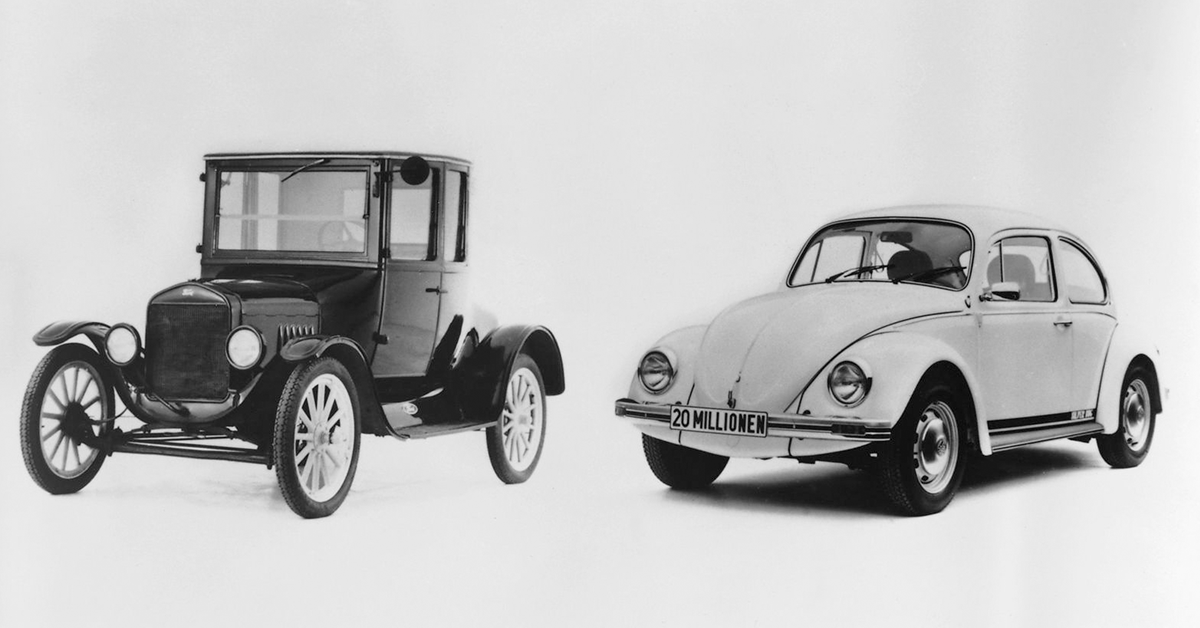
Official press image of the Volkswagen Beetle in 1972. | © Volkswagen AG
The mechanical layout of the original Beetle barely changed in 65 years. It had an air-cooled flat-four boxer engine mounted behind the rear axle, a four-speed gearbox, rear-wheel drive and a pressed-steel floorpan with a rounded body bolted on top. The engines used in the first cars were tiny by modern standards, with the earliest 1938 cars using a displacement of about 995 cc. Production cars from the post-war years used a 1,131 cc engine until 1954, and early cars made only about 25 PS.
| Layout | Air-cooled flat-four engine at the rear, rear-wheel drive |
| 1938 engine | About 995 cc |
| Until 1954 | 1,131 cc, about 25 PS |
| From 1954 | 1,192 cc, 22 kW (30 PS) |
| 1300 (1965) | 1,285 cc, 29 kW (40 PS) |
| 1500 (September 1967) | 1,493 cc, 32 kW (44 PS) |
| 1302 S | 1.6-litre, 50 PS |
| Mexican Beetle 1600 | 34 kW (46 PS) |
| Gearbox | Four-speed manual, Saxomat and three-speed semi-automatic options |
| Wheelbase | 2,400 to 2,420 mm |
| Length | About 4,079 to 4,140 mm |
| Kerb weight | 730 to 930 kg |
| 1992 update (Type 121) | Fuel injection, catalytic converter, front disc brakes |
Volkswagen increased the engine size slowly and steadily. From 1954 the Beetle had a 1,192 cc engine rated at 22 kW (30 PS). The 1300 followed in 1965 with a 1,285 cc unit rated at 29 kW (40 PS), and in September 1967 the 1500 arrived with a 1,493 cc engine rated at 32 kW (44 PS). The 1302 of 1970 was also rated at 44 PS, while the 1302 S used a 1.6-litre engine and was rated at 50 PS. The long-running 1600 was the final form of the car. In the Mexican Beetle built from 1970, the 1.6-litre boxer produced 34 kW (46 PS), which is about 21 PS more than the early cars.
Transmissions were simple too. The standard gearbox was a four-speed manual, and from 1961 the Beetle had a fully synchronised four-speed. For drivers who did not want to use a clutch, Volkswagen offered semi-automatic systems, including the Saxomat and later a three-speed semi-automatic that arrived with the 1500 in 1967. Semi-automatic transmission was available on the 1300 from 1969. Even so, most owners then and now drive a manual, and the light steering and direct controls are a large part of what people enjoy about the car.
The Beetle was a small car. Depending on the year and market, the wheelbase was between 2,400 and 2,420 mm, the overall length between about 4,079 and 4,140 mm, the width between 1,539 and 1,585 mm and the height around 1,500 mm. Kerb weight ranged from 730 to 930 kg, and that low mass is what let a 30 or 40 PS engine move the car at a respectable pace. The Super Beetle that arrived in 1971 stretched the wheelbase by 2 cm and the overall length by 8 cm, which roughly doubled the front luggage space and added a flow-through ventilation system.
The final period of the car in Mexico brought the biggest technical changes. In 1992 the car was renamed the Type 121 and gained fuel injection, a catalytic converter, front disc brakes and a more powerful alternator. The 1996 car had bumpers painted in body colour and black handles and window frames. These updates kept the old design legal and usable in a market with stricter emissions rules. They also show how much of the Beetle was simply carried forward, because the car in the showroom in 2003 was recognisably the same machine as the car of the 1950s. That consistency is a big part of why parts and know-how stayed available for so long, and why a car designed in the 1930s could still be sold new in the 21st century.

Official press image of the 1949 Karmann Beetle Cabriolet. | © Volkswagen AG
Volkswagen sold the Beetle under many names. Its own archive lists the sedan as the 1100 from 1945 to 1953, the 1200 from 1954 to 1985, the 1300 from 1965 to 1973, the 1500 from 1966 to 1970, the 1302 from 1970 to 1972, the 1303 from 1972 to 1975 and the 1600 and 1600i from 1970 to 2003. These numbers refer to engine sizes or model generations rather than dramatically different cars, and many of them overlapped, so a Beetle bought in 1967 could be a 1200, a 1300 or a 1500 depending on the order form.
| 1100 Cabriolet (Karmann and Hebmüller) | 1949 to 1953 |
| 1200 Cabriolet | 1954 to 1965 |
| 1500 Cabriolet | 1966 to 1970 |
| 1302 Cabriolet | 1970 to 1972 |
| 1303 Cabriolet | 1972 to 1980 |
| Last convertible | Number 330,281, Osnabrück, 10 January 1980 |
| Super Beetle | 1971, wheelbase +2 cm, length +8 cm, flow-through ventilation |
| Mexican Beetle | From 1970, 34 kW (46 PS), domestic market |
| Type 121 | Renamed in 1992 with fuel injection and catalytic converter |
| Brazil (Fusca) | São Bernardo do Campo until 1986, resumed 1992, ended 1996 |
The Cabriolet is the most popular variant among collectors. Two firms built convertible Beetles from 1949, with the Karmann version and the Hebmüller version both listed as 1100 Cabriolets for 1949 to 1953. Karmann then carried on with the 1200 Cabriolet from 1954 to 1965, followed by a model sold from 1965 to 1966, the 1500 Cabriolet from 1966 to 1970, the 1302 Cabriolet from 1970 to 1972 and the 1303 Cabriolet from 1972 to 1980. The last convertible, number 330,281, left the Karmann plant in Osnabrück on 10 January 1980. The first Golf Cabriolet replaced it in 1979, so the two cars briefly overlapped.
The 1302 and 1303 were Volkswagen’s attempt to modernise the Beetle without changing its personality. The Super Beetle, introduced in 1971, was the most obvious change. It had a longer nose, a wheelbase 2 cm longer and an overall length 8 cm longer than the standard car, which roughly doubled the luggage capacity under the front lid, and it added a flow-through ventilation system. These changes made the car more practical, though the standard 1200 stayed on sale alongside them for years because many buyers preferred its simplicity.
The Mexican Beetle is a variant of its own. The car built in Puebla from 1970 was sold exclusively on the domestic market and used the 1.6-litre engine rated at 34 kW (46 PS). It received a larger rear window in 1986, the same year that official Beetle exports to Germany ended on 12 August 1986, and Volkswagen then used the Type 121 name from 1992. In 1996 the car got painted bumpers and black window frames. For its last act Volkswagen built a run of about 3,000 Última Edición cars, finished by 30 July 2003 in Aquarius Blue and Harvest Moon Beige with chrome trim, a parcel shelf, a two-spoke steering wheel with the Wolfsburg emblem and a CD radio.
Brazil produced its own version, known as the Fusca. Production at São Bernardo do Campo ran until 1986 after more than 3.3 million cars, resumed in 1992 and finally ended in 1996. The car had a loyal following there and remained a familiar sight on the road for decades. These regional versions show how the Beetle was never one single product. It was a platform that Volkswagen adapted for different markets, and the long list of models, years and builders is one reason the car is so thoroughly documented by enthusiasts today.

Official press image of the original Volkswagen Beetle at its farewell in 2003. | © Volkswagen AG
The Beetle is best known for its numbers. Volkswagen’s own archive records 21,529,464 Beetles built in total, and the same figure is used for the final car that left the line in Puebla, Mexico, on 30 July 2003. That count covers all versions of the original car, including the Cabriolet and the Mexican and Brazilian builds. Volkswagen’s archive also states that the Beetle was sold more than 21 million times, a rounder statement that appears on one of its own press pages, so it is sensible to quote the exact production total only when you want the full figure.
| Total built | 21,529,464 (all original Beetle versions) |
| Model T record passed | 17 February 1972, at 15,007,034 cars |
| Record held until | 2002, when the Golf overtook it |
| US best year (reported) | 563,522 cars in 1968, about 40% of production |
| US total (reported) | Nearly 5 million |
| German production ended | 1978 |
| Brazil production ended | 1996 |
| Last original Beetle | Puebla, Mexico, 30 July 2003 |
| Final Mexican run | About 3,000 Última Edición cars |
The famous record came in 1972. On 17 February 1972 the Beetle passed the Ford Model T total of 15,007,034 cars, and the sedan and Cabriolet together took the title of the best-selling car of all time. The Model T had held the record for nearly 50 years. Volkswagen’s archive says the Beetle kept the record until 2002, when the Golf overtook it as the most successful car model ever. That detail is often forgotten, because it means the Beetle’s record was finally broken by another Volkswagen.
The United States was the most important export market. Reports say the Beetle sold best there in 1968, at 563,522 cars, which was about 40 percent of its production that year, and by 1960 it was the top-selling import in the country. In total nearly five million Beetles were sold in the United States over the car’s life. Reports also say the original car left the American market in the late 1970s because it could no longer meet safety and emissions rules, although the New Beetle and the later Beetle brought the name back to showrooms.
The geography of production changed over time. The first cars came from Wolfsburg, and from 1950 Volkswagen could assemble kits abroad, which is how Beetle production spread to other countries. German production of the sedan ended in 1978 and the last Cabriolet was built in 1980. Mexico became the heart of the Beetle’s later life because the Puebla plant had been building it since 1967, and the car there was built continuously until 2003. Brazil built it for decades, with a pause in the late 1980s, before ending production in 1996.
The record also comes with a footnote about counting. Volkswagen’s archive gives 21,529,464 for all versions of the original car, while another page in the same archive lists 21,528,480, and counts that leave out the cars built before the war differ again. For a headline, “more than 21.5 million” is the safest wording, and it is the figure most readers will recognise. Whichever number you use, the Beetle stands as one of the few cars to pass 20 million units from a single basic design.
Production finally ended because the world had moved on. Reports from 2003 point to competition from inexpensive compact cars and Mexico’s decision to phase out two-door taxis, which had been a steady source of demand for the cheap Mexican Beetle. The last car went to a museum in Wolfsburg. Taken together, the figures show a car that was built over 65 years in several countries and sold in almost every market, and they explain why the Beetle is usually the first car people think of when they are asked to name a Volkswagen.

Official press image of the Volkswagen New Beetle (1998). | © Volkswagen AG
The New Beetle is the retro-styled car Volkswagen launched in the late 1990s, and it is a very different machine under the skin. It began as the Concept 1 study by designers J Mays and Freeman Thomas, which was shown at the 1994 North American International Auto Show. Series production began at Puebla in Mexico on 1 October 1997, and the world premiere followed on 5 January 1998 at the Detroit Motor Show. The factory code is 9C, and Volkswagen built the car until July 2010, after almost 1.2 million units.
| Concept | Concept 1 by J Mays and Freeman Thomas, 1994 |
| Production start | 1 October 1997, Puebla, Mexico |
| World premiere | 5 January 1998, Detroit |
| Production ended | July 2010, almost 1.2 million built |
| Platform | Golf IV, front engine, front-wheel drive |
| Launch price | 34,950 German marks |
| Power range | 55 kW (75 PS) to 165 kW (224 PS) |
| 2000 engines | 1.6 petrol 102 PS, 1.9 TDI 100 PS, 2.3 five-cylinder 170 PS |
| Cabriolet | 2003 to 2010 |
| RSi (2001) | 3.2 VR6, 224 PS, 371 Nm, Haldex AWD, 250 built |
| Cup (1999) | 2.8 VR6, 204 PS, 270 Nm, 40 conversions |
The mechanical layout was the exact opposite of the original. The New Beetle shared its platform with the Golf IV saloon and had a transverse, water-cooled engine at the front driving the front wheels. It was priced at 34,950 German marks for the basic version at launch, well above the Golf, and a 1.6-litre entry engine introduced in 1999 brought the starting price to just under 30,000 marks. Early studies for the car even considered a hybrid with a 50 kW 1.4-litre three-cylinder turbo diesel and an 18 kW electric motor, and a purely electric 37 kW version.
Over its run the engine range covered 55 kW (75 PS) up to 165 kW (224 PS). The line-up in 1999 included the 1.6-litre petrol and a 1.8-litre turbo as the top engine. In 2000 the 1.6 was upgraded to 75 kW (102 PS), a 1.9 TDI with 74 kW (100 PS) and pump-nozzle injection arrived, and a 2.3-litre five-cylinder petrol with 125 kW (170 PS) joined the range. The 2005 facelift, shown at the IAA, brought flatter wings, revised bumpers and new headlights and taillights, and a New Beetle Cabriolet joined the range and was built from 2003 to 2010.
Volkswagen produced several special versions. The Dune of 2000 was a two-seat, front-wheel-drive leisure car with higher ground clearance and a larger luggage area. The New Beetle Cup of 1999 was a motorsport conversion of 40 cars with a 2.8-litre VR6 24V producing 150 kW (204 PS) and 270 Nm. The Sport Edition of 2001 used the 1.8 turbo with 110 kW (150 PS) or the 2.3 VR5 with 125 kW (170 PS), and it was limited to black and Reflex Silver paint. These cars show Volkswagen using the Beetle name for fun and for performance, not just for nostalgia.
The most extreme version was the New Beetle RSi of 2001. It used a 3.2-litre VR6 with 24 valves, 165 kW (224 PS) and 371 Nm, which made it the most powerful production version of any New Beetle, and it was limited to 250 saloons. It used Haldex all-wheel drive and 235/40 ZR18 tyres. It was 19 mm longer and 86 mm wider than the standard car, with the track widened by 45 mm at the front and 59 mm at the rear. It was previewed by a 1999 RSi study that had a twin-turbo V6, and it remains the rarest and fastest way to own a Beetle of this generation.

Official press image of the Volkswagen Beetle (2011). | © Volkswagen AG
The third Beetle generation, sold simply as the Beetle, went on sale in Germany on 5 November 2011. It was built on the Golf’s PQ35 platform at Puebla, the same site that built its predecessor and the original car, and it was 4.28 metres long and 1.81 metres wide. The luggage compartment grew from 206 to 310 litres. Equipment lines at launch were Beetle, Design and Sport. Its factory code is 5C.
| Market launch (Germany) | 5 November 2011 |
| Platform | PQ35 (Golf), built in Puebla, Mexico |
| Size | 4.28 m long, 1.81 m wide |
| Luggage | 206 litres grew to 310 litres |
| Engines | 1.2 TSI 105 PS, 160 PS, 2.0 TSI 200 PS, 1.6 TDI 105 or 140 PS (Cabriolet) |
| GSR (2013) | 2.0 TSI 210 PS, 0 to 100 km/h in 7.3 s, 229 km/h, 3,500 built |
| Cabriolet | Unveiled November 2012, Germany from February 2013 from 21,350 euros |
| Cabriolet roof | Opens in 9.5 seconds |
| 2016 update | New front apron, LED taillights, Euro 6, Dune and Denim lines |
| Final Edition | SE and SEL, US only, 2.0 turbo, premiered 28 November 2018 |
| Production ended | 10 July 2019, Puebla |
At 4.28 metres long the 2011 car is close in size to a compact hatchback, so it competes in the same class as the Golf while keeping the Beetle shape. That is a notable change from the original, which was a small economy car by the standards of its day. Volkswagen sold it as a stylish choice rather than a practical one, and the trim names, from Design and Sport to the later Dune and Denim lines, reflect that focus on personality over outright usefulness.
The engines were turbocharged petrol units for most markets. Volkswagen listed a 1.2-litre TSI with 77 kW (105 PS), a version with 118 kW (160 PS) and a 2.0-litre TSI with 147 kW (200 PS). The sportiest road car was the Yellow-Black Racer, also known as the GSR, built in 2013 in 3,500 units with a 2.0-litre TSI rated at 154 kW (210 PS), R-Line seats and 19-inch wheels. Volkswagen quoted 0 to 100 km/h in 7.3 seconds and a top speed of 229 km/h for that car. Diesel versions of the 1.6 TDI with 77 kW (105 PS) and 103 kW (140 PS) were offered on the Cabriolet.
The Beetle Cabriolet was unveiled at the Los Angeles Auto Show in November 2012, and the German market launch followed in February 2013, starting at 21,350 euros for the 1.2 TSI with 77 kW (105 PS). It used the same PQ35 platform with extra reinforcements for body stability. The fabric roof opened electrohydraulically in 9.5 seconds and folded flat behind the rear seats under an enclosed tarpaulin. The two most powerful petrol engines had the XDS electronic differential lock as standard. A 2012 e-Bugster concept also showed a possible electric version with an 84 kW (114 PS) motor and a range of up to 180 km.
A 2016 update gave the car a redesigned front apron, optional LED taillights, Euro 6 engines and a DSG coasting function. At the same time Volkswagen added the Dune, a front-wheel-drive version with 15 cm of ground clearance, a wider track and 18-inch Canyon wheels, and a Denim trim line. In Germany the car was sold only as a convertible from April 2017 and could be configured as a new car until the end of March 2018. Reports say that more than 500,000 of this generation were built between 2011 and 2019, a figure well below the first Beetle but healthy for a niche car.
The last chapter was the Final Edition, premiered at the Los Angeles Auto Show on 28 November 2018 and sold only in the United States. It came as the SE with 17-inch wheels and the SEL with 18-inch wheels, with the 2.0-litre turbo petrol as the only engine, and it was offered as a Beetle and a Beetle Cabriolet. It is the last Beetle that most buyers will be able to find new or nearly new, and it is the car the market remembers as the final chapter of one of the longest-running names in the industry.
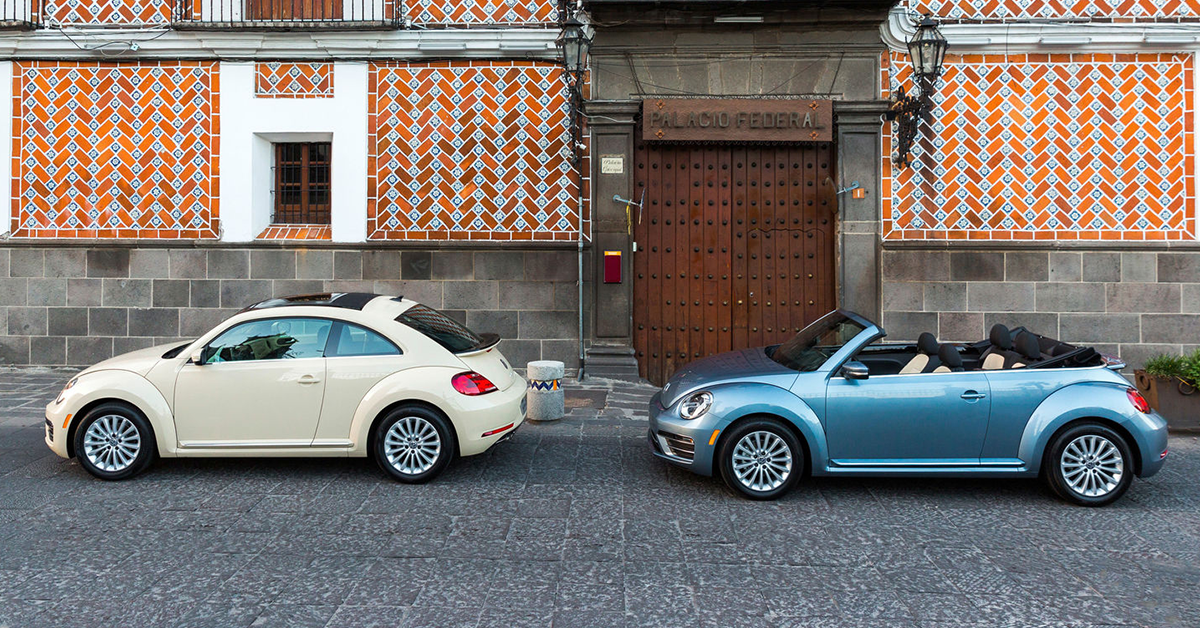
Official press image of the Volkswagen Beetle Final Edition. | © Volkswagen AG
The last Beetle left the line at Puebla on 10 July 2019. It was a coupe finished in Stonewashed Blue, and it closed a production story that had started with the original car in the 1930s. Volkswagen did not give a single dramatic reason. Scott Keogh, then head of Volkswagen Group of America, said the car’s time had come, and the end arrived as Volkswagen was moving its focus to SUVs and its first electric cars, including the ID.3. The Beetle had been a niche model for years, and a small two-door bought mostly for style was a hard car to justify in a market that wanted crossovers.
| Last car built | 10 July 2019, Puebla, a coupe in Stonewashed Blue |
| German imports ended | 29 April 2017 |
| Germany from April 2017 | Sold only as a convertible |
| Final Edition | US only, SE and SEL, 2.0 turbo |
| Brand chief on a revival | Would not consider it from where he stands, nostalgia a dead end |
| Related concepts | e-Bugster (2012, 84 kW), ID. Buggy |
| ID. Every1 | Intended for 2027, target around 20,000 euros, Beetle name not confirmed |
The end of the car also had a symbolic side. Reports said the final car was destined for a museum, and Volkswagen presented the Final Edition as a farewell rather than a quiet cancellation. In the United States, where nearly five million Beetles had been sold over the years, the car had a long enough history that many owners treated its end as the end of an era. Volkswagen’s own naming now points in a different direction, because the company is moving established names onto its electric cars, such as the ID. Polo and the ID. Tiguan, and the Beetle has so far not been given that treatment.
There was also the question of what the Beetle was supposed to be. The original car was cheap, honest transport. The New Beetle and the 2011 car were fashion statements built on Golf mechanicals, and they cost more than the Golf while offering less space. That is a hard formula to sustain. German imports ended on 29 April 2017, and from that month the car was sold only as a convertible there. The United States kept it going with special editions, including the Final Edition of 2018.
The question people ask most is whether Volkswagen will ever bring the Beetle back. The company’s brand chief, Thomas Schäfer, has said that a revival of the Beetle is not something he would consider from where he stands now, adding that relying on nostalgia would be a dead end and that the car, like the Scirocco, had its day. He did not rule it out with complete certainty. That is a long way from a confirmation, and no Beetle successor has been announced.
Volkswagen has shown electric ideas that nod to the Beetle. The 2012 e-Bugster concept used an 84 kW (114 PS) motor, and an ID. Buggy concept has also appeared, although neither was presented as a Beetle successor. Some reports link the planned ID. Every1, a small electric car that Volkswagen has said it intends to launch in 2027 with a target price of around 20,000 euros, to the Beetle idea, but the Beetle name has not been confirmed and the car is still described as a concept. Treat any Beetle revival as a rumour until Volkswagen announces it.
For buyers the practical conclusion is simple. If you want a new Volkswagen small car today, the Golf, the ID.3 Neo and the new ID. Polo are the cars to look at, and the Volkswagen models guide covers each of them with specs and prices. If you want a Beetle, you are shopping in the used market, from the original Type 1 and its Cabriolet to the New Beetle and the 2011 car. Each has its own character, and the long history above explains why collectors still value them and why the name has stayed in the public mind long after production stopped.
