 Brands
Hyundai i10 — Grand i10 Nios, UK Prices and Safety
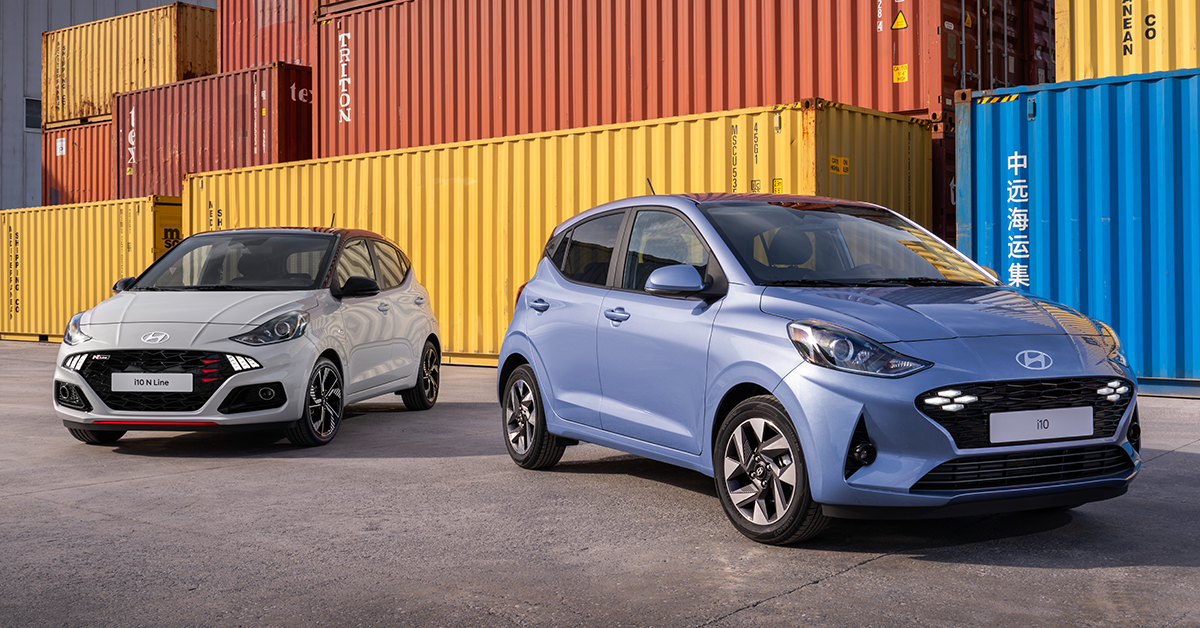
Official press image of the Hyundai i10. | © Hyundai Motor Deutschland
Hyundai i10. India Grand i10 Nios from 5,59,700 rupees with 83 PS and CNG, the Europe i10 and N Line, UK prices, crash ratings and the story since 2007.
The Hyundai i10 is Hyundai’s smallest hatchback in Europe, and in India the same family goes by the name Grand i10 Nios. Hyundai Europe calls the i10 a full-featured A-segment car, designed, developed and built in Europe for European customers, and says it has been in production since 2008 (Hyundai). Hyundai’s worldwide history page says the i10 launched in Europe in 2008 and names customers in Europe and India (Hyundai). Our Hyundai Models article covers the wider Hyundai range. From 2008 to 2026 is 18 years, since 2026 minus 2008 is 18 (Hyundai, our calculation).
| Built in Europe since | 2008 (Hyundai) |
| India name | Grand i10 Nios (Hyundai) |
| India starting price | 5,59,700 rupees ex-showroom (Hyundai) |
| India customers | More than 5 lakh (Hyundai) |
| India engines | 1.2 Kappa petrol and 1.2 bi-fuel CNG (Hyundai) |
| India length | 3,815 mm (Hyundai) |
| Europe length | 3,670 mm (Hyundai) |
| Europe engines | 1.0 63 PS, 1.2 79 PS, 1.0 turbo 90 PS (Hyundai) |
| Europe boot | 252 liters seats up (Hyundai) |
| Length gap, India over Europe | 145 mm (Hyundai, our calculation) |
We read Hyundai’s own pages first. For India those are the April 10, 2026 VIBE edition release, the Hyundai India Grand i10 Nios price and highlights pages and the 2023 and 2024 brochures. For Europe they are the Hyundai Europe press kit of July 21, 2023, a Hyundai UK technical and pricing sheet dated April 2026 and the Hyundai worldwide history page. Reports fill the gaps and carry the reported tag, and we do not name them. Prices and availability may have changed since publication, and exchange rates are not applied.
In India the Grand i10 Nios is a petrol and CNG hatchback. Hyundai India’s price pages list a starting price of 5,59,700 rupees ex-showroom (Hyundai). Its page lists a 1.2-liter Kappa petrol engine and a 1.2-liter bi-fuel petrol and CNG engine, with a 5-speed manual and a Smart auto AMT (Hyundai). The VIBE edition release says the Grand i10 Nios has more than 5 lakh customers in India, and a lakh means 100,000 (Hyundai). So 5 lakh customers means 500,000 (Hyundai, our calculation).
In Europe the i10 is a smaller car with smaller engines. The Hyundai UK sheet lists three trims, Advance, Premium and N Line, and a 1.0-liter 63 PS engine, a 1.2-liter 79 PS engine and a 1.0-liter turbo with 90 PS on the N Line only (Hyundai). It gives a length of 3,670 mm and a boot of 252 liters with the seats up (Hyundai). The Indian car is bigger, with a length of 3,815 mm on Hyundai India’s highlights page (Hyundai). The folded boot is 1,050 liters (Hyundai).
The two cars share a name and a family, but they are different cars. The Indian car is 145 mm longer and 40 mm taller, since 3,815 minus 3,670 is 145 and 1,520 minus 1,480 is 40, and both are 1,680 mm wide (Hyundai, our calculation). Hyundai Europe says its car is built in Europe for European customers, so we cover the two cars in separate sections (Hyundai). Our Hyundai i20 article covers the bigger hatchback.
This guide covers Indian prices and variants, the Indian engines and CNG, the European range and specifications, the UK prices, equipment and crash ratings, the generations from 2007 and the conflicts between sources. We mark every figure Hyundai, reported or our calculation, and we show both values where sources disagree. We found no Hyundai page that gives the Indian boot or mileage, so we give those only as reported. Check a Hyundai dealer for current prices, because Hyundai says prices may change (Hyundai).
Hyundai India’s price pages list the Grand i10 Nios at 5,59,700 rupees ex-showroom, and the pages for Delhi, Chennai, Bengaluru, Ahmedabad and Indore repeat the same starting price (Hyundai). The pages say the on-road price depends on insurance, registration and local taxes (Hyundai). The page meta text gives other numbers, 5.55 lakh on the price page and 5.47 lakh on the highlights page, so Hyundai’s own pages disagree on the entry price (Hyundai). Hyundai says the starting price carries an asterisk and that the on-road price changes with the state (Hyundai). The gap between 5,59,700 and 5.55 lakh is 4,700 rupees (Hyundai, our calculation).
| Starting price | 5,59,700 rupees (Hyundai) |
| Sportz VIBE manual | 7,09,400 rupees (Hyundai) |
| Sportz VIBE AMT | 7,61,400 rupees (Hyundai) |
| Sportz (O) VIBE AMT | 7,73,400 rupees (Hyundai) |
| Asta manual | 7,50,700 rupees (Hyundai) |
| Asta AMT | 8,02,600 rupees (Hyundai) |
| AMT premium, Sportz VIBE | 52,000 rupees (Hyundai, our calculation) |
| VIBE over starting price | 1,49,700 rupees (Hyundai, our calculation) |
| Variants listed | 16 (Hyundai, our calculation) |
| 2023 facelift intro price | 5.69 lakh rupees (reported) |
Hyundai Motor India added the VIBE edition on April 10, 2026. Its release lists the Sportz VIBE manual at 7,09,400 rupees, the Sportz VIBE AMT at 7,61,400 and the Sportz (O) VIBE AMT at 7,73,400 (Hyundai). It lists the Asta at 7,50,700 with the manual and 8,02,600 with the AMT, and says a dashcam was added to the VIBE edition and the Asta (Hyundai). The page does not state a currency, and we read the figures as rupees from the context (Hyundai).
The AMT costs about 52,000 rupees more. The Sportz VIBE AMT costs 52,000 more than the manual, since 7,61,400 minus 7,09,400 is 52,000, and the Asta AMT costs 51,900 more, since 8,02,600 minus 7,50,700 is 51,900 (Hyundai, our calculation). The Sportz (O) VIBE AMT costs 12,000 more than the Sportz VIBE AMT, since 7,73,400 minus 7,61,400 is 12,000 (Hyundai, our calculation). The Asta manual costs 41,300 more than the Sportz VIBE manual, since 7,50,700 minus 7,09,400 is 41,300 (Hyundai, our calculation). The AMT premium is about 7 percent of the Sportz VIBE manual price, since 52,000 divided by 7,09,400 is 0.073 (Hyundai, our calculation).
The VIBE edition costs much more than the base car. The Sportz VIBE manual is 1,49,700 rupees above the 5,59,700 starting price, since 7,09,400 minus 5,59,700 is 1,49,700 (Hyundai, our calculation). A trade report says the VIBE costs 10,000 to 26,000 rupees more than the regular Sportz trims and that the Asta price rose 11,000 rupees with the dashcam (reported). The release says the VIBE has black alloy wheels, a black interior with red inserts and a new Titan Grey Matte color (Hyundai).
The variant list is long. Hyundai India lists eight petrol manual trims, Era, Magna, Corporate, Sportz, Sportz VIBE, Sportz (O), Sportz (O) VIBE and Asta (Hyundai). It lists five AMT trims, Magna, Corporate, Sportz, Sportz (O) and Asta, and three CNG trims, Magna CNG, Sportz CNG and Dual CNG (Hyundai). That is 16 variants, since 8 plus 5 plus 3 is 16 (Hyundai, our calculation). The page’s variant price table was empty when we read it, so we give no per-variant prices from it (Hyundai).
Older and reported prices give context. A trade report says the 2023 facelift launched in January 2023 with introductory prices from 5.69 lakh rupees (reported). The current start of 5,59,700 is 9,300 rupees lower, since 5,69,000 minus 5,59,700 is 9,300 (reported, our calculation). A trade report puts the current ex-showroom start at 5.60 lakh in August 2026 (reported). We do not adjust for inflation, and exchange rates are not applied.
The Indian petrol engine is a 1.2-liter Kappa. Hyundai’s brochures list 1,197 cc and 61 kW, or 83 PS, at 6,000 rpm (Hyundai). A copy of the brochure hosted by a dealer lists 113.8 Nm, or 11.6 kgm, at 4,000 rpm (reported). The gearbox is a 5-speed manual or a Smart auto AMT (Hyundai). The 2024 brochure lists the same 83 PS output at 6,000 rpm for the petrol (Hyundai). The kilowatt and PS figures agree, since 61 times 1.36 is about 83, and the torque figures agree, since 11.6 times 9.807 is about 113.8 (reported, our calculation).
| Petrol engine | 1.2 Kappa, 1,197 cc (Hyundai) |
| Petrol power | 61 kW, 83 PS at 6,000 rpm (Hyundai) |
| Petrol torque | 113.8 Nm, 11.6 kgm at 4,000 rpm (reported) |
| CNG power | 50.5 kW, 69 PS at 6,000 rpm (Hyundai) |
| CNG torque | 95.2 Nm, 9.7 kgm at 4,000 rpm (Hyundai) |
| Gearboxes | 5-speed manual, Smart auto AMT (Hyundai) |
| Petrol tank | 37 liters (Hyundai) |
| CNG capacity | 60 liters water equivalent (Hyundai) |
| Body size | 3,815 by 1,680 by 1,520 mm (Hyundai) |
| Boot | 260 liters, unconfirmed (reported) |
The CNG version is gentler. Hyundai India’s page lists the 1.2-liter bi-fuel engine at 50.5 kW, or 69 PS, at 6,000 rpm and 95.2 Nm, or 9.7 kgm, at 4,000 rpm, with a 5-speed manual only (Hyundai). Both torque peaks come at 4,000 rpm (Hyundai). The CNG car has 14 PS less than the petrol, since 83 minus 69 is 14, and 18.6 Nm less torque, since 113.8 minus 95.2 is 18.6 (Hyundai, our calculation). The Hy-CNG Duo has two smaller cylinders in the boot, which Hyundai says gives more boot space and fuel efficiency (Hyundai).
The fuel tanks are small. Hyundai India lists 37 liters for petrol and 37 liters of petrol plus 60 liters of CNG, a water equivalent figure (Hyundai). Hyundai’s older Grand i10 brochure lists a 43-liter tank, so the current tank is 6 liters smaller, since 43 minus 37 is 6 (Hyundai, our calculation). The CNG capacity of 60 liters, a water equivalent figure, is 23 liters above the 37-liter petrol tank, since 60 minus 37 is 23 (Hyundai, our calculation). Hyundai’s highlights page lists the body at 3,815 mm long, 1,680 mm wide and 1,520 mm high, and the brochure lists a wheelbase of 2,450 mm (Hyundai).
The body has grown since the first Grand i10. The older brochure lists 3,765 mm by 1,660 mm by 1,520 mm and a wheelbase of 2,425 mm (Hyundai). The Nios is 50 mm longer, 20 mm wider and has a wheelbase 25 mm longer, with the same height, since 3,815 minus 3,765 is 50, 1,680 minus 1,660 is 20 and 2,450 minus 2,425 is 25 (Hyundai, our calculation). A copy of the 2023 brochure hosted by a dealer lists a kerb weight of 908 to 998 kg (reported).
The older car had a diesel. Hyundai’s older brochure lists a 1.2-liter U2 CRDi diesel with 75 PS at 4,000 rpm and 19.4 kgm from 1,750 to 2,250 rpm, next to the 83 PS petrol and a CNG version (Hyundai). The diesel has 8 PS less than the petrol, since 83 minus 75 is 8 (Hyundai, our calculation). The current Hyundai India pages list only petrol and CNG, so the diesel is gone from the range (Hyundai). We found no Hyundai date for its end.
Mileage and boot come from reports. Catalogs give a boot of 260 liters and a mileage of 16 to 18 kmpl, and a catalog lists 82 bhp and 114 Nm (reported). Hyundai’s pages we read give no boot or mileage figure, and PS and bhp are different units that we do not convert (Hyundai). A 37-liter tank at 16 to 18 kmpl gives about 592 to 666 km, since 37 times 16 is 592 and 37 times 18 is 666 (reported, our calculation). Real-world figures will be lower.
A Hyundai UK sheet gives the current European specifications, with data correct as of April 2026. It lists three trims, Advance, Premium and N Line, and Euro 6E engines throughout (Hyundai). The engines are a 1.0-liter three-cylinder with 63 PS and 93 Nm, a 1.2-liter four-cylinder with 79 PS and 112 Nm and a 1.0-liter turbo with 90 PS and 171 Nm, which is on the N Line only (Hyundai). Manual and AMT gearboxes are both 5-speed (Hyundai).
| Trims | Advance, Premium, N Line (Hyundai) |
| Base engine | 1.0, 998 cc, 63 PS, 93 Nm (Hyundai) |
| Mid engine | 1.2, 1,197 cc, 79 PS, 112 Nm (Hyundai) |
| N Line engine | 1.0 turbo, 90 PS, 171 Nm (Hyundai) |
| 0 to 62 mph, N Line | 11.4 seconds (Hyundai) |
| Length and width | 3,670 mm and 1,680 mm (Hyundai) |
| Wheelbase | 2,425 mm (Hyundai) |
| Boot | 252 liters, 1,050 folded (Hyundai) |
| Fuel tank | 36 liters (Hyundai) |
| Turning circle | 9.72 m (Hyundai) |
The power steps are small. The 1.2-liter has 16 PS more than the 1.0-liter, since 79 minus 63 is 16, and the N Line turbo has 11 PS more than the 1.2-liter, since 90 minus 79 is 11 (Hyundai, our calculation). The N Line has 78 Nm more torque than the base engine, since 171 minus 93 is 78 (Hyundai, our calculation). The turbo makes its torque at 1,500 rpm, against 3,750 rpm for the base engine and 4,200 rpm for the 1.2-liter (Hyundai).
The sheet gives acceleration to 62 mph. The 1.0-liter manual takes 15.6 seconds, the 1.2-liter manual 13.2 seconds and the N Line 11.4 seconds, with top speeds of 88, 98 and 108 mph (Hyundai). The 1.2-liter is 2.4 seconds quicker than the 1.0-liter, since 15.6 minus 13.2 is 2.4, and the N Line is 1.8 seconds quicker than the 1.2-liter, since 13.2 minus 11.4 is 1.8 (Hyundai, our calculation). The AMT adds 2.8 seconds on the 1.0-liter and 3.4 seconds on the 1.2-liter (Hyundai, our calculation).
The body is small. The sheet lists a length of 3,670 mm, a width of 1,680 mm without mirrors, a wheelbase of 2,425 mm and a height of 1,480 mm, or 1,483 mm on the N Line (Hyundai). The boot is 252 liters with the seats up and 1,050 liters with them folded, a gain of 798 liters, since 1,050 minus 252 is 798 (Hyundai, our calculation). The turning circle is 9.72 m, and the steering takes 2.64 turns lock to lock (Hyundai). Our Hyundai i20 article covers the next size up.
Weights and economy are modest. Kerb weights run from 921 to 1,045 kg, a spread of 124 kg, since 1,045 minus 921 is 124, with the N Line the heaviest at 1,024 to 1,045 kg (Hyundai, our calculation). The sheet lists a 36-liter tank and WLTP combined use of 5.1 to 5.6 liters per 100 km (Hyundai). That is about 643 to 706 km per tank, since 36 divided by 5.6 times 100 is 643 and 36 divided by 5.1 times 100 is 706 (Hyundai, our calculation).
Hyundai Europe’s July 2023 press kit gives older figures. It lists a 1.0-liter MPi with 67 PS and 96.1 Nm, a 1.2-liter MPi with 84 PS and 117.6 Nm and an N Line 1.0-liter turbo with 100 PS and 172 Nm, with an N Line top speed of 185 km/h and a manual gearbox only (Hyundai). The 2026 sheet is lower by 4, 5 and 10 PS, since 67 minus 63 is 4, 84 minus 79 is 5 and 100 minus 90 is 10 (Hyundai, our calculation). Hyundai does not explain the change.
The Hyundai UK sheet lists prices effective April 1, 2026. The Advance 1.0 manual has a retail price of 17,130 pounds and an on-the-road price of 18,365 pounds (Hyundai). The Advance 1.2 manual is 17,930 pounds, the Premium 1.0 manual is 18,430 pounds and the Premium 1.2 AMT is 19,880 pounds, the dearest car (Hyundai). The Premium 1.2 AMT costs 150 pounds more than the N Line manual, since 19,880 minus 19,730 is 150 (Hyundai, our calculation). The N Line manual is 19,730 pounds (Hyundai). The span from the cheapest to the dearest is 2,750 pounds, since 19,880 minus 17,130 is 2,750 (Hyundai, our calculation).
| Advance 1.0 manual | 17,130 pounds retail (Hyundai) |
| Advance 1.2 manual | 17,930 pounds retail (Hyundai) |
| Premium 1.0 manual | 18,430 pounds retail (Hyundai) |
| Premium 1.2 AMT | 19,880 pounds retail (Hyundai) |
| N Line manual | 19,730 pounds retail (Hyundai) |
| Price span | 2,750 pounds (Hyundai, our calculation) |
| AMT premium | 650 pounds on every trim (Hyundai, our calculation) |
| Metallic or pearl paint | 600 pounds (Hyundai) |
| N Line two-tone roof | 500 pounds (Hyundai) |
| Early N Line UK price | From 16,195 pounds (reported) |
The steps are regular. The AMT costs 650 pounds more than the manual on every trim and engine, since 17,780 minus 17,130, 19,080 minus 18,430, 18,580 minus 17,930 and 19,880 minus 19,230 are each 650 (Hyundai, our calculation). All nine listed cars are within 2,750 pounds of the cheapest, since the dearest is 2,750 above it (Hyundai, our calculation). The 1.2-liter engine costs 800 pounds more than the 1.0-liter, and the Premium costs 1,300 pounds more than the Advance, since 17,930 minus 17,130 is 800 and 18,430 minus 17,130 is 1,300 (Hyundai, our calculation).
The N Line sits between the Premium engines. It costs 1,300 pounds more than the Premium 1.0 manual and 500 pounds more than the Premium 1.2 manual, since 19,730 minus 18,430 is 1,300 and 19,730 minus 19,230 is 500 (Hyundai, our calculation). Its insurance group is 10E against 3E for the Advance 1.0 manual (Hyundai). The sheet lists on-the-road prices 1,235 pounds above retail on the cars we checked, and it does not itemize the difference (Hyundai, our calculation).
Paint and options cost extra. The sheet lists Atlas White special solid paint at 300 pounds and metallic or pearl paint at 600 pounds on all trims, and a two-tone black roof at 500 pounds on the N Line only (Hyundai). The first-year road tax is 455 pounds on every car (Hyundai). The 2023 Hyundai Europe kit listed nine base colors and a two-tone roof option, with new Lumen Grey and Meta Blue Pearl at launch (Hyundai). The Hyundai UK sheet lists nine retail prices in all, four for the Advance, four for the Premium and one for the N Line (Hyundai, our calculation). The price tables carry VAT at 20 percent of the basic retail price (Hyundai, our calculation).
The N Line is a styling and tuning package. Hyundai Europe’s 2023 kit says it is the fourth Hyundai with the N Line trim after the i30, i30 Fastback and Tucson, with bespoke bumpers, a skid plate, a diffuser, an N steering wheel and gear lever, red vent rings, metal pedals and sport seats with triple red line fabric (Hyundai). Hyundai UK says it is available only with a turbocharged 90 PS engine, with 16-inch N Line wheels and diagonal LED daytime lights (Hyundai).
Reports add earlier prices. A trade report on the original N Line gives a UK price from 16,195 pounds, with chassis changes of longer rear bump stops, firmer rear dampers and stiffer springs, and does not give a year we could confirm (reported). The 2026 N Line price is 3,535 pounds higher, since 19,730 minus 16,195 is 3,535, but the two figures may not use the same price basis (reported, our calculation). A Hyundai Poland page describes the N Line engine as 100 PS, which matches the 2023 power and not the 2026 sheet (Hyundai).
Hyundai India lists six airbags on the Grand i10 Nios VIBE edition, and Hyundai Motor India’s annual report says Hyundai became India’s first mass-market maker to standardize six airbags across all models and trims in 2023 (Hyundai). The VIBE release also lists a tire pressure monitor on the highline variant, cruise control, projector headlamps, automatic air conditioning, rear AC vents and a leather-wrapped steering wheel (Hyundai). The Sportz (O) VIBE adds a smart key with push-button start (Hyundai).
| India airbags | 6 on the VIBE edition (Hyundai) |
| India six-airbag rule | All models and trims since 2023 (Hyundai) |
| India touchscreen | 20.25 cm, 8 in (Hyundai) |
| India dashcam | VIBE edition and Asta (Hyundai) |
| Europe collision braking | Car, pedestrian, cyclist (Hyundai) |
| Europe lane assist | Lane follow and lane keep (Hyundai) |
| Europe emergency call | eCall on all trims (Hyundai) |
| Europe Bluelink | 10-year LITE, 3-year PLUS (Hyundai) |
| Global NCAP, Africa test | 0 stars adult, 3 stars child (reported) |
| Global NCAP, 2020 Nios | 2 stars adult and child (reported) |
The VIBE edition has a long feature list. It includes a 20.25 cm, or 8-inch, touchscreen with Android Auto and Apple CarPlay, black 15-inch alloy wheels with a 380.2 mm rolling diameter, and a black interior with red inserts (Hyundai). The dashcam records driving, emergency and event, vacation, on-demand video and photo modes, and the videos can be downloaded to a phone through an app (Hyundai). The release calls the dashcam a first in its segment, and the matte Titan Grey color the only matte color in the segment, which we could not check (Hyundai).
The European i10 is well equipped for its size. The Hyundai UK sheet lists driver attention warning, eCall, stability control, forward collision avoidance for cars, pedestrians and cyclists, intelligent speed limit assist, lane follow and lane keep assist, a leading vehicle alert, rear ISOFIX anchors and tire pressure monitoring on all trims (Hyundai). It also lists a rear view camera, rear parking sensors, cruise control, hill-start assist and a rear occupant alert (Hyundai). An 8-inch navigation screen with Bluelink is listed for all trims (Hyundai).
Equipment depends on the trim. The Premium and N Line add climate control, heated front seats and steering wheel, front fog lights, rear privacy glass, blue mood lighting and a wireless charging pad, while the Advance has manual air conditioning (Hyundai). The Premium alone has a smart key with a start button (Hyundai). Bluelink includes a free 10-year LITE subscription, 3 years of PLUS and a 6-month PRO trial, and features expire after the LITE period unless a paid plan is chosen (Hyundai).
The crash ratings are mixed. Global NCAP’s December 2025 test of a made-in-India Grand i10 sold in South Africa gave 0 stars for adult protection, with 0 of 34 points, and 3 stars for child protection, with 28.57 of 49 points (reported). The child score is about 58 percent of the maximum, since 28.57 divided by 49 is 0.583 (reported, our calculation). A report says the two-airbag Nios tested in 2020 earned 2 stars for adults and children (reported).
Hyundai South Africa responded. A report says it said the Grand i10 conforms to the mandatory requirements of South Africa’s national regulator and is safe to drive (reported). Global NCAP says the result applies to the South African specification, so it is not an Indian rating (reported). We found no Hyundai page with a Global NCAP score for the current Indian car or a Euro NCAP score for the European i10, and a 2025 reliability survey result in Hyundai Europe’s kit is not a crash rating (Hyundai).
The i10 start date depends on the Hyundai page. Hyundai’s worldwide history page heads the entry 2007 but says the i10 launched in Europe in 2008, and Hyundai Slovakia says that since its introduction in 2007 the i10 has been a success story for Hyundai in Europe (Hyundai). Hyundai France says the i10 has sold more than 50,000 cars there since its 2008 launch (Hyundai). Reports say the i10 replaced the Atos, and in India followed the Santro (reported). From 2008 to 2026 is 18 years of European production, since 2026 minus 2008 is 18 (Hyundai, our calculation).
| Europe launch | 2008 (Hyundai) |
| Hyundai page heading | 2007 (Hyundai) |
| Second generation unveiled | Frankfurt 2013 (Hyundai) |
| Grand i10 India launch | September 2013 (reported) |
| Grand i10 Nios India launch | August 20, 2019 (reported) |
| India facelift | January 2023 (reported) |
| Europe facelift introduced | February 27, 2023 (Hyundai) |
| France sales since 2008 | More than 50,000 (Hyundai) |
| Nameplate sales | 3 million, date unconfirmed (reported) |
| European generation gaps | 5 and 6 years (Hyundai, our calculation) |
The second generation was developed in Europe. Hyundai’s worldwide page says it was unveiled at the 65th Frankfurt motor show in 2013 and has a more spacious and refined interior (Hyundai). From 2008 to 2013 is 5 years, since 2013 minus 2008 is 5 (Hyundai, our calculation). A report says it went on sale in India as the Grand i10 in September 2013 (reported). Hyundai’s Grand i10 brochure lists a 3,765 mm body, a 2,425 mm wheelbase, an 83 PS petrol, a 75 PS diesel and a bi-fuel CNG version (Hyundai).
The third generation came in 2019. A report says the Grand i10 Nios launched in India on August 20, 2019, was built at Hyundai’s Sriperumbudur plant near Chennai and took bookings at 11,000 rupees (reported). The report says it was positioned above the i10, which would not be discontinued (reported). Reports date the European third generation to 2019 as well (reported). Hyundai’s worldwide page does not give a 2019 date (Hyundai). From the 2013 Grand i10 to the 2019 Nios is 6 years (reported, our calculation).
The Nios was refreshed in 2023. A report says the facelift launched in January 2023 from 5.69 lakh rupees (reported). Hyundai Europe introduced the updated i10 and i10 N Line on February 27, 2023, and its press kit is dated July 21, 2023 (Hyundai). The Hyundai Germany release said the cars were not yet on sale and that approval and fuel figures would come before launch (Hyundai). The gap between the two Hyundai dates is 144 days (Hyundai, our calculation). The 144-day gap is about 4.7 months, since 144 divided by 30.4 is 4.7 (Hyundai, our calculation).
The European range has changed since 2023. The 2023 kit listed two petrol engines with 67 and 84 PS, plus an N Line with 100 PS, and said some variants were four-seaters (Hyundai). The 2026 sheet lists 63, 79 and 90 PS, and five seats on all trims (Hyundai). The 2023 kit gave nine base colors, and Hyundai Slovakia’s 2026 list shows paint options such as Mangrove Green, Phantom Black and Atlas White (Hyundai). A report says the i10 nameplate had passed 3 million sales across three generations, with no date we could confirm (reported).
Counting the gaps shows the rhythm. The European generations are 2008, 2013 and 2019, so the gaps are 5 and 6 years, and 2026 is 7 years after 2019 (Hyundai, reported, our calculation). The Indian names are i10 in 2007, Grand i10 in 2013 and Grand i10 Nios in 2019, so the gaps are 6 and 6 years (reported, our calculation). Our Hyundai history article covers the company behind these cars.
Hyundai’s own pages conflict on dates and prices. The worldwide page heads the i10 as 2007 but says Europe launched it in 2008 (Hyundai). The 2007 and 2008 dates differ by one year (Hyundai, our calculation). The Hyundai India price page gives 5,59,700 rupees in its body, 5.55 lakh in its page text and 5.47 lakh on the highlights page (Hyundai). The Hyundai India pages also carry an unrelated corporate price banner that we ignore (Hyundai). The spread between 5.47 and 5.55 lakh is 8,000 rupees (Hyundai, our calculation).
| Start year | 2007 or 2008 (Hyundai) |
| India start price | 5,59,700, 5.55 or 5.47 lakh rupees (Hyundai) |
| Europe base engine power | 67 PS in 2023, 63 PS in 2026 (Hyundai) |
| Europe mid engine power | 84 PS in 2023, 79 PS in 2026 (Hyundai) |
| Europe N Line power | 100 PS in 2023, 90 PS in 2026 (Hyundai) |
| CO2, Advance 1.0 manual | 114 or 116 g/km (Hyundai) |
| Crash result, 2020 | 2 stars, India spec (reported) |
| Crash result, 2025 | 0 stars adult, South Africa spec (reported) |
| Indian boot | Not on a Hyundai page (Hyundai) |
| Europe plant | Not named in the kit (Hyundai) |
European power figures changed. The 2023 kit gives 67, 84 and 100 PS, and the 2026 sheet gives 63, 79 and 90 PS (Hyundai). Hyundai UK’s N Line page says 90 PS, and a Hyundai Poland N Line page says 100 PS (Hyundai). The CO2 figures differ between the sheet’s specification table and its price table, such as 114 and 116 grams per km for the Advance 1.0 manual (Hyundai). The gap is 2 grams, since 116 minus 114 is 2 (Hyundai, our calculation). The 63 and 67 PS base figures differ by 4 PS, the 79 and 84 by 5 and the 90 and 100 by 10, which is 19 PS in total (Hyundai, our calculation).
Crash ratings are not comparable. Global NCAP gave a 2-star result in 2020 to a two-airbag Indian Nios and a 0-star adult result in 2025 to a South African-specification car (reported). The cars had different equipment and the tests were under different rules, so we do not treat one as an update of the other (reported). The 2025 car also scored 3 stars for child protection (reported). The 2025 adult score of 0 of 34 points means no adult points were awarded (reported). Hyundai India says six airbags are standard across its range, which was not the case in 2020 (Hyundai).
Several items are not confirmed. We found no Hyundai page for the Indian boot, mileage, the end date of the diesel or a current Indian crash score (Hyundai). The Hyundai Europe kit does not name the plant where the i10 is built (Hyundai). The i10 sales total, the 3 million figure and the 2019 European date are reported only (reported). That is six items we could not confirm on a Hyundai page, counting the boot, mileage, diesel end date, Indian crash score, plant name and sales total (Hyundai, our calculation).
There are also gaps in coverage. We did not research the i10 in markets outside Europe and India, such as South Africa beyond the crash test, and we found no Hyundai statement on a next-generation i10 or an electric i10 (Hyundai). We did not check the Hyundai Slovakia price list beyond its paint options, and we give no euro prices from it (Hyundai). The Hyundai UK prices are UK prices only, and exchange rates are not applied.
To check this article, start with the Hyundai India VIBE release and the Grand i10 Nios price and highlights pages (Hyundai). For Europe, read the Hyundai UK technical and pricing sheet and the Hyundai Europe press kit (Hyundai). Our Hyundai Accent article covers Hyundai’s small sedan. Treat any figure tagged reported as a lead to verify, and check a Hyundai dealer for current prices and equipment.