 Brands
Hyundai Grand i10 — Nios, Aura, South Africa and Mexico
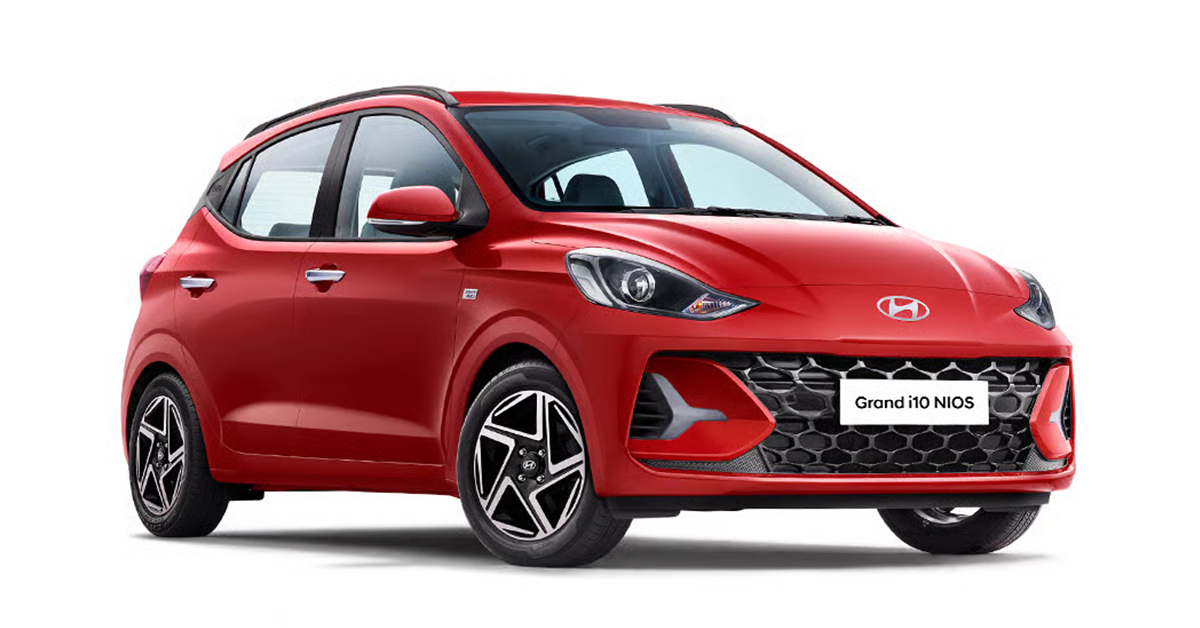
Official image of the Hyundai Grand i10. | © Hyundai Motor India Limited
Hyundai Grand i10. Nios prices from 5,59,700 rupees, 83 PS and CNG, the Aura sedan, the South Africa safety update, the Mexico range and the story since 2013.
The Grand i10 name covers more than one car. In India it is the Grand i10 Nios hatchback, and Hyundai India lists it with more than 5 lakh customers, where a lakh means 100,000 (Hyundai). In South Africa and Mexico the Grand i10 is the brand’s entry car, and reports say the South African and Philippine cars were built in India (reported). The European i10 is a different car, and our Hyundai i10 article covers it with the Nios. From 2013 to 2026 is 13 years, since 2026 minus 2013 is 13 (reported, our calculation).
| India name | Grand i10 Nios (Hyundai) |
| India customers | More than 5 lakh (Hyundai) |
| India starting price | 5,59,700 rupees ex-showroom (Hyundai) |
| India engines | 1.2 Kappa petrol and bi-fuel CNG (Hyundai) |
| Petrol power | 61 kW, 83 PS (Hyundai) |
| CNG power | 50.5 kW, 69 PS (Hyundai) |
| Aura starting price | 5,99,990 rupees (Hyundai) |
| Aura over Nios price | 40,290 rupees (Hyundai, our calculation) |
| South Africa safety update | April 13, 2026 (Hyundai) |
| Global NCAP, Africa test | 0 stars adult, December 4, 2025 (reported) |
We read Hyundai’s own pages first. For India those are the April 10, 2026 VIBE edition release, the Grand i10 Nios and Aura price pages, the Pune price page and the Hyundai brochures. For South Africa it is the Hyundai Automotive South Africa release of April 13, 2026. Reports supply the Mexican, Philippine and early history figures and carry the reported tag, and we do not name them. Prices and availability may have changed since publication, and exchange rates are not applied.
The Indian car starts at 5,59,700 rupees ex-showroom on Hyundai India’s price pages (Hyundai). Hyundai lists a 1.2-liter Kappa petrol and a bi-fuel petrol and CNG engine, with a 5-speed manual and a Smart auto AMT (Hyundai). The petrol makes 83 PS and the CNG makes 69 PS, according to Hyundai’s brochure (Hyundai). The base Era has six airbags as standard, according to Hyundai India’s Pune price page (Hyundai). Hyundai India’s older brochure gave the same 83 PS for the first Grand i10 (Hyundai).
The Grand i10 has a sedan sister. Hyundai India lists the Aura, a compact sedan with a 1.2-liter Kappa petrol and a factory-fitted CNG option, from 5,99,990 rupees (Hyundai). The Aura costs 40,290 rupees more than the Nios at the entry level, since 5,99,990 minus 5,59,700 is 40,290 (Hyundai, our calculation). In Mexico the Grand i10 itself comes as a hatchback and a sedan, and reports say the sedan costs 16,000 to 18,000 pesos more (reported).
Safety is the story of 2025 and 2026. Global NCAP gave a South African-specification, India-built Grand i10 zero stars for adult protection on December 4, 2025 (reported). Hyundai Automotive South Africa answered on April 13, 2026 with an Executive derivative that has side airbags, curtain airbags and stability control as standard (Hyundai). We cover both in the safety and South Africa sections. The South African Executive was announced 3 days after the Indian VIBE edition, since April 13 minus April 10 is 3 (Hyundai, our calculation).
This guide covers the Indian Nios, its engines and CNG, the Aura, South Africa, Mexico and the Philippines, the generations since 2013, the crash ratings and the conflicts between sources. We mark every figure Hyundai, reported or our calculation, and we show both values where sources disagree. We found no Hyundai page for Mexico or the Philippines, so we give those markets as reported only. Check a Hyundai dealer for current prices, because Hyundai says prices may change (Hyundai). The markets covered are India, South Africa, Mexico and the Philippines, which is four (reported, our calculation).
Hyundai India’s Pune price page lists the trim ladder. Petrol manual trims are Era, Magna, Corporate, Sportz, Sportz (O) and Asta, which is six, and petrol AMT trims are Magna, Corporate, Sportz, Sportz (O) and Asta, which is five (Hyundai). The CNG trims are Dual CNG Magna, Sportz CNG and Dual CNG Sportz, which is three (Hyundai). Six plus five plus three is 14 on that page, against 16 on the main price page, which also counts the two VIBE trims (Hyundai, our calculation). The gap of 2 is the two VIBE trims, since 16 minus 14 is 2 (Hyundai, our calculation).
| Petrol manual trims | 6 (Hyundai) |
| Petrol AMT trims | 5 (Hyundai) |
| CNG trims | 3 (Hyundai) |
| Era equipment | 6 airbags, ABS with EBD, rear sensors (Hyundai) |
| Magna adds | LED daytime lamps, rear AC vents, TPMS (Hyundai) |
| Sportz adds | Rear camera, cruise control (Hyundai) |
| Asta adds | Wireless smartphone connectivity (Hyundai) |
| VIBE edition | Black alloys, red-insert interior (Hyundai) |
| Dashcam | VIBE and Asta (Hyundai) |
| Asta manual price | 7,50,700 rupees (Hyundai) |
Equipment grows with each trim. The Era has six airbags as standard, ABS with EBD, rear parking sensors, LED tail lamps and keyless entry (Hyundai). The Magna adds LED daytime lamps, rear AC vents and a tire pressure monitor, and the Corporate adds projector headlamps and a touchscreen (Hyundai). The Sportz and Sportz (O) add a rear camera and cruise control, and the Asta adds wireless smartphone connectivity (Hyundai). The page does not list every item per trim.
The VIBE edition has black 15-inch alloy wheels, a black interior with red inserts, an 8-inch touchscreen with Android Auto and Apple CarPlay, cruise control, projector headlamps, automatic air conditioning, rear AC vents and six airbags (Hyundai). The Sportz (O) VIBE adds a smart key with push-button start (Hyundai).
The dashcam is the new feature. Hyundai says it was added to the VIBE edition and the Asta, calls it a first in its segment, and lists driving, emergency and event, vacation, on-demand video and photo modes (Hyundai). The release also adds a Titan Grey Matte color, which Hyundai calls the only matte color in the segment (Hyundai). We could not check either segment claim against rivals, so we treat them as Hyundai claims.
Prices from the VIBE release show the ladder at the top. The Sportz VIBE manual is 7,09,400 rupees and the AMT is 7,61,400, and the Asta is 7,50,700 with the manual and 8,02,600 with the AMT (Hyundai). The Asta manual costs 41,300 rupees more than the Sportz VIBE manual, since 7,50,700 minus 7,09,400 is 41,300 (Hyundai, our calculation). The Asta AMT costs 51,900 more than the Asta manual, since 8,02,600 minus 7,50,700 is 51,900 (Hyundai, our calculation). The Sportz (O) VIBE AMT at 7,73,400 costs 12,000 rupees more than the Sportz VIBE AMT, since 7,73,400 minus 7,61,400 is 12,000 (Hyundai, our calculation).
Reports give other numbers. A trade report puts the Asta manual at 7.57 lakh rupees, which is 6,300 rupees above Hyundai’s 7,50,700, since 7,57,000 minus 7,50,700 is 6,300 (reported, our calculation). A catalog lists the Era at 5.92 lakh and the Asta AMT at 8.56 lakh, while others start at 5.60 lakh (reported). A report puts the dashcam price rise on the Asta at 11,000 rupees, about 1.5 percent of 7,50,700, since 11,000 divided by 7,50,700 is 0.015 (reported, our calculation). We use Hyundai’s figures first, and the reported ones are likely to come from different dates or cities.
Hyundai’s current brochure lists a 1.2-liter Kappa petrol of 1,197 cc with 61 kW, or 83 PS, at 6,000 rpm (Hyundai). The bi-fuel version has 50.5 kW, or 69 PS, at 6,000 rpm and 95.2 Nm, or 9.7 kgm, at 4,000 rpm (Hyundai). The petrol has 14 PS more than the CNG, since 83 minus 69 is 14 (Hyundai, our calculation). A dealer-hosted copy of the brochure gives the petrol torque as 113.8 Nm, or 11.6 kgm, at 4,000 rpm (reported).
| Petrol engine | 1.2 Kappa, 1,197 cc (Hyundai) |
| Petrol power | 61 kW, 83 PS at 6,000 rpm (Hyundai) |
| CNG power | 50.5 kW, 69 PS at 6,000 rpm (Hyundai) |
| CNG torque | 95.2 Nm, 9.7 kgm at 4,000 rpm (Hyundai) |
| Old diesel | 1.2 U2 CRDi, 1,186 cc, 75 PS (Hyundai) |
| Old CNG power | 66.3 PS at 5,600 rpm (Hyundai) |
| Current body | 3,815 by 1,680 by 1,520 mm (Hyundai) |
| Older body | 3,765 by 1,660 by 1,520 mm (Hyundai) |
| Current wheelbase | 2,450 mm (Hyundai) |
| Older wheelbase | 2,425 mm (Hyundai) |
The CNG cars have a special layout. Hyundai says the Hy-CNG Duo uses two smaller cylinders fitted at the factory in the boot, a fast-refuelling nozzle near the petrol filler and a switch to change fuel (Hyundai). It says the two-cylinder system gives more boot space and fuel efficiency than a single cylinder (Hyundai). The fuel tank holds 37 liters of petrol and 60 liters of CNG, a water equivalent figure (Hyundai). The CNG cars are manual only (Hyundai).
Hyundai India’s older Grand i10 brochure lists three engines. They are the 1.2-liter Kappa Dual VTVT petrol with 83 PS at 6,000 rpm, a bi-fuel petrol and CNG version and a 1.2-liter U2 CRDi diesel of 1,186 cc with 75 PS at 4,000 rpm (Hyundai). The diesel made 19.4 kgm from 1,750 to 2,250 rpm, and the CNG made 66.3 PS at 5,600 rpm (Hyundai). The diesel has 8 PS less than the petrol, since 83 minus 75 is 8 (Hyundai, our calculation).
The CNG power has risen since the first Grand i10. The older bi-fuel car made 66.3 PS on CNG and the current one makes 69 PS, a gain of 2.7 PS, since 69 minus 66.3 is 2.7 (Hyundai, our calculation). The older brochure lists a 43-liter petrol tank, and the current one lists 37 liters, 6 liters less (Hyundai, our calculation). Catalogs list the Nios at 82 bhp and 113.8 Nm, with a 260-liter boot and 16 to 18 kmpl (reported). Hyundai’s pages we read give no boot or mileage figure (Hyundai).
The size has grown. The older brochure lists 3,765 mm by 1,660 mm by 1,520 mm with a 2,425 mm wheelbase, and Hyundai India now lists 3,815 mm by 1,680 mm by 1,520 mm with a 2,450 mm wheelbase (Hyundai). The Nios is 50 mm longer, 20 mm wider and 25 mm longer in the wheelbase, since 3,815 minus 3,765 is 50, 1,680 minus 1,660 is 20 and 2,450 minus 2,425 is 25 (Hyundai, our calculation). A catalog lists the 2019 Nios at 3,805 mm, 10 mm shorter than today’s car (reported, our calculation).
Other markets use other engines. A South African listing shows 1.0-liter and 1.2-liter petrols, and Mexican reports give a 1.2-liter with 83 hp and 84 lb-ft, with a 5-speed manual or a 4-speed automatic (reported). A South African catalog lists the 1.2-liter at 61 kW and 114 Nm (reported). PS and hp are different units that we do not convert. Hyundai’s Indian pages do not list a 1.0-liter, so the 1.0-liter appears to be a South African option (Hyundai, reported).
The Aura is Hyundai India’s compact sedan. Hyundai’s price page says it starts at 5,99,990 rupees ex-showroom and comes with a 1.2-liter Kappa petrol or a factory-fitted Hy-CNG, with a manual or an AMT on selected trims (Hyundai). The page lists manual petrol variants E, S, Corporate, SX and SX (O), which is five, and says it offers several CNG variants without naming them (Hyundai). The larger Verna starts at 10,98,400 rupees in Hyundai India’s March 2026 release, which is 4,98,410 rupees above the Aura, since 10,98,400 minus 5,99,990 is 4,98,410 (Hyundai, our calculation). Its variant price table was empty when we read it (Hyundai). The Aura trim names differ from the Nios names, with E and S in place of Era and Magna (Hyundai).
| Aura starting price | 5,99,990 rupees (Hyundai) |
| Aura engine | 1.2 Kappa petrol (Hyundai) |
| Aura CNG | Factory-fitted Hy-CNG (Hyundai) |
| Aura gearboxes | Manual, AMT on selected trims (Hyundai) |
| Manual petrol variants | E, S, Corporate, SX, SX (O) (Hyundai) |
| Nios starting price | 5,59,700 rupees (Hyundai) |
| Aura over Nios | 40,290 rupees (Hyundai, our calculation) |
| Aura revealed | December 19, 2019 (reported) |
| Aura trims, per report | 11 (reported) |
| Aura rivals | Dzire, Amaze, Tigor (reported) |
The Aura costs more than the Nios. The entry Aura is 40,290 rupees above the entry Nios, since 5,99,990 minus 5,59,700 is 40,290 (Hyundai, our calculation). It is also 10 rupees below 6,00,000 rupees, since 6,00,000 minus 5,99,990 is 10 (Hyundai, our calculation). Hyundai does not say the price was chosen to sit just under 6 lakh.
Reports give the Aura’s history. A report says Hyundai revealed the Aura compact sedan on December 19, 2019, with five engine and gearbox options planned, and that the next-generation Xcent was expected in early 2020 on the new Grand i10 underpinnings with its own identity (reported). So the Aura was the next-generation Xcent, built on the Nios underpinnings (reported). Hyundai’s own pages we read do not describe the Xcent (Hyundai). Another report gives the Aura’s Delhi on-road price as 6.52 to 9.95 lakh rupees, which includes taxes and so is not comparable with ex-showroom prices (reported).
The range is wide. A trade report says the Aura comes in 11 trims across the petrol and bi-fuel Kappa engines and rivals the Maruti Suzuki Dzire, Honda Amaze and Tata Tigor (reported). Another report says the Aura is India’s second-best-selling sedan as of 2026, and we could not check that against sales data (reported). Hyundai’s page lists five manual petrol trims, so the 11-trim figure must count CNG and AMT versions (Hyundai, reported). Eleven trims against five manual petrol trims leaves six, which would be the AMT and CNG versions if the report counts them (reported, our calculation).
Fleet cars share the platform. A report says Hyundai launched fleet-only Prime HB and Prime SD models based on the Grand i10 Nios and the Aura on December 30, 2025, with bookings at 5,000 rupees (reported). The Hyundai India pages we read do not list them, so we treat them as reported (Hyundai). We found no Hyundai specification for them.
Hyundai India does not give the Aura’s power, size or airbag count on the price page (Hyundai). The Pune page says the Nios Era has six airbags, and Hyundai says six airbags are standard across its models and trims since 2023, which would include the Aura (Hyundai). That inference is ours, since the Aura page itself does not state it (Hyundai, our calculation). Check the Aura brochure before you buy.
Hyundai Automotive South Africa announced a Grand i10 Executive derivative on April 13, 2026, in Johannesburg. The release says the Executive comes with manual and automatic gearboxes and has side airbags, curtain airbags and Electronic Stability Programme as standard, and that the existing Premium derivatives remain on sale (Hyundai). The Executive adds three safety items to the dual-airbag Premium, namely side airbags, curtain airbags and ESP (Hyundai, our calculation). It gave no engine, price or warranty details, and it says pricing and availability would be announced later (Hyundai). It does not mention Global NCAP (Hyundai).
| Executive announced | April 13, 2026 (Hyundai) |
| Executive standard safety | Side and curtain airbags, ESP (Hyundai) |
| Premium derivatives | Remain on sale (Hyundai) |
| 1.2 Executive hatch price | 279,900 rand (reported) |
| 1.0 Executive Cargo price | 260,500 rand (reported) |
| Entry price, revised | 224,900 rand (reported) |
| Entry price, before | 239,500 rand (reported) |
| 2020 launch warranty | 5 years or 150,000 km (reported) |
| 2020 launch powertrain warranty | 7 years or 200,000 km (reported) |
| 2020 launch models | 8 (reported) |
The CEO commented. Stanley Anderson of Hyundai Automotive South Africa said the company takes a proactive and continuous approach to improving its vehicles and that the Executive reflects its commitment to safety and value (Hyundai). He also said the update shows an intent to stay competitive in the entry-level market through incremental innovation and feature-led differentiation (Hyundai). The release is dated April 13 and the page is dated April 14, a one-day difference (Hyundai, our calculation).
Reports fill in the prices. A catalog lists the Grand i10 1.2 Executive hatch at 279,900 rand and says it was introduced on April 20, 2026, and a report says the 1.0 Executive Cargo panel van costs 260,500 rand, up 11,000 (reported). The rise is about 4.4 percent of the old 249,500 rand price, since 260,500 minus 11,000 is 249,500 and 11,000 divided by 249,500 is 0.044 (reported, our calculation). The 2020 launch list gave the 1.2 Fluid hatch automatic at 309,900 rand, so the 1.2 Executive is 30,000 rand lower, since 309,900 minus 279,900 is 30,000, although the trims differ (reported, our calculation). The 279,900 rand price is also the 2020 price of the 1.2 Fluid manual hatch and sedan, but the trims and gearboxes differ (reported, our calculation).
The entry price has moved. A report says a later revision cut the entry Grand i10 from 239,500 rand to 224,900 rand, a drop of 14,600 rand, or about 6 percent, since 239,500 minus 224,900 is 14,600 and 14,600 divided by 239,500 is 0.061 (reported, our calculation). At the 2020 launch the 1.0 Motion hatch was 229,900 rand, so 224,900 is 5,000 lower, since 229,900 minus 224,900 is 5,000 (reported, our calculation).
The 2020 launch list was wide. It had a 1.0 Motion hatch at 229,900 rand, a 1.0 Motion Cargo panel van at 245,900, a 1.0 Fluid hatch at 264,900, a 1.2 Motion hatch automatic at 269,900, and 1.2 Fluid hatches and sedans at 279,900 manual and 309,900 automatic (reported). That is eight models, and a warranty of 5 years or 150,000 km, 7 years or 200,000 km on the powertrain and a 1-year or 15,000 km service plan (reported).
Hyundai South Africa first defended the car. A report says it said the Grand i10 meets the 53 compliance requirements of South Africa’s national regulator for compulsory specifications and every homologation requirement (reported). A report on the Executive says it was launched seemingly in response to the zero-star result (reported). Hyundai’s own release does not draw that link, so we treat it as a reading by the press and not as Hyundai’s statement (Hyundai, reported).
Mexico sells the Grand i10 as a hatchback and a sedan. Reports say the 2026 car comes in ten versions, five of each body, with a 1.2-liter four-cylinder of 83 hp and 84 lb-ft, a 5-speed manual or a 4-speed automatic (reported). The Hyundai pages we read do not cover Mexico, so every Mexican figure here is reported (Hyundai). Five versions per body times two bodies is ten, so the count matches (reported, our calculation). Prices are in pesos, and exchange rates are not applied.
| Mexico engine | 1.2, 83 hp, 84 lb-ft (reported) |
| Mexico gearboxes | 5-speed manual, 4-speed automatic (reported) |
| Hatchback GL manual | 286,600 pesos (reported) |
| Hatchback GLS automatic | 364,500 pesos (reported) |
| Sedan GL manual | 304,000 pesos (reported) |
| Sedan GLS automatic | 381,200 pesos (reported) |
| Sedan premium over hatchback | 16,300 to 18,100 pesos (reported, our calculation) |
| 2027 entry price with bonus | 240,400 pesos (reported) |
| Philippines launch | 2014 (reported) |
| Philippines 2014 entry price | 518,000 pesos (reported) |
The 2026 hatchback prices run from 286,600 pesos for the GL manual to 364,500 for the GLS automatic, with the GL Mid manual at 316,600, the GL Mid automatic at 338,800 and the GLS manual at 342,900 (reported). The span is 77,900 pesos, since 364,500 minus 286,600 is 77,900 (reported, our calculation). The sedan runs from 304,000 to 381,200 pesos, a span of 77,200, since 381,200 minus 304,000 is 77,200 (reported, our calculation). The GLS automatic hatchback costs 21,600 pesos more than the GLS manual, since 364,500 minus 342,900 is 21,600, and the sedan GLS automatic costs 22,000 more than the sedan GLS manual, since 381,200 minus 359,200 is 22,000 (reported, our calculation).
The sedan costs 16,000 to 18,000 pesos more. The gaps between matching versions are 17,400 for the GL manual, 18,100 for the GL Mid manual, 17,800 for the GL Mid automatic, 16,300 for the GLS manual and 16,700 for the GLS automatic (reported, our calculation). The automatic costs about 22,200 pesos more than the manual in the hatchback GL Mid, since 338,800 minus 316,600 is 22,200 (reported, our calculation). The sedan has a bigger trunk, according to reports (reported).
The 2027 year brought a price offer. A report says Hyundai offered a flexible bonus of 50,000 pesos until November 2, 2026, taking the entry hatchback to 240,400 pesos without changing its equipment (reported). That implies a list price of 290,400 pesos, since 240,400 plus 50,000 is 290,400 (reported, our calculation). The offer has ended, since today is after November 2, 2026, and we do not know the current price (reported).
Equipment grows by version. Reports say the higher versions add an 8-inch screen with Android Auto and Apple CarPlay, automatic headlamps, a rear camera and sensor, a smart key and power equipment, and that advanced driver assistance is not offered, even as an option (reported). Ten versions across two bodies with no driver assistance means none of them has it, if the report is right (reported). Reports say a 7-year warranty applies, while a reseller lists 5 years or 100,000 km, so the warranty is a conflict (reported). We found no Mexican crash rating.
The Philippines had the car early. A report says Hyundai Asia Resources launched the Grand i10 in 2014, developed and made by Hyundai Motor India, with introductory prices from 518,000 pesos for the 1.0 E manual to 658,000 for the 1.0 L automatic (reported). The top is 140,000 pesos above the base, since 658,000 minus 518,000 is 140,000 (reported, our calculation). Another report calls the car discontinued there, and an unconfirmed report says it might return (reported).
Hyundai’s worldwide history page says the second-generation i10 was developed in Europe and unveiled in Frankfurt in 2013, and its gallery uses Grand i10 file names although the text does not name a Grand i10 (Hyundai). A report says Hyundai Motor India released the Grand i10 in September 2013 (reported). So the Grand i10 started in India alongside the second European generation (Hyundai, reported). The older Hyundai brochure lists a 3,765 mm body, an 83 PS petrol and a 75 PS diesel (Hyundai). From the 2013 unveiling to 2026 is 13 years, since 2026 minus 2013 is 13 (Hyundai, our calculation).
| Second European generation unveiled | Frankfurt 2013 (Hyundai) |
| Grand i10 India release | September 2013 (reported) |
| Philippines launch | February 2014 (reported) |
| Grand i10 Nios launch | August 20, 2019 (reported) |
| Nios facelift | January 20, 2023 (reported) |
| Nios VIBE edition | April 10, 2026 (Hyundai) |
| Older body length | 3,765 mm (Hyundai) |
| Current body length | 3,815 mm (Hyundai) |
| Gap, 2013 to 2019 | 6 years (reported, our calculation) |
| Gap, 2019 to 2026 | 7 years (reported, our calculation) |
The Philippines saw it in 2014 and Mexico got it later. A report says the Philippine car launched in February 2014, and another says it won a Best Mini Car of the Year award for 2014 to 2015 there (reported). From February 2014 to the August 2019 Nios is 66 months, or 5.5 years (reported, our calculation). Catalogs list a 2017 facelift with the same 3,765 mm by 1,660 mm body and outputs from 75 to 83 hp (reported). Hyundai’s pages we read do not describe that facelift (Hyundai).
The third generation was the Nios. A report says Hyundai launched the Grand i10 Nios in India on August 20, 2019, after production began at Sriperumbudur near Chennai, with bookings at 11,000 rupees (reported). A reference page says it came in 10 variants with petrol and diesel engines and manual and automatic gearboxes (reported). From September 2013 to August 2019 is about 6 years, since 2019 minus 2013 is 6 (reported, our calculation).
The 2023 facelift added safety. A report says it launched on January 20, 2023 from 5.69 lakh rupees (reported). That was 9,300 rupees above today’s 5,59,700 starting price, since 5,69,000 minus 5,59,700 is 9,300 (reported, our calculation). Another report says the facelift kept the same 2-star Global NCAP rating as the old car because the platform is shared, while Hyundai added equipment (reported). Hyundai Motor India’s annual report says six airbags became standard across its models and trims in 2023 (Hyundai).
The Nios keeps getting updates. The VIBE edition and the dashcam on the Asta came in April 2026 (Hyundai). Hyundai India now lists 16 variants across petrol, AMT and CNG (Hyundai, our calculation). That is 6 more than the 10 variants at the 2019 launch, since 16 minus 10 is 6 (Hyundai, reported, our calculation). Reports say an Aura and Nios based Prime fleet range was added in December 2025 (reported). The diesel has gone from the Hyundai India pages we read, and we found no Hyundai date for its end (Hyundai).
The numbers across the years show a rhythm. From the 2013 Grand i10 to the 2019 Nios is 6 years, and from the Nios to 2026 is 7 years, since 2026 minus 2019 is 7 (reported, our calculation). The 2023 facelift came 4 years after the Nios, since 2023 minus 2019 is 4 (reported, our calculation). Hyundai has not announced a fourth generation of the Grand i10 on any page we read (Hyundai). Our Hyundai history article covers the company.
Global NCAP’s December 4, 2025 page covers an India-built Grand i10 tested for South Africa. It says the car got zero stars for adults and three for children, that the standard safety equipment was driver and passenger frontal airbags, with no side body or head protection, no stability control and a driver-only seat belt reminder (reported). It says adult protection got zero points because the chest injury limits were exceeded in the side impact test (reported).
| Global NCAP, Africa test | 0 stars adult, 3 stars child (reported) |
| Tested car airbags | 2 front airbags only (reported) |
| Tested car stability control | None (reported) |
| Child score | 28.57 of 49 points (reported) |
| Global NCAP, 2020 Nios | 2 stars adult and child (reported) |
| India Era airbags | 6 standard (Hyundai) |
| South Africa Executive | Side and curtain airbags, ESP (Hyundai) |
| India start price | 5,59,700, 5.55 or 5.47 lakh rupees (Hyundai) |
| Asta manual price | 7,50,700 or 7.57 lakh rupees (Hyundai, reported) |
| Mexico warranty | 7 years or 5 years, 100,000 km (reported) |
Frontal and side impact results were poor. The page says driver chest protection in the frontal test was weak and that the bodyshell and footwell were rated unstable, and that the side impact showed a high risk of non-recoverable chest injuries (reported). Media reports give the adult score as 0 of 34 points and the child score as 28.57 of 49, which is about 58 percent, since 28.57 divided by 49 is 0.583 (reported, our calculation). The Automobile Association of South Africa said safety should never be optional (reported).
Indian cars are different. Global NCAP tested a two-airbag Nios in 2020 and gave it 2 stars for adults and children, according to a report (reported). The Indian Era now has six airbags, ABS with EBD and rear sensors, according to Hyundai India’s Pune page (Hyundai). The South African Executive adds side airbags, curtain airbags and stability control, which the tested car lacked (Hyundai, reported). We found no new Global NCAP result for either car.
Hyundai’s own pages conflict on price. The Hyundai India price page gives 5,59,700 rupees in its body, 5.55 lakh in the page text and 5.47 lakh on the highlights page (Hyundai). The Pune page repeats 5,59,700 against 5.55 lakh (Hyundai). The 5.55 lakh figure is 4,700 rupees below the body price, since 5,59,700 minus 5,55,000 is 4,700 (Hyundai, our calculation). The spread from 5.47 to 5.55 lakh is 8,000 rupees (Hyundai, our calculation). The Hyundai India pages also carry a corporate price banner in dollars that conflicts with the rupee prices, and we ignore it (Hyundai).
Reported figures conflict too. The Asta manual is 7,50,700 rupees from Hyundai and 7.57 lakh in a catalog, and the entry price is 5.60 lakh in one catalog and 5.92 lakh for the Era in another (reported). The Era gap between catalogs is 32,000 rupees, since 5.92 minus 5.60 is 0.32 lakh (reported, our calculation). The Mexican warranty is 7 years in reports and 5 years or 100,000 km in a reseller listing (reported). The Nios length is 3,815 mm from Hyundai and 3,805 mm for the 2019 car in a catalog (Hyundai, reported). We keep each value tagged by source.
Several items are not confirmed. We found no Hyundai page for the Nios boot, mileage, a current Indian crash score, the Aura’s power or size, or any Mexican or Philippine detail (Hyundai). The Aura’s status as the second-best-selling sedan, the Prime fleet cars and the Philippine return are reported only (reported). To check this article, start with the Hyundai India VIBE release and price pages and the South African release (Hyundai). Our Hyundai Accent article covers Hyundai’s small sedan.