 Brands
Kimera K39 — Italy's New Hypercar Has a Koenigsegg V8 and Looks Like a Modern F40

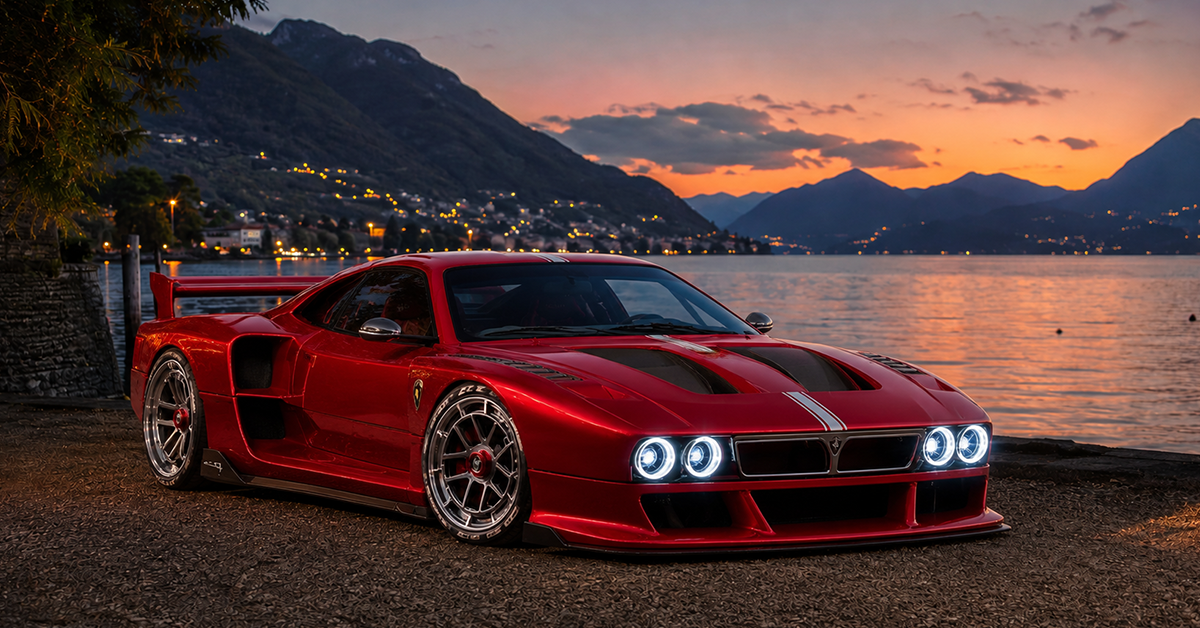
AI-generated concept illustration of the Kimera K39 — not an official Kimera image. | Rev N Rise
Christian von Koenigsegg does not hand out the engine from his own hypercars to just anyone. The fact that he gave one to Kimera says everything you need to know about the K39. Italy's newest hypercar was unveiled at Villa d'Este on the shores of Lake Como — a ground-up carbon-fibre machine with a 972hp Koenigsegg twin-turbo V8, a 7-speed manual gearbox, rear-wheel drive, pop-up headlights and a design that makes it look like the Ferrari F40 never went away. It costs €2.3 million. Twenty people have already bought one.
Kimera Automobili was founded in Turin, Italy by Luca Betti — a man whose obsession with Lancia's rally heritage produced two of the most celebrated restomod hypercars of the past decade. The EVO37 and EVO38 were modern reinterpretations of the legendary Lancia 037 Group B rally car — analogue, manual, rear-wheel drive machines built in tiny numbers for collectors who wanted the spirit of 1980s motorsport in a road-legal package. The EVO37 won Top Gear's Performance Car of the Year. The waiting list was immediate.
The K39 is not a restomod. It shares no platform, no chassis and no bodywork with any previous car. It is a clean-sheet, fully original hypercar — a carbon-fibre monocoque designed from scratch, developed in partnership with Koenigsegg for the engine and Dallara for the chassis engineering. Kimera has stepped from boutique restomod specialist into the most exclusive tier of the global hypercar market. The K39 is the car that announces that transition to the world.
The K39's powertrain is its most extraordinary element — and the one that makes this car genuinely significant beyond the supercar niche. The engine is a 5.0-litre twin-turbocharged V8 developed by Koenigsegg specifically for the K39. In its most extreme form — as fitted to the Koenigsegg Jesko running on E85 ethanol — this engine produces close to 1,600 horsepower. For the K39, Kimera asked for something different: real-world drivability, throttle response and the ability to produce its power on standard 95-octane pump fuel.
Koenigsegg's engineers responded by fitting smaller turbochargers sourced from the Agera rather than the Jesko's larger units — prioritising response over peak boost. A revised intake system, bespoke engine management software and a new exhaust were developed specifically for the K39's requirements. The result: 972 horsepower at 7,350rpm and 885 lb-ft of torque at 5,500rpm, with the rev limiter set at 8,250rpm — high for a turbocharged V8, and an indication of just how freely this engine breathes in its Kimera-specific tune. All of it accessible on the fuel you can buy at any petrol station in Europe.
The gearbox is a 7-speed manual. There is no dual-clutch option. No paddle-shift alternative. You change gears yourself, with a physical lever, connected mechanically to a gearbox that sends every one of those 972 horsepower to the rear wheels. In 2026, when almost every hypercar uses a twin-clutch automatic because it is faster, Kimera chose a manual because it is better. That is a values statement as much as a technical decision.
The K39's design draws from two sources simultaneously. The silhouette and proportions reference the Group 5 Lancia Beta Montecarlo — the endurance racing version of the car that preceded the 037 — with its long rear deck, wide rear haunches and dramatically low roofline. The detailing references the Ferrari F40 in ways that feel deliberate rather than coincidental: a fixed rear wing, four vertical slats on the rear fenders, a flat rear fascia and — most strikingly — pop-up headlights, a feature that disappeared from road cars in the early 2000s when pedestrian safety regulations made them impractical.
The aerodynamics are not purely aesthetic. An S-duct integrated into the nose — a feature seen on Formula 1 cars and a handful of extreme road cars — channels air from beneath the front splitter through the bodywork and exits at the top of the hood, generating downforce on the front axle without the drag penalty of a conventional splitter. Combined with the fixed rear wing and aggressive diffuser, Kimera claims the K39 generates downforce comparable to modern racing machinery. For a car weighing approximately 1,100kg, that is a significant aerodynamic achievement.
The bodywork is constructed entirely from carbon fibre, stretched over a carbon-fibre monocoque that forms the structural core of the car. Every panel has been designed with functional purpose — the flared rear arches feed cooling air to the rear brakes and engine bay, the side sills direct airflow to the diffuser, and the front splitter is integrated with the S-duct rather than fighting against it. The result is a car that looks like it was designed in 1985 and built in 2026 — which is precisely the point.
Alongside the standard K39, Kimera revealed a dedicated Pikes Peak configuration — a stripped-out, high-downforce version that will compete at Pikes Peak International Hill Climb while remaining fully road-legal. This variant wears the Martini Racing livery — the iconic blue, red and white stripe that defined Lancia's factory motorsport programme throughout the 1970s and 1980s — on its more aggressive bodywork, which includes additional aerodynamic elements beyond the standard car's already considerable downforce package.
The Pikes Peak car will be offered to a small number of the first K39 buyers — those who want the most extreme specification available and the opportunity to drive their car up one of motorsport's most iconic and demanding courses. It is the kind of detail that illustrates exactly what kind of company Kimera is: a hypercar manufacturer that treats competition not as a marketing exercise but as the natural extension of what its cars are designed to do.
| Manufacturer | Kimera Automobili — Turin, Italy |
| Engine | 5.0L twin-turbo V8 — Koenigsegg developed |
| Output | 972 hp @ 7,350 rpm |
| Torque | 885 lb-ft @ 5,500 rpm |
| Rev Limit | 8,250 rpm |
| Fuel | Standard 95-octane pump fuel |
| Gearbox | 7-speed manual |
| Drive | Rear-wheel drive |
| Monocoque | Carbon-fibre — ground-up design |
| Bodywork | Full carbon-fibre |
| Target Weight | ~1,100 kg |
| Design Inspiration | Group 5 Lancia Beta Montecarlo + Ferrari F40 |
| Headlights | Pop-up — road legal |
| Aero | S-duct nose + fixed rear wing + full diffuser |
| Chassis Partner | Dallara |
| Pikes Peak Version | Martini Racing livery — road legal — for first buyers |
| Production | Limited — 20+ units already allocated |
| Starting Price | €2,300,000 / $2,700,000 / £2,000,000 |
| Revealed | Concorso d'Eleganza Villa d'Este — Lake Como, May 2026 |
| Upcoming Events | Spa, Le Mans, Goodwood FOS, Monterey Car Week, Las Vegas |
Christian von Koenigsegg is not known for sharing his engines. The Koenigsegg powertrain programme is one of the most closely guarded in the automotive world — the result of decades of in-house development that has produced some of the most powerful and technically sophisticated engines ever fitted to a road car. The decision to supply the K39 with a bespoke version of that engine is therefore genuinely significant — a statement of endorsement that carries more weight than any amount of marketing could provide.
Von Koenigsegg's own description of the collaboration removes any ambiguity about how seriously he takes it. In his words, the K39 is "exactly the kind of project that deserves something truly special: independent, emotional, technically ambitious and built with a clear sense of purpose." He added that Koenigsegg developed a dedicated version of the twin-turbo V8 specifically to match the character Kimera wanted — prioritising response and reliability over peak power figures. That is not the language of a contract supplier. That is the language of a genuine collaborator who believes in the project.
The K39 will not disappear into private collections immediately after its Villa d'Este debut. Kimera has confirmed an ambitious public appearance schedule for 2026 that will take the car to some of the most prestigious automotive events in the world: Spa, Le Mans, Goodwood Festival of Speed (including a full hillclimb run), Monterey Car Week and the Las Vegas concours. The Pikes Peak variant will compete at the hillclimb itself. For a car that only 20-odd people will ever own, the K39 will be remarkably visible over the coming months — which is entirely by design.
The K39 is priced at €2.3 million — approximately $2.7 million or £2 million. Twenty customers have already committed before the car's public reveal. Given Kimera's track record with the EVO37 and EVO38, both of which sold out entirely, the remaining allocation is unlikely to last long. Those who want one should contact Kimera Automobili directly through their official channels — and move quickly.
"The K-39 is exactly the kind of project that deserves something truly special: independent, emotional, technically ambitious and built with a clear sense of purpose."
— Christian von Koenigsegg, Founder & CEO, Koenigsegg Automotive ABThe Kimera K39 is one of the most exciting hypercar reveals of the decade. A ground-up carbon-fibre machine with a Koenigsegg V8, a 7-speed manual gearbox, pop-up headlights and the soul of a 1980s endurance racer — built by a small Italian company that has earned the right to make this car through years of uncompromising work on the EVO37 and EVO38. At €2.3 million it sits comfortably in the hypercar tier. At 972 horsepower on pump fuel with a manual gearbox and rear-wheel drive, it sits entirely in a class of its own. The 20 people who already own one made an excellent decision.